











Westpac Dividend: Payment Dates, History, Franking and Payout Policy
Westpac Banking Corporation (ASX: WBC) pays two fully franked dividends a year. For the year to 30 September 2026 (FY2026) it declared 154 cents a share: a 77 cent interim paid on 26 June 2026 and a 77 cent final that went ex-dividend on 5 November and is due to be paid on 21 December 2026. That was 75% of profit excluding what Westpac calls Notable Items, the top of its 65% to 75% target range, and still below the 188 cents it paid in FY2016 to FY2018. This guide covers the history, the dates, franking, the payout policy and the results behind it.
Key takeaways
- Westpac's FY2026 dividend was 154 cents a share, fully franked, up 1 cent on FY2025's 153 cents. The last three half-year dividends have all been 77 cents.
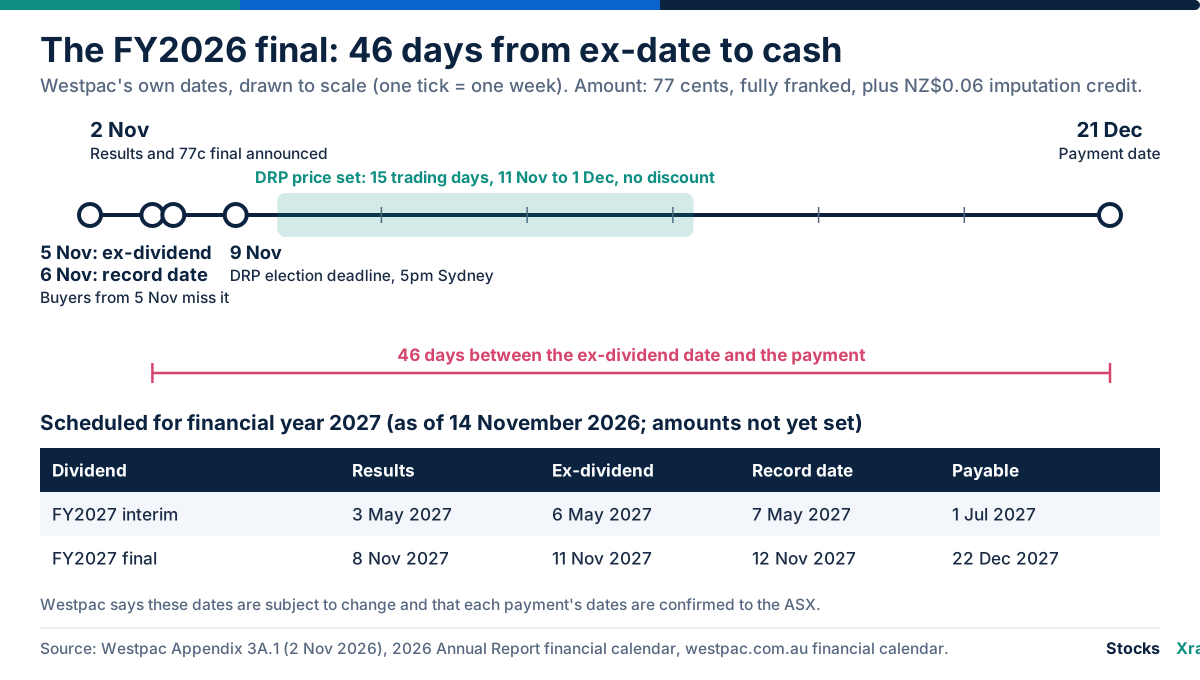
- The FY2026 final of 77 cents has a record date of 6 November 2026 and a payment date of 21 December 2026. Anyone who bought on or after the 5 November ex-dividend date does not receive it.
- As of 14 November 2026, Westpac's financial calendar schedules the FY2027 interim for announcement on 3 May 2027, ex-dividend on 6 May and payment on 1 July 2027. The amount is not set.
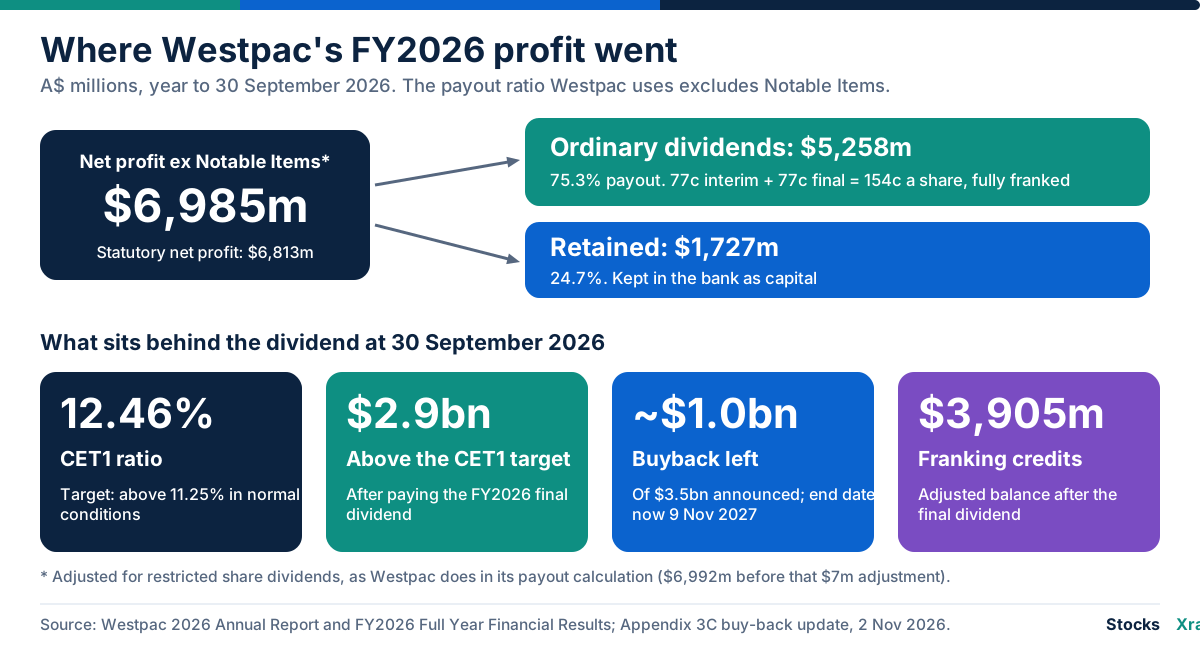
- The payout ratio was 75.3% of net profit excluding Notable Items (77.3% of statutory profit). Westpac's target range is 65% to 75%, so at the top of the range the policy leaves little room for the dividend to grow faster than profit.
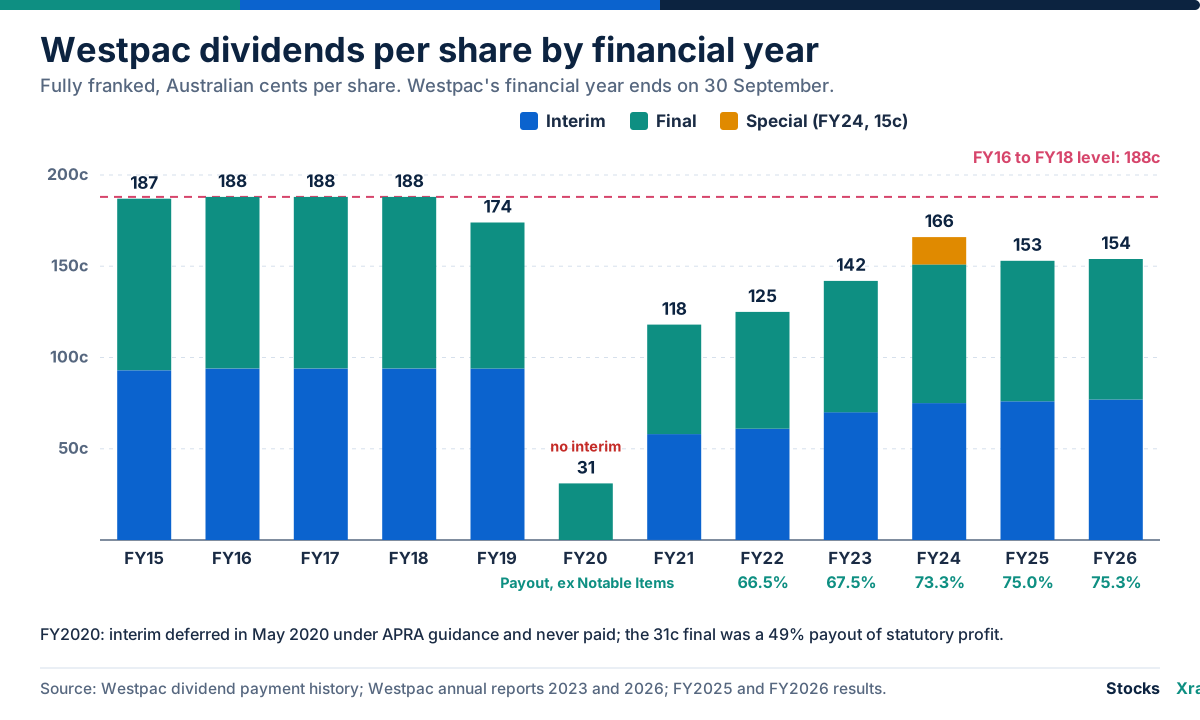
- Westpac cut its dividend in 2019, paid no interim at all in 2020 and has rebuilt it since. FY2026's 154 cents is 18% below the 188 cents paid in each of FY2016, FY2017 and FY2018.
How Westpac earns the money it pays out
Westpac was established in New South Wales in 1817 and calls itself Australia's first bank. It serves about 13 million customers in Australia and New Zealand through the Westpac, St.George, Bank of Melbourne and BankSA brands, among others.
Like other banks, it earns most of its income from the gap between the interest it charges on loans and the interest it pays on deposits and wholesale funding. In FY2026, net interest income was $19.7 billion of $22.7 billion in net operating income excluding Notable Items, about 87%. The net interest margin, that gap as a share of average interest-earning assets, narrowed from 1.94% to 1.87%. Westpac pointed to lending competition, the mix of its deposits and weaker Treasury revenue.
The bank reports five segments. Their net profit, excluding Notable Items, was:
| Segment | What it covers | FY2026 (A$m) | FY2025 (A$m) | Change |
|---|---|---|---|---|
| Consumer | Home loans, cards, personal loans and deposits for Australian households | 2,301 | 2,211 | +4% |
| Business & Wealth | Business banking, wealth management, private wealth, Westpac Pacific | 2,367 | 2,186 | +8% |
| Institutional | Corporates, institutions and governments | 1,630 | 1,575 | +3% |
| New Zealand (A$) | Westpac New Zealand | 915 | 1,090 | -16% |
| Group Businesses | Treasury, central costs and the RAMS loan book until its sale | (221) | (90) | n/a |
| Group | 6,992 | 6,972 | 0% |
The table holds a shift worth noticing. In FY2026 Business & Wealth overtook Consumer as the largest contributor, with 34% of group profit against 33%. Business lending rose 12% and institutional lending 18% over the year, while Australian housing loans, excluding the RAMS book Westpac sold in August 2026, grew 7%. New Zealand went the other way, with profit down 16% in Australian dollars.
Westpac's results, FY2022 to FY2026
Westpac reports a statutory profit and a profit "excluding Notable Items". Notable Items are things Westpac does not treat as part of ongoing performance, such as hedge accounting timing effects, remediation and litigation costs, and gains or losses on selling businesses. The board typically excludes them when it sets the dividend.
| Year to 30 September | Net operating income (A$m) | Statutory net profit (A$m) | Net profit ex Notable Items (A$m) | Basic EPS (cents) | Ordinary dividend (cents) | Payout, ex Notable Items | ROE, statutory |
|---|---|---|---|---|---|---|---|
| FY2022 | 19,606 | 5,694 | 6,568 | 159.9 | 125 | 66.5% | 8.1% |
| FY2023 | 21,645 | 7,195 | 7,368 | 205.3 | 142 | 67.5% | 10.1% |
| FY2024 | 21,588 | 6,990 | 7,113 | 200.9 | 151 | 73.3% | 9.8% |
| FY2025 | 22,384 | 6,916 | 6,972 | 201.9 | 153 | 75.0% | 9.7% |
| FY2026 | 22,602 | 6,813 | 6,992 | 199.3 | 154 | 75.3% | 9.6% |
Net operating income and statutory profit are as reported in each year's annual report or results. FY2024 also had a 15 cent special dividend, not included in the ordinary column or the payout ratio.
What moved the numbers:
- FY2022: Statutory profit was cut by $874 million of Notable Items, which is why the statutory payout was 76.8% while the ratio Westpac uses was 66.5%.
- FY2023: Profit excluding Notable Items rose 12% to $7.4 billion. Westpac credited a higher net interest margin and growth in home and business loans, partly offset by higher provisions for bad debts.
- FY2024 and FY2025: Profit excluding Notable Items eased to $7.1 billion and then $7.0 billion, and the second half of FY2025 carried a restructuring charge. The dividend kept rising, so the payout ratio climbed from 67.5% to 75.0%.
- FY2026: Pre-provision profit, earnings before bad-debt charges, rose 4% to $10.9 billion. Impairment charges roughly doubled, from $424 million to $864 million, as Westpac revised its economic outlook and added overlays, extra provisions based on management judgment, for energy-intensive industries and discretionary spending. Profit excluding Notable Items ended flat at $7.0 billion. Notable Items of $179 million after tax, mostly costs of the RAMS sale and related litigation and hedging effects, pulled statutory profit down 1% to $6.8 billion.
The two halves of FY2026 were close: $3,483 million excluding Notable Items in the first half and $3,509 million in the second. Return on equity, profit as a share of shareholders' funds, was 9.6% on a statutory basis. Our explainer on return on equity covers why banks are compared on it, and our guide to the financials sector explains bank earnings in more detail.
Westpac dividend history: from 188 cents to 31 and back to 154
Westpac's payment history, which goes back to 1983, shows every dividend since July 2000 as fully franked; the last unfranked one was paid in January 2000. All of those below were franked at the 30% company tax rate. The table shows the last 12 financial years with Westpac's payment dates.
| Financial year | Interim | Paid | Final | Paid | Total |
|---|---|---|---|---|---|
| FY2015 | 93c | 2 Jul 2015 | 94c | 21 Dec 2015 | 187c |
| FY2016 | 94c | 4 Jul 2016 | 94c | 21 Dec 2016 | 188c |
| FY2017 | 94c | 4 Jul 2017 | 94c | 22 Dec 2017 | 188c |
| FY2018 | 94c | 4 Jul 2018 | 94c | 20 Dec 2018 | 188c |
| FY2019 | 94c | 24 Jun 2019 | 80c | 20 Dec 2019 | 174c |
| FY2020 | none | n/a | 31c | 18 Dec 2020 | 31c |
| FY2021 | 58c | 25 Jun 2021 | 60c | 21 Dec 2021 | 118c |
| FY2022 | 61c | 24 Jun 2022 | 64c | 20 Dec 2022 | 125c |
| FY2023 | 70c | 27 Jun 2023 | 72c | 19 Dec 2023 | 142c |
| FY2024 | 75c + 15c special | 25 Jun 2024 | 76c | 19 Dec 2024 | 166c |
| FY2025 | 76c | 27 Jun 2025 | 77c | 19 Dec 2025 | 153c |
| FY2026 | 77c | 26 Jun 2026 | 77c | 21 Dec 2026 (due) | 154c |
Westpac's year ends on 30 September and the final is paid in December, so both dividends of a financial year are paid in the same calendar year. The dividends paid in calendar 2025 were therefore the FY2025 pair, 76 and 77 cents, or 153 cents. In calendar 2026 they are 77 and 77 cents, or 154 cents once the final is paid on 21 December.
The 2019 cut and the 2020 gap
For four years Westpac paid 94 cents every half. In November 2019 it cut the final to 80 cents, saying it needed to bring the payout ratio to a more sustainable range after a $2.5 billion capital raising and a lower return on equity. The FY2019 total of 174 cents was 88.1% of that year's cash earnings.
Then came the pandemic. On 4 May 2020 Westpac deferred its interim dividend decision, citing uncertain conditions and the bank regulator APRA's guidance on dividends, and no interim was paid that year. The FY2020 final of 31 cents was 49% of statutory profit, which Westpac described as the most it could pay under APRA's guidance at the time.
Since then, the dividend has grown from 118 cents in FY2021 to 154 cents in FY2026, a rise of 31%, or about 5.5% a year compounded. Most of that growth came early. From FY2024 to FY2026 the ordinary dividend went from 151 to 153 to 154 cents. Our guide to dividend growth investing explains why the starting year changes how a record like this looks.
The 2024 special dividend
In May 2024 Westpac added a 15 cent special dividend to its 75 cent interim, citing its strong capital position and its franking credit balance, and increased its on-market share buyback by $1 billion. The special has not been repeated, so it is best read as a one-off when adding up the history: FY2024's ordinary dividend was 151 cents, not 166.
Worked example: 1,000 shares through the reset
Using Westpac's own per-share figures, a holder of 1,000 shares throughout would have received:
- FY2018: $1,880 in cash (188 cents a share).
- FY2019: $1,740.
- FY2020: $310, a fall of 82% on FY2019.
- FY2021: $1,180.
- FY2026: $1,540, still $340 a year below FY2018.
Each FY2026 dividend was franked at 30%, so the franking credit is the cash amount times 30/70: 66 cents a share, or $660 on 1,000 shares. An Australian resident adds the credit to taxable income, making $2,200 of grossed-up income, and then deducts the same $660 from the tax bill. If their marginal tax rate is 30%, the credit exactly covers the tax on the dividend. Below that, eligible resident individuals can get the excess refunded; above it, there is tax left to pay.
The FY2026 final also carries a New Zealand imputation credit of NZ$0.06 a share, which Westpac says may be used by New Zealand tax residents. For other foreign holders, the Australian Taxation Office says no withholding tax has to be deducted from fully franked dividends paid to non-residents, though their own country may tax them.
Westpac dividend dates for 2025, 2026 and 2027
Westpac announces its interim dividend with half-year results in early May and its final with full-year results in early November. The ex-dividend date follows three days later. A buyer on or after the ex-dividend date does not get the coming dividend; the record date, one business day later, is when Westpac checks its share register. Our explainer on ex-dividend and record dates covers how these dates fit together.
| Dividend | Announced | Ex-dividend | Record date | Payment |
|---|---|---|---|---|
| FY2025 interim (76c) | 5 May 2025 | 8 May 2025 | 9 May 2025 | 27 Jun 2025 |
| FY2025 final (77c) | 3 Nov 2025 | 6 Nov 2025 | 7 Nov 2025 | 19 Dec 2025 |
| FY2026 interim (77c) | 5 May 2026 | 8 May 2026 | 11 May 2026 | 26 Jun 2026 |
| FY2026 final (77c) | 2 Nov 2026 | 5 Nov 2026 | 6 Nov 2026 | 21 Dec 2026 |
| FY2027 interim (not yet set) | 3 May 2027 | 6 May 2027 | 7 May 2027 | 1 Jul 2027 |
| FY2027 final (not yet set) | 8 Nov 2027 | 11 Nov 2027 | 12 Nov 2027 | 22 Dec 2027 |
The 2027 dates are from Westpac's financial calendar as published in its 2026 Annual Report and on its website on 14 November 2026. Westpac says dates are subject to change and that each payment's dates are confirmed to the ASX. Our dividend calendar lists upcoming ex-dates as they approach.
Westpac's timetable has one feature that surprises new holders: a long wait for the cash. The FY2026 final went ex-dividend on 5 November but is paid on 21 December, 46 days later. The interim gap is similar: seven weeks in 2026, from 8 May to 26 June, and eight weeks on the 2027 schedule.
The dividend reinvestment plan
Westpac's dividend reinvestment plan (DRP) lets shareholders with a registered address in Australia or New Zealand take additional Westpac shares instead of cash, with no transaction costs. For the FY2026 final, elections had to reach the registry by 5pm Sydney time on 9 November 2026. The DRP price is the average daily volume-weighted price over the 15 trading days from 11 November to 1 December 2026, with no discount, and the shares go to participants on 21 December.
Westpac is buying those shares on market through a third party rather than issuing new ones, which it calls neutralising the DRP. That keeps the share count from growing. Recent DRP prices on Westpac's history page were $36.08 for the FY2026 interim and $38.09 for the FY2025 final; the FY2026 final's price had not been set on 14 November 2026.
The payout policy and the capital behind it
Westpac's results presentation lists a target dividend payout range of 65% to 75% of profit excluding Notable Items, and a post-dividend Common Equity Tier 1 (CET1) capital ratio above 11.25% in normal conditions. CET1 is a bank's core capital, mostly shareholders' equity, as a share of risk-weighted assets.
The FY2026 payout was 75.3% for the year and 75.0% for the second half, at the top of the range. That has a plain arithmetic consequence. FY2026 earnings per share excluding Notable Items were 204.5 cents. At that level of profit, the 65% to 75% range spans roughly 133 to 153 cents a share, and the 154 cents paid sits on the upper edge. Inside the policy as stated, a bigger dividend needs bigger profit, because the payout ratio is already at the top of the range. Our guide to the dividend payout ratio explains how to read a ratio near the top of a range.
Capital is where the other levers sit. At 30 September 2026:
- CET1 was 12.46%, against the 11.25% target and APRA's current total requirement of 10.25%, which rises to 10.50% on 1 January 2027 as APRA phases out Additional Tier 1 capital. Westpac said it had $2.9 billion of capital above its target after paying the FY2026 final.
- About $1.0 billion of the buyback remains. Westpac has completed $2.5 billion of a $3.5 billion on-market buyback announced in stages from November 2023, buying 88.8 million shares at an average $28.01. It bought only 50,000 shares in FY2026, and on 2 November 2026 it extended the buyback's end date to 9 November 2027.
- The franking balance was $3,905 million, after allowing for the final dividend. That is the stock of credits Westpac can attach to future dividends.
The chairman's report in the 2026 Annual Report says that, given uncertainty in the operating environment, the board considers it important to retain surplus capital, and that in weighing future capital returns it remains mindful of the large franking balance and the remaining buyback. That is the board's stated position as of November 2026, not a commitment to any particular payment. Our guide to share buybacks explains how buybacks and dividends differ as ways to return capital.
Westpac dividend yield, with dates
Dividend yield is the dividends of the last 12 months divided by the share price. Westpac closed at A$37.83 on 13 November 2026. The two dividends that went ex in the 12 months to then, 77 cents each, give $1.54 and a cash yield of 4.1%. Adding the franking credits, the grossed-up yield was 5.8%.
Westpac's own results presentation quotes a different figure, 4.4% cash and 6.3% grossed up, because it annualises the final dividend against the 30 September 2026 close of $35.07. Both are correct for their date and method. The yield changes every day with the share price, and it looks backward: Westpac has not set its FY2027 dividends. Our explainer on dividend yield covers how to compare yields fairly, and our best dividend stocks list ranks income stocks across markets. The Westpac stock page shows the latest price and yield, the interactive chart shows the price history, and the ASX 200 page shows how the wider market has moved.
How StocksXray scores Westpac
On 13 November 2026 Westpac had a Market X-Ray score of 80 out of 100, with high confidence, ranking 129th of 1,820 stocks on the ASX on our stock page. The Market X-Ray is price-based: it compares how the shares have traded with other ASX stocks. Its five lenses read trend 74, momentum 72, stability 93, liquidity 100 and income 50.
The income lens uses the cash dividend yield and the number of recent years with dividends, without franking credits, ranked against the rest of the ASX, so 50 puts Westpac near the middle. The score says nothing about Westpac's capital, credit quality or the safety of its dividend; our fundamental X-Ray, built from financial statements, is not yet available for Australian stocks. The Westpac research report gathers the data on one page, and how the X-Ray Score works explains the method.
Risks Westpac itself lists
Westpac's 2026 Risk Factors, published with its results on 2 November 2026, set out what could hurt its performance and, in its words, the level of dividends. The points that bear most directly on the dividend:
- Economic conditions in Australia and New Zealand. Most of Westpac's business is in these two countries. Westpac says rates staying higher for longer could cut spending and raise credit losses, while falling rates could squeeze margins.
- Property and credit. Westpac names the changes to negative gearing and the capital gains tax discount for residential investment property announced in the 2026-27 Federal Budget, and APRA's limits on high debt-to-income home lending from 1 February 2026, as factors that could affect housing demand and the value of its collateral.
- Geopolitical conflict. Conflicts, tariffs and sanctions could raise energy costs and hurt customers' ability to repay. Westpac added new provision overlays for energy-intensive sectors in FY2026.
- Capital. If CET1 falls into the regulatory buffer range, restrictions on distributions apply, which could limit dividends. APRA's capital rules are also changing from 1 January 2027.
- Financial crime, cyber and legal risk. Westpac says failures under anti-money laundering and sanctions laws have hurt it before, and it booked $41 million before tax in the second half of FY2026 for RAMS-related litigation and legal costs.
Common mistakes when reading Westpac's dividend
- Counting the 2024 special as regular. The 15 cent special was a one-off; ordinary FY2024 dividends were 151 cents.
- Buying in December to get the December payment. The final goes ex-dividend in early November, about seven weeks before it is paid.
- Mixing payout bases. FY2026 was 77.3% of statutory profit but 75.3% of profit excluding Notable Items, the measure Westpac's range uses.
- Comparing yields from different dates. Westpac's 4.4% and our 4.1% both hold for their date and method.
- Expecting a DRP discount. Recent DRPs had no discount, and the shares were bought on market.
- Assuming franking credits are automatic. The ATO's holding-period rule generally requires shares to be held at risk for at least 45 days, not counting the days of purchase and sale, unless the small shareholder exemption applies.
Frequently asked questions
When is the next Westpac dividend paid? The next payment is the FY2026 final of 77 cents a share, fully franked, due on 21 December 2026 to shareholders on the register on 6 November 2026. The shares went ex-dividend on 5 November 2026, so buyers since then do not receive it. As of 14 November 2026, the next scheduled ex-dividend date is 6 May 2027, for the FY2027 interim.
What are the Westpac dividend dates for 2026? The FY2026 interim of 77 cents went ex-dividend on 8 May 2026, had a record date of 11 May and was paid on 26 June 2026. The FY2026 final of 77 cents went ex-dividend on 5 November 2026, has a record date of 6 November and is payable on 21 December 2026.
How much was the Westpac dividend in 2025? Westpac paid 153 cents a share in calendar 2025: a 76 cent interim on 27 June 2025 (ex-dividend 8 May) and a 77 cent final on 19 December 2025 (ex-dividend 6 November). Both were fully franked and together made up the FY2025 dividend.
What is the Westpac dividend yield? Based on the $1.54 of dividends that went ex in the 12 months to 13 November 2026 and that day's close of A$37.83, the cash yield was 4.1%, or 5.8% including franking credits. The yield moves with the share price and with each new dividend.
Are Westpac dividends fully franked? Yes. Westpac's payment history shows every dividend since July 2000 as fully franked, recently at the 30% company tax rate, and Westpac's adjusted franking credit balance was $3,905 million at 30 September 2026. Each 77 cent dividend carries a franking credit of 33 cents, and the FY2026 final also carries a NZ$0.06 New Zealand imputation credit.
Why did Westpac cut its dividend in 2020? In May 2020 Westpac deferred its interim dividend decision, citing uncertain conditions and APRA's guidance to banks on dividends, and no interim was paid. The FY2020 final of 31 cents was 49% of statutory profit, which Westpac said was the maximum it could pay under APRA's guidance. Westpac had already cut its final from 94 to 80 cents in November 2019.
When will Westpac's financial year 2027 dividends be paid? As of 14 November 2026, Westpac's calendar schedules the FY2027 interim to be announced on 3 May 2027, go ex-dividend on 6 May and be paid on 1 July 2027. The FY2027 final is scheduled for announcement on 8 November 2027, ex-dividend on 11 November and payment on 22 December 2027. The amounts are set by the board at each result.
Sources and data notes
- Westpac, FY26 ASX announcement, 2026 Full Year Financial Results and 2026 Presentation and Investor Discussion Pack, 2 November 2026.
- Westpac, 2026 Annual Report and 2026 Risk Factors.
- Westpac, Appendix 3A.1 dividend notice and Appendix 3C buyback update, ASX, 2 November 2026.
- Westpac, dividend payment history, dividend information and financial calendar, read on 14 November 2026.
- Westpac 2023 Annual Report, FY2025 and 1H26 results, FY2019 and FY2020 media releases, and its 4 May 2020 results news item.
- ATO guidance on franking credits and withholding from dividends paid to foreign residents.
- Share price and Market X-Ray scores: StocksXray, close of 13 November 2026.
This guide covers Westpac's dividends and results to 14 November 2026. It does not include dividend forecasts or personal tax advice; tax outcomes depend on your residence and circumstances.
Educational information, not financial advice.
Related reading
Educational only, not financial advice. Examples use illustrative numbers.