











NVIDIA Earnings: Quarterly Results, Report Dates and Dividend History
NVIDIA's earnings are the quarterly results it publishes three to four weeks after each fiscal quarter ends. The latest report, released on 26 August 2026, covered the quarter to 26 July 2026: revenue of $96.2 billion, up 106% from a year earlier, and earnings of $2.46 per diluted share under GAAP, the US accounting rules. As of 14 November 2026 the next report is scheduled for 17 November 2026. This guide sets out the record from NVIDIA's own filings, how results compared with its outlook, the dividend, cash flow and the risks the company lists.
Key takeaways
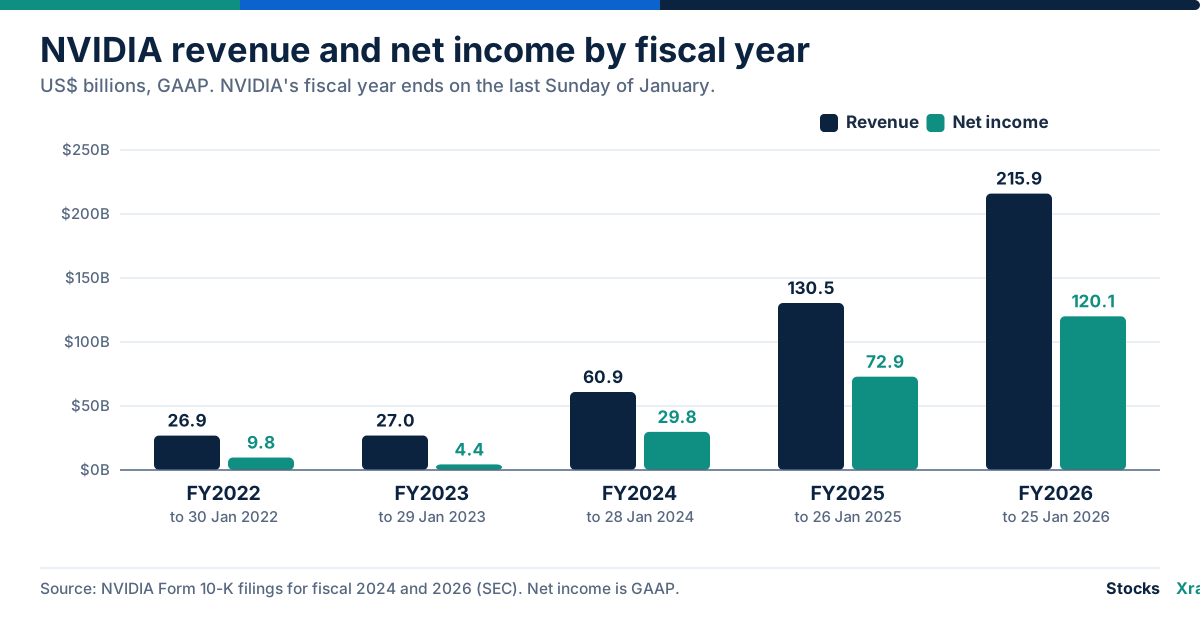
- In fiscal 2026, the year to 25 January 2026, NVIDIA reported revenue of $215.9 billion, up 65%, and GAAP net income of $120.1 billion. Data Center sales were $193.7 billion, about 90% of the total.
- In each of the six quarters to July 2026, revenue landed above the top of the range NVIDIA had given one quarter earlier, between 2.5% and 5.7% above the midpoint.
- NVIDIA raised its quarterly dividend from $0.01 to $0.25 a share in May 2026. Buybacks are still the larger cash return: $19.7 billion in the July 2026 quarter against $6.0 billion of dividends.
- Jensen Huang resigned as chief executive on 11 November 2026. Chief financial officer Colette Kress is interim CEO, and NVIDIA said the 17 November results date is unchanged.
- GAAP profit has recently included large gains on NVIDIA's stakes in other companies, $15.9 billion in the April 2026 quarter, so it pays to read operating income alongside net income.
When NVIDIA reports earnings
NVIDIA's fiscal year ends on the last Sunday in January, so the year is labeled one ahead of the calendar year in which most of its months fall. Fiscal 2027 runs from 26 January 2026 to 31 January 2027. It is a 53-week year, and the extra week sits in the fourth quarter, which will be 14 weeks long.
The third quarter of fiscal 2027 ended on 25 October 2026. On 28 October NVIDIA said it will publish the results on Tuesday, 17 November 2026, at about 1:20 p.m. Pacific time, after the US market close. A conference call follows at 2 p.m. Pacific (5 p.m. Eastern), webcast in listen-only mode on investor.nvidia.com, and questions are limited to financial analysts and institutional investors. The company's 12 November statement on the change of chief executive repeated the date.
| Fiscal quarter | Quarter ended | Results released |
|---|---|---|
| Q4 FY2025 | 26 Jan 2025 | Wed 26 Feb 2025 |
| Q1 FY2026 | 27 Apr 2025 | Wed 28 May 2025 |
| Q2 FY2026 | 27 Jul 2025 | Wed 27 Aug 2025 |
| Q3 FY2026 | 26 Oct 2025 | Wed 19 Nov 2025 |
| Q4 FY2026 | 25 Jan 2026 | Wed 25 Feb 2026 |
| Q1 FY2027 | 26 Apr 2026 | Wed 20 May 2026 |
| Q2 FY2027 | 26 Jul 2026 | Wed 26 Aug 2026 |
| Q3 FY2027 | 25 Oct 2026 | Tue 17 Nov 2026 (scheduled) |
The pattern is consistent: late February, late May, late August and mid-to-late November, after the closing bell. Each release comes with a written commentary from the CFO, both filed with the SEC on Form 8-K, and for every report from February 2025 to August 2026 NVIDIA filed its 10-Q or 10-K on the same day. Because the numbers arrive after 4 p.m. Eastern, the first price reaction happens in extended-hours trading, which has its own risks covered in our guide to pre-market and after-hours trading. Our guide to 10-Q and 8-K filings explains what each document contains.
What NVIDIA sells and how it makes money
NVIDIA designs graphics processors, central processors, networking equipment, complete rack-scale systems and the software that runs on them. Most of the money now comes from data centers that train and run AI models. NVIDIA does not own chip factories: its annual report says it depends on third parties to manufacture, assemble, test and package its products, with a supply chain concentrated in Asia.
For accounting it reports two segments, Compute & Networking and Graphics. The more useful view is its split by market platform. Fiscal 2026 was reported under five platforms:
| Platform | Fiscal 2026 revenue | Share | Change from fiscal 2025 |
|---|---|---|---|
| Data Center | $193.7 billion | 89.7% | +68% |
| Gaming | $16.0 billion | 7.4% | +41% |
| Professional Visualization | $3.2 billion | 1.5% | +70% |
| Automotive | $2.3 billion | 1.1% | +39% |
| OEM and other | $0.6 billion | 0.3% | +59% |
| Total | $215.9 billion | 100% | +65% |
From the first quarter of fiscal 2027 NVIDIA moved to two platforms. Data Center is split into Hyperscale, meaning the public clouds and the largest consumer internet companies, and ACIE, short for AI Clouds, Industrial and Enterprise. Edge Computing gathers PCs, game consoles, workstations, AI-RAN base stations, robotics and cars, so the old Gaming line no longer appears on its own.
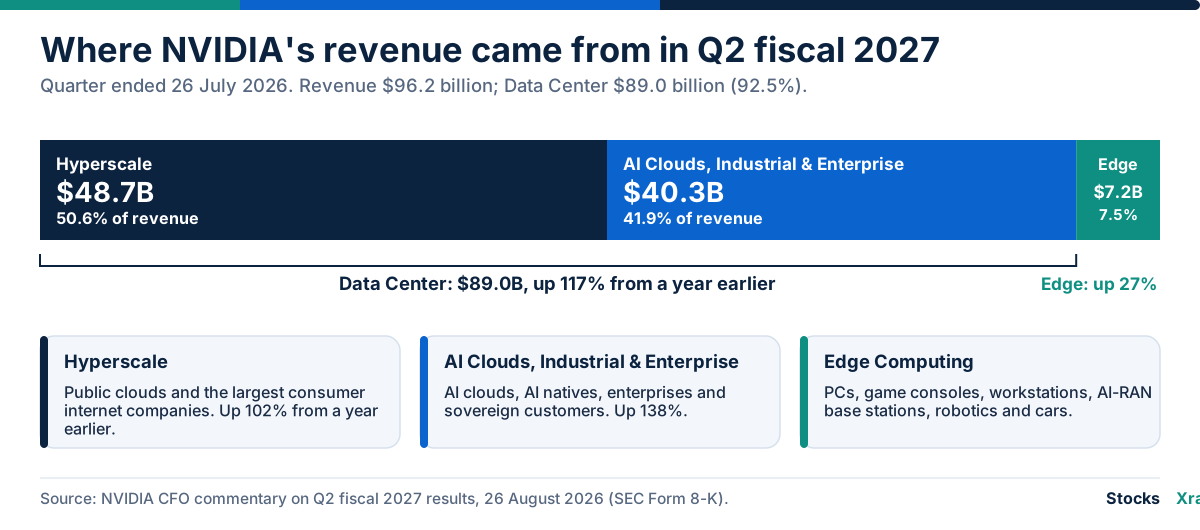
Sales are concentrated. In the July 2026 quarter one direct customer accounted for 16% of revenue, and over the first half of fiscal 2027 three direct customers accounted for 16%, 15% and 13%. Direct customers include system builders and distributors, so NVIDIA also estimates indirect demand: it said one AI research and deployment company contributed a meaningful amount of revenue by buying cloud services from NVIDIA's customers. Customers headquartered outside the United States made up 38% of revenue in that quarter.
China has largely dropped out of the Data Center numbers. Shipments of Hopper products to China were under 1% of Data Center revenue in the July 2026 quarter, and NVIDIA's outlook assumes no Data Center compute revenue from China. For how the chip business fits into its sector, see our information technology sector guide.
NVIDIA's results record
Five fiscal years
| Fiscal year | Year ended | Revenue | Gross margin | Operating income | Net income | Diluted EPS |
|---|---|---|---|---|---|---|
| FY2022 | 30 Jan 2022 | $26.9B | 64.9% | $10.0B | $9.8B | $0.39 |
| FY2023 | 29 Jan 2023 | $27.0B | 56.9% | $4.2B | $4.4B | $0.17 |
| FY2024 | 28 Jan 2024 | $60.9B | 72.7% | $33.0B | $29.8B | $1.19 |
| FY2025 | 26 Jan 2025 | $130.5B | 75.0% | $81.5B | $72.9B | $2.94 |
| FY2026 | 25 Jan 2026 | $215.9B | 71.1% | $130.4B | $120.1B | $4.90 |
All figures are GAAP. Earnings per share are adjusted for the ten-for-one stock split of June 2024; NVIDIA reported fiscal 2022 EPS of $3.85 before that split, which we divided by ten. Our NVIDIA stock split page lists the company's splits.
Fiscal 2023 was the low point, with flat revenue and net income down 55%. Revenue then more than doubled in fiscal 2024 and again in fiscal 2025 as demand for AI data-center systems took off, and rose another 65% in fiscal 2026. From fiscal 2022 to fiscal 2026 revenue grew about eightfold.
The dip in fiscal 2026 gross margin, to 71.1% from 75.0%, traces mostly to one quarter. On 9 April 2025 the US government told NVIDIA that exports of its H20 chips to China needed a license, and NVIDIA took a $4.5 billion charge for H20 inventory and purchase obligations. Gross margin in that quarter fell to 60.5%, then recovered to 75.0% by the fourth quarter.
The last six quarters
| Quarter | Ended | Revenue | Data Center | Gross margin | Net income | Diluted EPS |
|---|---|---|---|---|---|---|
| Q1 FY2026 | 27 Apr 2025 | $44.1B | $39.1B | 60.5% | $18.8B | $0.76 |
| Q2 FY2026 | 27 Jul 2025 | $46.7B | $41.1B | 72.4% | $26.4B | $1.08 |
| Q3 FY2026 | 26 Oct 2025 | $57.0B | $51.2B | 73.4% | $31.9B | $1.30 |
| Q4 FY2026 | 25 Jan 2026 | $68.1B | $62.3B | 75.0% | $43.0B | $1.76 |
| Q1 FY2027 | 26 Apr 2026 | $81.6B | $75.2B | 74.9% | $58.3B | $2.39 |
| Q2 FY2027 | 26 Jul 2026 | $96.2B | $89.0B | 75.0% | $59.7B | $2.46 |
Over the four quarters to July 2026 revenue added up to $303.0 billion. In the July 2026 quarter, sales rose 18% from the previous quarter, operating expenses rose 55% from a year earlier to $8.4 billion on higher spending on computing infrastructure and pay, and operating income reached $63.7 billion. Inventory rose to $31.6 billion, which the CFO commentary tied to preparing for the introduction of NVIDIA's next platform, Vera Rubin, in the following quarter.
What moved the numbers
Three things drove the record. First, product cycles: NVIDIA credited the July 2026 quarter's Data Center growth mainly to its Blackwell Ultra systems. Networking grew fastest; under its old reporting lines, Data Center networking revenue was $14.8 billion in the April 2026 quarter, up 199% from a year earlier. Second, export rules: the H20 charge above, and China's absence from the outlook. Third, NVIDIA's growing portfolio of investments in other companies, which now moves GAAP profit.
Worked example: reading the April 2026 quarter. Operating income, the profit from selling products after running costs, was $53.5 billion. "Other income" added $16.4 billion, of which $15.9 billion was gains on equity securities, so pre-tax income was $69.9 billion. After $11.6 billion of tax, net income was $58.3 billion, or $2.39 a share. NVIDIA's non-GAAP figures, its own adjusted measures, leave out those gains and came to $45.5 billion, or $1.87 a share. In the July quarter, operating income rose 19% but net income only 2%, because the investment gains shrank to $7.8 billion. The lesson: with NVIDIA, compare operating income from quarter to quarter before drawing conclusions from net income. Our guide to basic and diluted EPS explains the per-share arithmetic.
One more definition changed. From the first quarter of fiscal 2027 NVIDIA's non-GAAP measures no longer exclude stock-based compensation, and it restated earlier periods on the same basis. Older non-GAAP figures quoted in news reports may therefore not match the restated ones.
How results compared with NVIDIA's own outlook
Each quarter NVIDIA gives an outlook for the next one: a revenue midpoint with a range of plus or minus 2%, plus gross margin, operating expenses and the tax rate. In every one of the last six quarters, reported revenue came in above the top of that range.
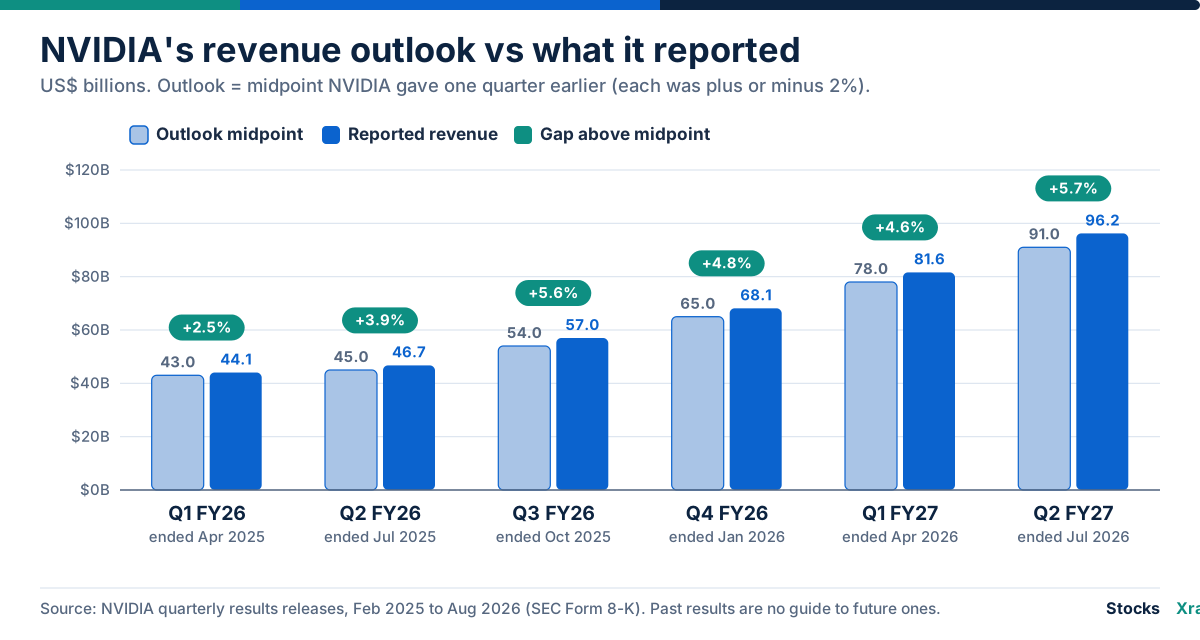
For the quarter that ended on 25 October 2026, NVIDIA said on 26 August to expect revenue of $108.0 billion plus or minus 2%, which is $105.8 billion to $110.2 billion. It also guided to GAAP and non-GAAP gross margins of 74.0%, plus or minus half a percentage point, and GAAP operating expenses of about $9.2 billion. This is the company's own outlook, not ours, and a run of quarters above guidance is not evidence the next one will be. Our guide to earnings season and guidance explains why markets often react to the gap between results and expectations rather than to the results themselves.
NVIDIA news as of 14 November 2026
Change of chief executive. On 8 November the board said it was starting an independent investigation, overseen by independent directors with outside counsel, after reports that Jensen Huang had been the target of a foreign intelligence effort. It said it had no reason to believe national security or company secrets had been compromised. On 11 November the board accepted Huang's resignation as president, chief executive and director, effective immediately. Colette Kress, CFO since 2013, became interim CEO while keeping the finance role, and the board began a search that will consider internal and external candidates. Harvey C. Jones, a director since 1993, became the board's first chair. The company said it expected operations, customer commitments and the product roadmap to continue without interruption.
The shares closed at $173.73 on 11 November. On 12 November, the day the change was announced, they traded as low as $148.80 before closing at $166.19, and they closed at $162.85 on 13 November, against an intraday high of $243.37 on 6 October 2026. The NVIDIA chart shows the full history.
Other recent filings. In June 2026 NVIDIA sold $25.0 billion of senior unsecured notes. In August it agreed to provide credit support, capped at $105 billion, for a data-center campus in Pike County, Ohio, developed with SB Energy: OpenAI is the tenant and will run NVIDIA systems there, and NVIDIA pays only if OpenAI fails to meet its lease payments. On 2 September it agreed to buy Hugging Face, the open-source AI model platform, for about $11.9 billion, with closing expected in the first half of 2027 subject to regulatory approval.
NVIDIA's dividend: history, dates and payout
NVIDIA does pay dividends. It pays a cash dividend every quarter and has announced each recent payment in its results release. The rate was tiny until 2026. The table converts every rate into today's shares.
| Period | Quarterly dividend as declared | Per share today |
|---|---|---|
| Payments in fiscal 2023 to March 2024 | $0.04 | $0.004 |
| Payments from June 2024 to April 2026 | $0.01 (announced as $0.10 before the split) | $0.01 |
| Payments from June 2026 | $0.25 | $0.25 |
| Record date | Paid | Amount | Announced with |
|---|---|---|---|
| 4 Dec 2025 | 26 Dec 2025 | $0.01 | Q3 FY2026 results |
| 11 Mar 2026 | 1 Apr 2026 | $0.01 | Q4 FY2026 results |
| 4 Jun 2026 | 26 Jun 2026 | $0.25 | Q1 FY2027 results |
| 10 Sep 2026 | 1 Oct 2026 | $0.25 | Q2 FY2027 results |
Under US one-day settlement, the ex-dividend date is normally the same as the record date, and recent NVIDIA dividends have followed that rule. Our guide to ex-dividend and record dates explains why the date matters.
| Fiscal year | Dividends declared per share | Cash paid |
|---|---|---|
| FY2023 | $0.016 | $398 million |
| FY2024 | $0.016 | $395 million |
| FY2025 | $0.034 | $834 million |
| FY2026 | $0.04 | $974 million |
| FY2027, first half | $0.26 | $6.29 billion |
The payout ratio, the share of profit paid out as dividends, was 0.8% in fiscal 2026 ($974 million of $120.1 billion). In the July 2026 quarter, after the increase, NVIDIA paid $6.0 billion against net income of $59.7 billion, about 10%. Our guide to the dividend payout ratio explains how to judge such numbers.
On yield: NVIDIA paid $0.52 a share over the last four payments, 0.32% of the $162.85 closing price on 13 November 2026. Four payments at the current $0.25 rate would total $1.00, or 0.61% of that price. See dividend yield explained for why a trailing yield understates a recent increase, and the dividend calendar for upcoming payment dates across US stocks.
NVIDIA's filings say future dividends depend on the board's continuing judgment that they are in shareholders' interests. Buybacks matter more: NVIDIA bought back $40.1 billion of its shares in fiscal 2026 and $19.7 billion in the July 2026 quarter alone, and it had $99.0 billion of authorization left at the end of that quarter after the board added $80.0 billion in May. Our guide to share buybacks explains when buybacks help owners. Investors who mainly want income can compare NVIDIA with our best dividend stocks list.
Balance sheet and cash flow
At 26 July 2026 NVIDIA held $56.6 billion of cash, cash equivalents and marketable debt securities. It also held $42.8 billion of listed shares in other companies and $51.2 billion of investments that do not trade on an exchange, the holdings behind the gains described above. Debt was $33.4 billion after the June notes issue, compared with $8.5 billion at the end of fiscal 2026.
Free cash flow, the cash from operations left after spending on property and equipment, was $96.6 billion in fiscal 2026, from operating cash flow of $102.7 billion. In the first half of fiscal 2027 it was $69.9 billion, but the second quarter alone fell to $21.3 billion from $48.6 billion in the first. NVIDIA explained the drop: receivables rose to $63.1 billion, or 60 days of sales from 45, because it gave longer payment terms on large multi-quarter contracts with certain investment-grade customers, and cash taxes were higher. Our guides to free cash flow and working capital cover these measures.
Commitments are now large. NVIDIA's supply and capacity commitments reached $279 billion at 26 July 2026, up from $119 billion a quarter earlier, mostly for memory, and its total future commitments were $366 billion. Its maximum exposure under guarantees of partners' data-center obligations was $108.5 billion, including the $105 billion Ohio cap. These arrangements support sales, but they also tie NVIDIA's finances to its customers' ability to pay.
How StocksXray scores NVIDIA
On 13 November 2026 NVIDIA's StocksXray X-Ray score was 70.7 out of 100, shown rounded on the stock page. The five lenses read: valuation 70.5, growth 91.9, profitability 59.7, financial health 65.3 and dividends 67.4. On our scale 70 to 100 is strong, 50 to 69 fair and under 50 weak, each judged against Information Technology peers. Our guides to how the X-Ray score works and the five lenses explain the method.
For a simple valuation check, GAAP diluted EPS over the four quarters to July 2026 was $7.91, so the $162.85 close on 13 November 2026 equaled about 20.6 times trailing earnings. Remember that this EPS includes the investment gains discussed above. Our guide to the price-to-earnings ratio explains its limits.
The NVIDIA stock page has the current price, scores and fair-value models, the NVIDIA research report gathers key indicators, valuation models and the X-Ray breakdown, and the NVIDIA forecast page shows probability ranges built from past price moves.
Risks NVIDIA lists
The risk factors in NVIDIA's fiscal 2026 annual report run to many pages. These are the ones most tied to its earnings:
- Export rules and politics. Restrictions on exports, especially to China, have already cost revenue and forced the $4.5 billion H20 charge, and further rules could hit sales or supply chains.
- Customer concentration. A few direct customers and partners provide much of the revenue, and losing or being barred from selling to any of them would hurt.
- Supply and demand mismatches. Long manufacturing lead times mean NVIDIA commits to supply before demand is known; the company says a failure to estimate demand has caused mismatches before.
- Dependence on third-party manufacturers. Outside foundries and suppliers control quantities, yields and delivery schedules.
- Counterparty risk. NVIDIA lists its commercial arrangements, which now include guarantees and large investments, as a source of counterparty risk.
- People. The annual report warns it may be unable to attract, retain and motivate executives and key employees; the CEO search makes this a current issue, not a theoretical one.
Common mistakes when reading NVIDIA's earnings
- Mixing up fiscal and calendar years. The quarter reported on 17 November 2026 is Q3 of fiscal 2027 and covers late July to late October 2026.
- Comparing per-share figures across the 2024 split. EPS and dividends from before June 2024 must be divided by ten.
- Treating GAAP net income as a measure of the core business. Investment gains added $15.9 billion before tax in one quarter and $7.8 billion in the next.
- Mixing old and new non-GAAP numbers. Since fiscal 2027 non-GAAP figures include stock-based compensation.
- Reading the outlook as a promise. It is management's estimate, and the record of beating it says nothing certain about the next quarter.
Frequently asked questions
When does NVIDIA report earnings? NVIDIA reports about three to four weeks after each fiscal quarter ends, which recently meant late February, late May, late August and mid-to-late November. Results come out after the US market close, at about 1:20 p.m. Pacific time, and every report from February 2025 to August 2026 came on a Wednesday.
When is NVIDIA's next earnings date? As of 14 November 2026, NVIDIA is scheduled to report third-quarter fiscal 2027 results, for the quarter that ended on 25 October 2026, on Tuesday, 17 November 2026. The report after that will cover the fourth quarter and full fiscal year ending 31 January 2027; NVIDIA had not announced its date at the time of writing.
What time is the NVIDIA earnings call? The call starts at 2 p.m. Pacific time (5 p.m. Eastern) on results day, about 40 minutes after the release. It is webcast live in listen-only mode on investor.nvidia.com, and NVIDIA keeps a replay available until its next quarterly call.
What did NVIDIA report in August 2025? On 27 August 2025 NVIDIA reported its second quarter of fiscal 2026, ended 27 July 2025: revenue of $46.7 billion, up 56% from a year earlier, Data Center revenue of $41.1 billion and GAAP diluted EPS of $1.08. It made no H20 sales to China-based customers that quarter and its board added $60.0 billion to the buyback authorization.
Does NVIDIA pay dividends? Yes. NVIDIA pays $0.25 a share each quarter, a rate it set in May 2026 when it raised the dividend from $0.01. The two payments at the new rate were made on 26 June and 1 October 2026, and each recent dividend has been announced with the quarterly results.
Who runs NVIDIA after Jensen Huang resigned? Colette Kress, NVIDIA's CFO since 2013, became interim chief executive on 11 November 2026 and also remains CFO. The board is searching for a permanent CEO among internal and external candidates, and director Harvey C. Jones became its first chair.
Where can I read NVIDIA's earnings report? The press release and CFO commentary are posted on investor.nvidia.com on results day. The same release is filed with the SEC as an exhibit to Form 8-K, and the full quarterly report appears as Form 10-Q, both free on the SEC's EDGAR system.
Sources and data notes
- NVIDIA Form 10-K for fiscal 2026, filed 25 February 2026.
- NVIDIA Form 10-Q for the quarter ended 26 July 2026, filed 26 August 2026.
- NVIDIA results releases and CFO commentaries, February 2025 to August 2026, filed on Form 8-K, for example the Q2 fiscal 2027 release and CFO commentary.
- NVIDIA Form 8-K on the CEO transition, 12 November 2026, and Forms 8-K of 18 June, 17 August and 2 September 2026 on the notes issue, the Ohio campus and Hugging Face.
- NVIDIA newsroom statement of 8 November 2026 and the 28 October 2026 notice of the third-quarter call.
- FINRA Regulatory Notice 24-04 on ex-dividend dates under one-day settlement.
- Prices and X-Ray scores: StocksXray, closing data to 13 November 2026.
This page covers results through the quarter ended 26 July 2026 and news to 14 November 2026. It does not include the third-quarter fiscal 2027 results due on 17 November 2026, and it contains no forecasts of our own.
Educational information, not financial advice.
Related reading
Stocks in this article
Educational only, not financial advice. Examples use illustrative numbers.