










RBC Dividend: History, Dates, Yield and Twice-Yearly Increases
Royal Bank of Canada (RBC) pays a quarterly dividend of C$1.76 per common share, a rate its board set on 28 May 2026 and first paid on 24 August 2026. At that rate the dividend comes to C$7.04 a year. RBC declares each dividend with its quarterly results, pays it around the 24th of February, May, August and November, and since December 2021 has raised it twice a year. This guide covers the dates, the record since 2016, the yield, the payout ratio and the earnings behind the dividend.
All amounts are in Canadian dollars unless stated. RBC's fiscal year ends on 31 October, so "fiscal 2026" runs from November 2025 to October 2026.
Key takeaways
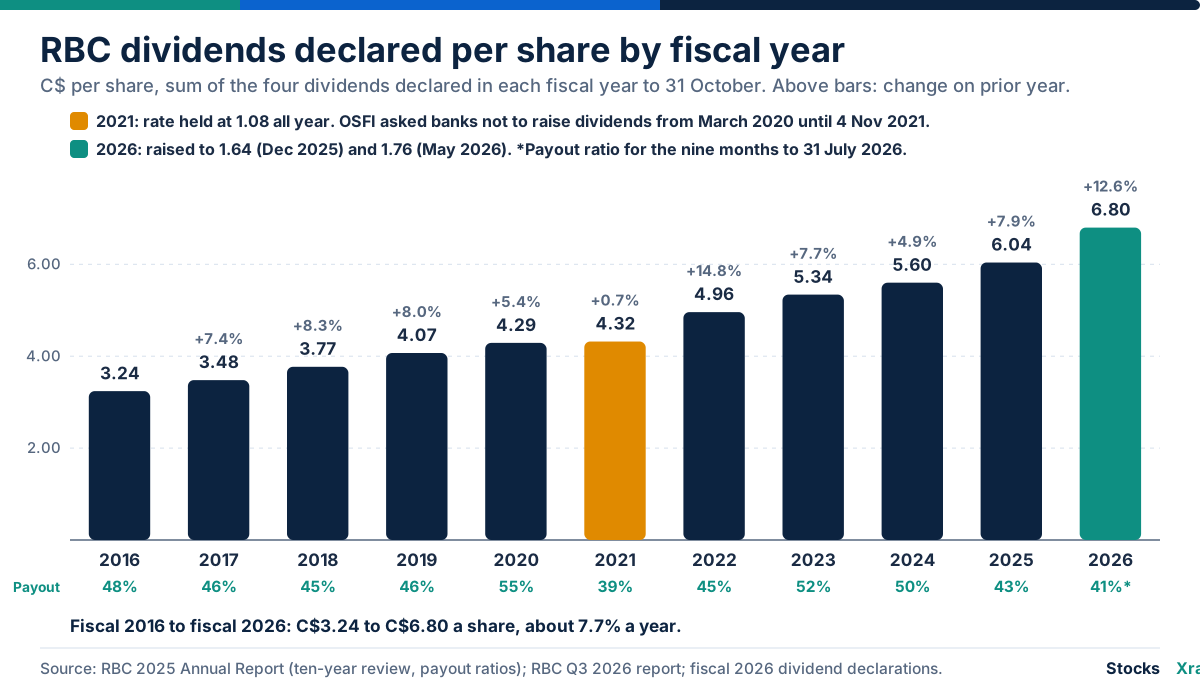
- The four dividends RBC declared in fiscal 2026 add up to C$6.80 per share, up 12.6% from C$6.04 in fiscal 2025 and more than double the C$3.24 of fiscal 2016, a rise of about 7.7% a year.
- The latest dividend, C$1.76, went ex-dividend on 26 October 2026 and is payable on or after 24 November 2026. As of 14 November 2026 the next dividend has not been declared; RBC's investor-relations page lists its fourth-quarter results for 3 December 2026.
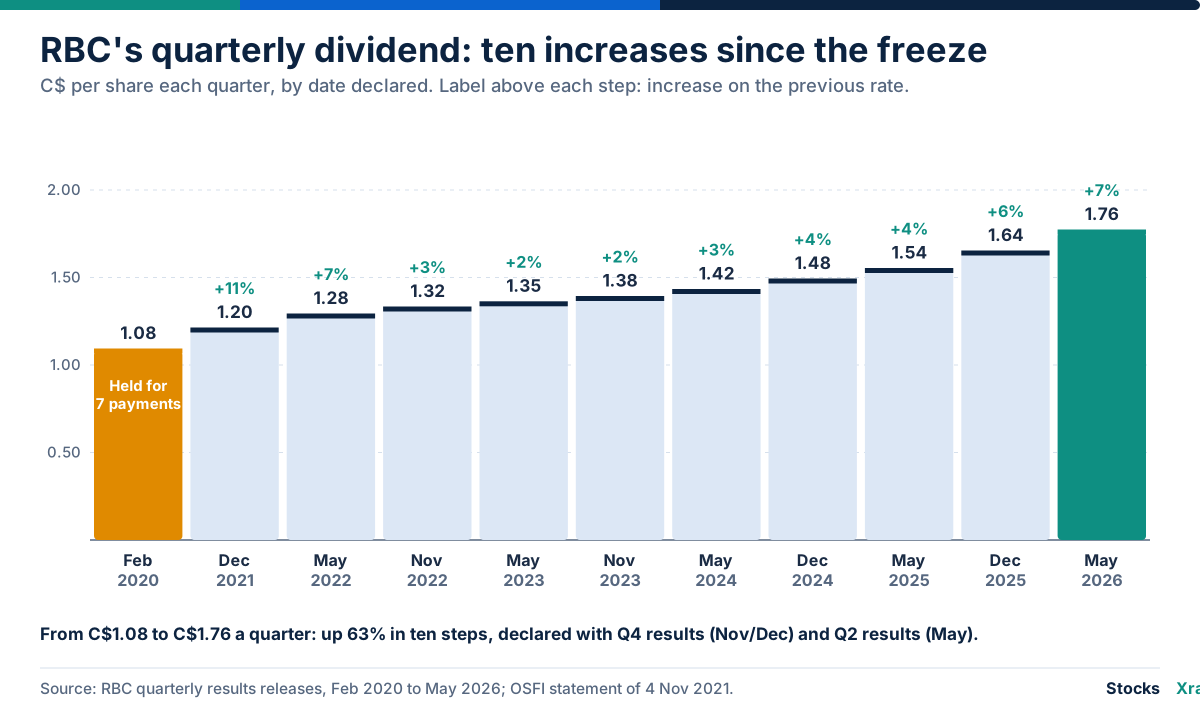
- RBC has raised the dividend at every half-year review since December 2021: ten increases in a row, taking the quarterly rate from C$1.08 to C$1.76, a rise of 63%.
- RBC's medium-term objective is to pay out 40% to 50% of earnings. The payout ratio was 43% in fiscal 2025 and 41% in the first nine months of fiscal 2026.
- On the 13 November 2026 close of C$288.37, the C$6.80 of dividends over the past 12 months gave a yield of 2.36%, down from 3.99% at the end of 2023, because the share price rose faster than the dividend.
What RBC does and how it makes money
RBC describes itself as Canada's biggest bank by market capitalization, with more than 19 million clients in Canada, the United States and 27 other countries and more than 100,000 employees. Like other banks, it earns the gap between what it charges on loans and what it pays on deposits (net interest income), plus fees from wealth management, insurance, cards and capital-markets work. It reports in five business segments and a Corporate Support segment:
- Personal Banking: everyday banking, mortgages, cards and investing for individuals in Canada, the Caribbean and the US.
- Commercial Banking: lending, deposits and transaction banking for Canadian businesses.
- Wealth Management: advice and investment services for wealthy individuals and institutions in Canada, the US (including City National Bank), the UK, Europe and Asia, plus asset management.
- Insurance: life, health, travel, group benefits, annuities and reinsurance.
- Capital Markets: corporate and investment banking and trading (Global Markets) for companies, institutions and governments.
| Segment | Net income, fiscal 2025 (C$ m) | Net income, nine months to 31 Jul 2026 (C$ m) | Share of segment profit, nine months |
|---|---|---|---|
| Personal Banking | 7,105 | 5,755 | 33.0% |
| Capital Markets | 5,393 | 4,506 | 25.8% |
| Wealth Management | 4,289 | 3,922 | 22.5% |
| Commercial Banking | 3,020 | 2,653 | 15.2% |
| Insurance | 828 | 628 | 3.6% |
| Corporate Support | (266) | (146) | n/a |
| Total net income | 20,369 | 17,318 |
No single segment dominates. The two Canadian banking segments supplied just under half of segment profit in the nine months to July 2026, and Capital Markets and Wealth Management most of the rest. That mix matters for the dividend: a weak year for Canadian borrowers can be partly offset by strong markets, and the reverse.
On 28 March 2024 RBC completed its purchase of HSBC Bank Canada for C$13.5 billion in cash for the common shares. Fiscal 2024 included seven months of the acquired business and fiscal 2025 the first full year.
RBC results: five fiscal years
RBC reports results under International Financial Reporting Standards (IFRS) and also gives "adjusted" figures that remove specified one-off items and the amortization of acquired intangibles. The table uses reported figures, which are also the basis for RBC's own payout ratio.
| Fiscal year | Total revenue (C$ m) | Net income (C$ m) | Diluted EPS (C$) | Dividends declared per share (C$) | Payout ratio | CET1 ratio |
|---|---|---|---|---|---|---|
| 2021 | 49,693 | 16,050 | 11.06 | 4.32 | 39% | 13.7% |
| 2022 | 48,985 | 15,807 | 11.06 | 4.96 | 45% | 12.6% |
| 2023 (restated) | 51,464 | 14,612 | 10.32 | 5.34 | 52% | 14.5% |
| 2024 | 57,344 | 16,240 | 11.25 | 5.60 | 50% | 13.2% |
| 2025 | 66,605 | 20,369 | 14.07 | 6.04 | 43% | 13.5% |
Fiscal 2023 is shown as restated for IFRS 17, the insurance accounting standard RBC adopted from 1 November 2023. EPS means earnings per share; our guide to basic and diluted EPS explains the difference.
What moved the numbers:
- Fiscal 2021: provisions for credit losses (PCL), the money set aside for loans that may go bad, were a net release of C$753 million as pandemic-era provisions were reversed, flattering profit.
- Fiscal 2023: profit fell as PCL rose to C$2,468 million and RBC booked C$1,050 million for the Canada Recovery Dividend, a one-time tax announced in the federal government's 2022 budget, and a 1.5-point rise in its corporate tax rate. The payout ratio rose to 52%, above RBC's range.
- Fiscal 2025: net income rose 25% to C$20.4 billion and diluted EPS to C$14.07, helped by higher net interest income, the full year of HSBC Canada, and stronger wealth and capital-markets revenue. Adjusted diluted EPS was C$14.43, up from C$12.09. PCL rose to C$4,362 million as unemployment and trade disruption weighed on borrowers.
Over the five years, diluted EPS rose from C$11.06 to C$14.07 (27%) while dividends declared rose from C$4.32 to C$6.04 (40%). The dividend outgrew earnings for a few years, which pushed the payout ratio to the top of the range in 2023 and 2024, then fell back as profit jumped in 2025.
The latest four quarters
| Quarter | Net income (C$ m) | Diluted EPS (C$) | Adjusted diluted EPS (C$) | Dividend declared (C$) | CET1 ratio |
|---|---|---|---|---|---|
| Q4 2025 (to 31 Oct 2025) | 5,434 | 3.76 | 3.85 | 1.54 | 13.5% |
| Q1 2026 (to 31 Jan 2026) | 5,785 | 4.03 | 4.08 | 1.64 | 13.7% |
| Q2 2026 (to 30 Apr 2026) | 5,509 | 3.85 | 3.90 | 1.64 | 13.5% |
| Q3 2026 (to 31 Jul 2026) | 6,024 | 4.23 | 4.28 | 1.76 | 13.5% |
In the first nine months of fiscal 2026, net income was C$17,318 million, up 16.0% from C$14,935 million a year earlier, and diluted EPS was C$12.10 against C$10.31, up 17.4%. The third quarter was a record: Wealth Management net income rose 32% on market gains and client inflows, and Capital Markets rose 16% on deal-making and equity trading. Personal Banking slipped 1% on higher costs and provisions. Return on equity, profit as a share of shareholders' capital, was 17.9% in the quarter; our guide to return on equity explains the measure.
One material event since then: on 10 August 2026 RBC and BMO agreed to sell Moneris, the payments processor they own jointly, to Francisco Partners for about C$2 billion in cash. RBC's half is expected to produce an after-tax gain of about C$475 million when the deal closes, which RBC expects by the end of the first quarter of fiscal 2027, subject to regulatory approval. A gain like that lifts reported profit for one quarter; it is the kind of item adjusted figures exist to separate out.
RBC dividend history
RBC's annual reports give the dividends declared in each fiscal year. The table adds the quarterly amounts for the years since 2019 and RBC's own payout ratio.
| Fiscal year | Quarterly amounts declared (C$) | Total per share (C$) | Change | Payout ratio |
|---|---|---|---|---|
| 2016 | not shown | 3.24 | 48% | |
| 2017 | not shown | 3.48 | +7.4% | 46% |
| 2018 | not shown | 3.77 | +8.3% | 45% |
| 2019 | 0.98, 1.02, 1.02, 1.05 | 4.07 | +8.0% | 46% |
| 2020 | 1.05, then 1.08 three times | 4.29 | +5.4% | 55% |
| 2021 | 1.08 four times | 4.32 | +0.7% | 39% |
| 2022 | 1.20, 1.20, 1.28, 1.28 | 4.96 | +14.8% | 45% |
| 2023 | 1.32, 1.32, 1.35, 1.35 | 5.34 | +7.7% | 52% |
| 2024 | 1.38, 1.38, 1.42, 1.42 | 5.60 | +4.9% | 50% |
| 2025 | 1.48, 1.48, 1.54, 1.54 | 6.04 | +7.9% | 43% |
| 2026 | 1.64, 1.64, 1.76, 1.76 | 6.80 | +12.6% | 41% (nine months) |
RBC's 2025 annual report puts the annualized dividend increase at 7% over both five and ten years. Three patterns stand out.
The freeze of 2020 and 2021. On 21 February 2020 RBC raised its quarterly dividend to C$1.08. Weeks later, in March 2020, Canada's bank regulator, the Office of the Superintendent of Financial Institutions (OSFI), told the banks it supervises not to raise dividends. It lifted that expectation on 4 November 2021. RBC paid C$1.08 for seven quarters in a row, and the first increase after the freeze, declared on 1 December 2021, was 11%, to C$1.20.
Two increases a year since then. From December 2021 RBC has raised the dividend with its fourth-quarter results (late November or early December) and its second-quarter results (late May). In 2019 and early 2020 the increases came with first- and third-quarter results instead. The size has followed earnings: 2% to 3% a step from November 2022 to May 2024, when profit was flat, and 6% to 7% in the latest two steps, after the 2025 profit jump.
Faster growth since the freeze. From fiscal 2021 to fiscal 2026, dividends declared rose from C$4.32 to C$6.80, about 9.5% a year. Our guide to dividend growth investing explains why the base year changes the story.
RBC dividend dates and schedule
RBC's board declares the dividend on the day the bank reports quarterly results. Each declaration names two dates besides the amount:
- Record date: you must be on the shareholder register at the close of this day to be paid. Since Canadian markets moved to one-day settlement on 27 May 2024, the ex-dividend date, the first day the shares trade without the right to the coming payment, is the same day as the record date. A buyer needs to buy by the trading day before it.
- Payment date: RBC pays "on or after" a date around the 24th of February, May, August and November.
Our guide to ex-dividend and record dates explains the mechanics.
| Declared | Ex-dividend and record date | Paid | Amount (C$) |
|---|---|---|---|
| 4 Dec 2024 | 27 Jan 2025 | 24 Feb 2025 | 1.48 |
| 27 Feb 2025 | 24 Apr 2025 | 23 May 2025 | 1.48 |
| 29 May 2025 | 24 Jul 2025 | 22 Aug 2025 | 1.54 |
| 27 Aug 2025 | 27 Oct 2025 | 24 Nov 2025 | 1.54 |
| 3 Dec 2025 | 26 Jan 2026 | 24 Feb 2026 | 1.64 |
| 26 Feb 2026 | 23 Apr 2026 | 22 May 2026 | 1.64 |
| 28 May 2026 | 27 Jul 2026 | 24 Aug 2026 | 1.76 |
| 27 Aug 2026 | 26 Oct 2026 | 24 Nov 2026 (payable) | 1.76 |
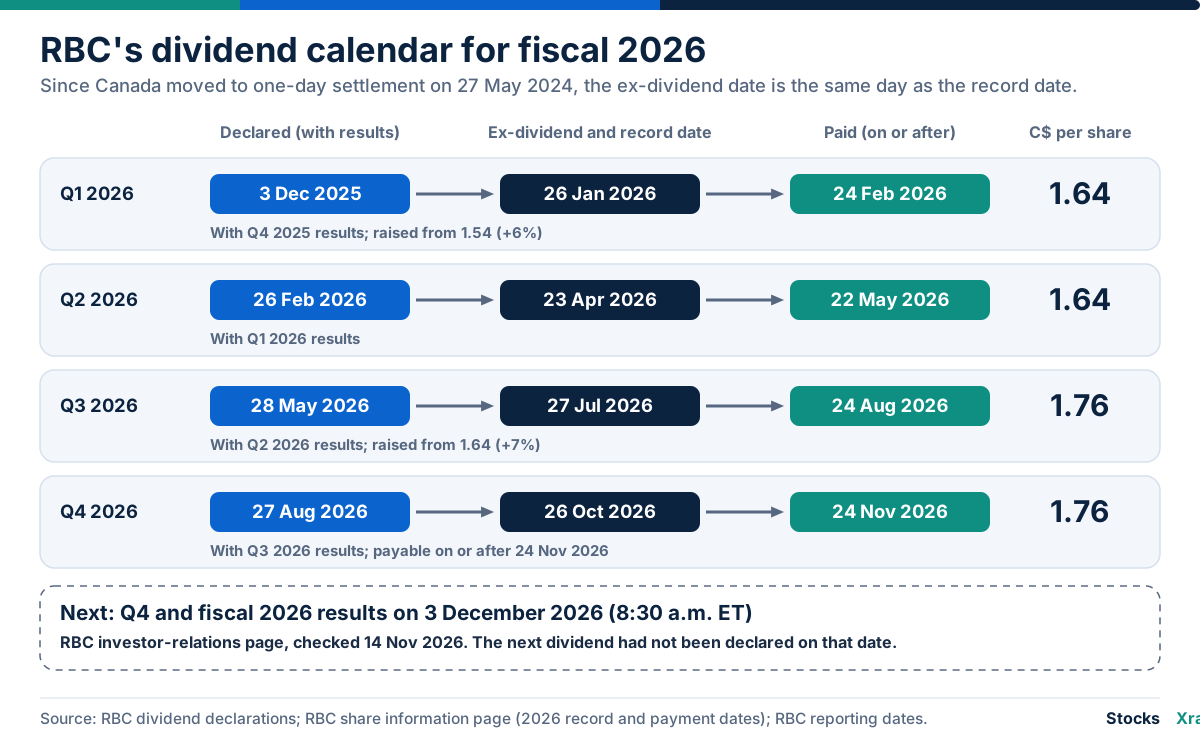
RBC publishes its record and payment dates for the calendar year in advance on its investor-relations site, subject to board approval; on 14 November 2026 that list covered 2026 only. The pattern of recent years is that the dividend declared with fourth-quarter results has a record date in late January and is paid on or after 24 February. Upcoming ex-dividend dates for RBC and other stocks appear on our dividend calendar once companies announce them.
Worked example (calculation from the dates above). An investor who bought 100 RBC shares by Friday 23 October 2026 was on the register at the close on Monday 26 October and is due 100 times C$1.76, or C$176, on 24 November 2026. Someone who held 100 shares through all four record dates of fiscal 2026 receives C$680. A holder who lives outside Canada would normally have Canadian withholding tax of 25% deducted at source, which a tax treaty can reduce; at the full 25% rate the C$176 would arrive as C$132 (illustrative). RBC designates its dividends as "eligible dividends" for Canadian tax purposes unless it says otherwise. The value in another currency depends on the exchange rate on the payment date; our CAD to USD converter shows the current rate.
Dividend policy and the payout ratio
RBC says its dividend policy reflects its earnings outlook, its payout ratio objective and the need to keep enough capital to support its business plans. The payout ratio is the share of earnings paid out as dividends. RBC's medium-term objective is 40% to 50%, and its 2025 annual report said that objective was unchanged for fiscal 2026. Over the three and five years to fiscal 2025, the average payout was 48% and 46%.
The ratio has strayed outside the range when earnings, not the dividend, moved sharply. It reached 55% in fiscal 2020, when pandemic loan-loss provisions cut profit, and 52% in fiscal 2023, the year of the Canada Recovery Dividend tax. It dropped to 39% in fiscal 2021, when provisions were released. In the first nine months of fiscal 2026 it was 41%, near the bottom of the range, because earnings grew faster than the dividend even after two increases. Our dividend payout ratio guide explains how to read the measure.
RBC also offers a dividend reinvestment plan (DRIP) to shareholders in Canada and the US. Since the May 2024 dividend it has filled the plan by buying shares in the market with no discount, rather than issuing new shares, so reinvestment does not add to the share count.
RBC dividend yield
Dividend yield is the dividend divided by the share price. Our stock pages use the dividends paid over the past 12 months, by ex-dividend date, divided by the latest close. On that basis RBC's yield was 2.36% on 13 November 2026, from C$6.80 of dividends and a close of C$288.37. On the current quarterly rate of C$1.76, or C$7.04 a year, the figure is about 2.44%.
| Date | Close (C$) | Dividends in the calendar year to that date (C$) | Yield |
|---|---|---|---|
| End of 2021 | 134.25 | 4.32 | 3.22% |
| End of 2022 | 127.30 | 4.96 | 3.90% |
| End of 2023 | 134.00 | 5.34 | 3.99% |
| End of 2024 | 173.32 | 5.60 | 3.23% |
| End of 2025 | 233.99 | 6.04 | 2.58% |
| 13 Nov 2026 | 288.37 | 6.80 (past 12 months) | 2.36% |
From the end of 2021 to 13 November 2026 the annual dividend rose 57.4%, from C$4.32 to C$6.80, and the share price rose 114.8%, from C$134.25 to C$288.37. A falling yield on a rising dividend means the price has outrun the payout, not that the payout has shrunk. Our dividend yield guide covers this and the opposite trap, a high yield caused by a falling price. For other income stocks, see our best dividend stocks list.
Capital, buybacks and what backs the dividend
Free cash flow, the usual test of whether a company can afford its dividend, does not work well for a bank, because lending and deposit-taking are its operating business. Investors look at capital instead. The key figure is the Common Equity Tier 1 (CET1) ratio: core shareholders' equity as a share of risk-weighted assets. The higher it is, the bigger the cushion against losses and the more room for dividends and buybacks.
RBC's CET1 ratio was 13.5% at 31 October 2025, against an OSFI minimum for RBC of 11.6% including buffers and the 3.5% Domestic Stability Buffer, and it was still 13.5% at 31 July 2026. In November 2025 the Financial Stability Board again named RBC a global systemically important bank, which carries a 1% capital surcharge, the same as its domestic one.
RBC returns capital through buybacks as well as dividends. In fiscal 2025 it returned C$11.3 billion through common dividends and share repurchases. In the nine months to 31 July 2026 it bought back about 17.2 million shares for C$4,236 million, and the share count fell from 1,400.1 million at 31 October 2025 to 1,384.6 million, which spreads profit and dividends over fewer shares. Its current normal course issuer bid allows up to 45 million shares, about 3% of the total, between 12 June 2026 and 11 June 2027. Our post on share buybacks explains when that helps owners.
How StocksXray scores RBC
On the 13 November 2026 close, RBC's Market X-Ray score on our RBC stock page was 80 out of 100, ranking 32nd of 870 stocks on the Toronto Stock Exchange, with high confidence. The five lenses were:
| Lens | Score (13 Nov 2026) | What it reflects |
|---|---|---|
| Trend | 77 | Price above its long-term averages; 5.7% below its 52-week high |
| Momentum | 70 | Returns over 3, 6 and 12 months against other TSX stocks |
| Stability | 94 | Low volatility and a shallow worst drawdown over one year |
| Liquidity | 100 | Average daily trading value of about C$902 million |
| Income | 42 | A dividend yield of 2.4%, small next to other TSX payers |
The Market X-Ray is price-based: it describes how the shares have traded against other stocks on the same exchange, not how healthy or cheap the bank is. The fundamental lenses in our five lenses guide are not yet available for Canadian stocks, and how the X-Ray score works explains the method. For the current price, the interactive RBC chart and a printable RBC research report sit alongside the stock page.
Risks RBC lists in its annual report
RBC's 2025 annual report sets out the "top and emerging risks" its board and senior management track. Six bear most directly on the dividend:
- Business and economic conditions, including trade policy and tariffs, unemployment, inflation and interest-rate moves, which drive loan demand, margins and credit losses.
- Canadian housing and household debt, which RBC calls heightened given affordability problems, high debt levels and a rising unemployment rate.
- Technology, cyber and third-party risk, including cyberattacks, ransomware, data breaches and failures at suppliers.
- Geopolitical uncertainty, from US policy changes and trade tensions to conflicts in Europe and the Middle East.
- Digital disruption, from technology companies, new competitors and digital assets such as stablecoins, and the new risks that come with using AI.
- Regulatory change and conduct risk, where new rules or enforcement could raise costs or restrict some activities.
Our financials sector guide covers how these risks affect banks generally.
Common mistakes when reading RBC's dividend
- Mixing fiscal and calendar years. RBC's fiscal year ends on 31 October, but the four dividends declared in a fiscal year go ex-dividend in January, April, July and October, so fiscal and calendar totals by ex-date match. Totals by payment date do not: the dividend declared in August is paid in November.
- Reading the payment date as the cut-off. To receive a dividend you must own the shares before the ex-dividend date, about four weeks before payment.
- Using the old ex-dividend rule. Before 27 May 2024 the ex-dividend date was one business day before the record date. It is now the same day.
- Treating a lower yield as a lower dividend. RBC's yield fell from 3.99% at the end of 2023 to 2.36% while the dividend rose 27%; the price did the work.
- Assuming increases are automatic. The 2020 to 2021 freeze shows that a regulator can stop increases, and the size of each step has followed earnings.
Frequently asked questions
How much is the RBC dividend? RBC pays C$1.76 per common share each quarter, or C$7.04 a year at that rate. The rate was declared on 28 May 2026, paid on 24 August 2026 and declared again on 27 August 2026 for payment on or after 24 November 2026. Dividends declared for fiscal 2026 total C$6.80 per share because the first two were C$1.64.
When does RBC pay its dividend? RBC pays four times a year, on or after a date around the 24th of February, May, August and November. In 2026 the payment dates were 24 February, 22 May, 24 August and 24 November. Each dividend is declared with quarterly results, roughly three months before it is paid.
What is the RBC ex-dividend date? The most recent ex-dividend date was 26 October 2026, the same day as the record date, for the C$1.76 dividend payable on or after 24 November 2026. Since May 2024 Canadian ex-dividend dates fall on the record date, so a buyer must purchase by the previous trading day. As of 14 November 2026 the next ex-dividend date has not been set.
What were RBC's dividend dates in 2025? In 2025 RBC's dividends went ex-dividend on 27 January, 24 April, 24 July and 27 October, and were paid on 24 February, 23 May, 22 August and 24 November. The amounts were C$1.48 for the first two and C$1.54 for the last two, C$6.04 in all.
What is RBC's dividend yield? On 13 November 2026, RBC's dividends over the past 12 months of C$6.80 and its close of C$288.37 gave a yield of 2.36%. On the current annual rate of C$7.04 the yield was about 2.44%. The yield changes every day with the share price.
How often does RBC increase its dividend? Since December 2021 RBC has raised its dividend twice a year, with fourth-quarter results in late November or early December and second-quarter results in late May. The last ten increases ranged from 2% to 11%; the latest, on 28 May 2026, was 12 cents or 7%. Increases are decided by the board each time and are not guaranteed.
When will RBC announce its next dividend? As of 14 November 2026, RBC's investor-relations page lists its fourth-quarter and fiscal 2026 results for 3 December 2026, with a conference call at 8:30 a.m. Eastern time. RBC normally declares its next dividend the same day, which in recent years has had a record date in late January and a payment date of 24 February.
Sources and data notes
- Royal Bank of Canada, share information and dividend dates and financial information and reporting dates, checked 14 November 2026.
- RBC earnings releases for the fourth quarter and fiscal 2025, and the first, second and third quarters of 2026; Q3 2026 report to shareholders.
- RBC 2025 Annual Report (ten-year statistical review, medium-term objectives, dividend policy, capital, top and emerging risks) and earlier results releases for fiscal 2019 to 2024.
- RBC dividend declarations of 3 December 2025 and later, as reproduced on newswire services.
- OSFI, statement lifting the expectations on dividends and buybacks, 4 November 2021; Toronto Stock Exchange, T+1 trading notice; Canada Revenue Agency, rates for Part XIII tax.
- Share prices, yields and Market X-Ray scores are StocksXray's own end-of-day records for the Toronto Stock Exchange, as of the 13 November 2026 close.
This page covers RBC's common-share dividend and results to the third quarter of fiscal 2026. It does not cover preferred-share dividends, individual tax advice, or RBC's dividend mutual funds, such as the RBC Canadian Dividend Fund, which are separate investment products managed by RBC Global Asset Management.
Educational information, not financial advice.
Related reading
Educational only, not financial advice. Examples use illustrative numbers.