











Netflix Earnings: Quarterly Results, Report Dates and Guidance
Netflix's earnings are the quarterly results it posts in a letter to shareholders shortly after the US market closes, 16 to 21 days after each quarter ends. The latest, on 20 October 2026, covered the quarter to 30 September 2026: revenue of $12.9 billion, up 12% from a year earlier, an operating margin of 34.6% and earnings of $0.87 per diluted share under GAAP, the US accounting rules. This guide sets out the record from Netflix's filings, how results compared with its own guidance, why it pays no dividend, cash flow and the risks it lists.
Key takeaways
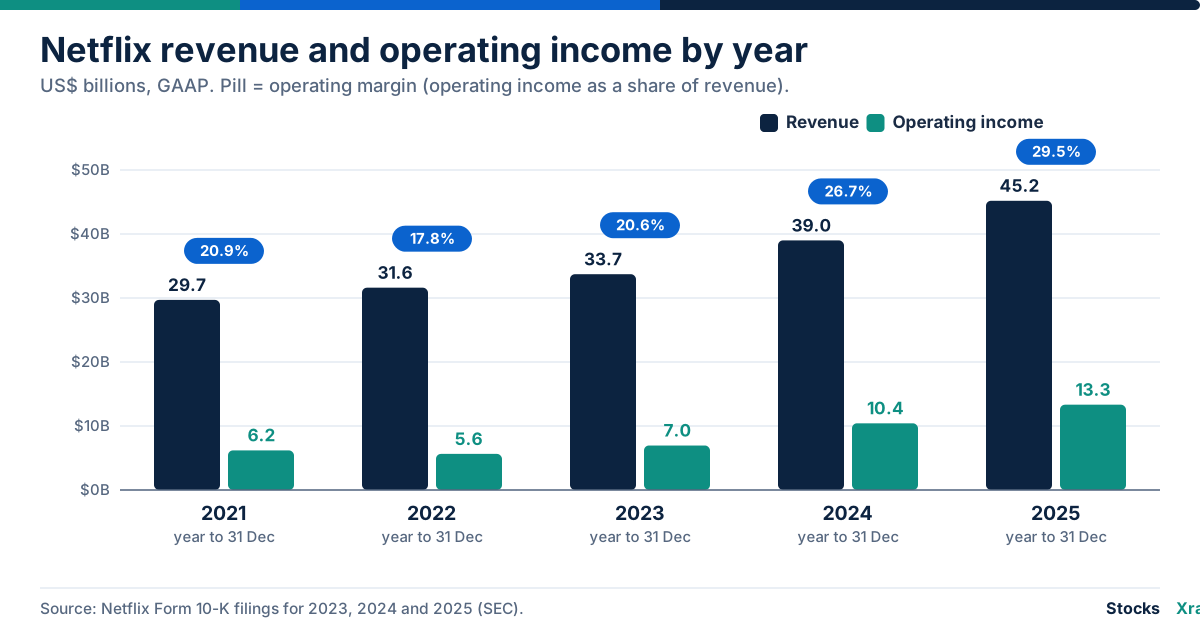
- In 2025 Netflix reported revenue of $45.2 billion, up 16%, an operating margin of 29.5%, up from 26.7%, and net income of $11.0 billion, or $2.53 a share.
- Revenue rose 14% to $37.7 billion in the first nine months of 2026. Netflix expects $51.1 billion for the full year, up 13%, and an operating margin of 31.5%.
- In each of the five quarters to September 2026, revenue came within 0.8% of the guidance Netflix gave a quarter earlier. Operating margin beat guidance four times; the one miss came in a quarter hit by a $619 million Brazilian tax charge.
- First-quarter 2026 net income of $5.3 billion included a $2.8 billion fee Netflix received when Warner Bros. Discovery ended their merger agreement to accept a rival offer.
- Netflix has never paid a dividend. It returns cash through buybacks: $10.8 billion in the first nine months of 2026, which cut the diluted share count 3.3% in a year.
When Netflix reports earnings
Netflix's fiscal year is the calendar year. It posts results and its outlook on ir.netflix.net just after the US market close, at about 1:01 p.m. Pacific time (4:01 p.m. Eastern) for the July and October 2026 reports. At 1:45 p.m. Pacific the co-chief executives Greg Peters and Ted Sarandos and finance chief Spence Neumann answer questions submitted by sell-side analysts in a live video interview on the Netflix investor relations YouTube channel, which replaces a traditional earnings call. A recording follows at about 2:30 p.m. Pacific.
| Quarter | Quarter end | Results released |
|---|---|---|
| Q4 2024 | 31 Dec 2024 | Tue 21 Jan 2025 |
| Q1 2025 | 31 Mar 2025 | Thu 17 Apr 2025 |
| Q2 2025 | 30 Jun 2025 | Thu 17 Jul 2025 |
| Q3 2025 | 30 Sep 2025 | Tue 21 Oct 2025 |
| Q4 2025 | 31 Dec 2025 | Tue 20 Jan 2026 |
| Q1 2026 | 31 Mar 2026 | Thu 16 Apr 2026 |
| Q2 2026 | 30 Jun 2026 | Thu 16 Jul 2026 |
| Q3 2026 | 30 Sep 2026 | Tue 20 Oct 2026 |
| Q4 2026 | 31 Dec 2026 | Not yet announced |
As of 14 November 2026, Netflix had not announced the date for its fourth-quarter 2026 results. The pattern is consistent: fourth-quarter results in the third week of January, usually on a Tuesday, then mid-April, mid-July and the third week of October. Netflix announces each date four to five weeks ahead; the 20 October date was announced on 14 September. The letter is filed with the SEC on Form 8-K the same day; the 10-Q has followed the next day and the 10-K a few days later. Our guide to 10-Q and 8-K filings explains these documents, and our guide to after-hours trading explains why the first price reaction comes outside normal hours.
How Netflix makes money
Netflix sells streaming memberships in more than 190 countries, and it sells advertising shown on a cheaper ad-supported plan, priced at $8.99 a month in the United States in 2026. Subscription fees bring in most of the revenue. Advertising is growing from a small base: 2025 was only Netflix's third year selling ads, ad revenue rose more than 2.5 times to over $1.5 billion, and Netflix now expects about $2.7 billion in 2026.
Netflix reports one business segment but splits revenue by region:
| Region | 2025 revenue | Share | Change from 2024 | Q3 2026 revenue | Change from Q3 2025 |
|---|---|---|---|---|---|
| US and Canada (UCAN) | $20.0B | 44% | +15% | $5.6B | +11% |
| Europe, Middle East and Africa (EMEA) | $14.5B | 32% | +17% | $4.1B | +11% |
| Latin America (LATAM) | $5.4B | 12% | +11% | $1.6B | +17% |
| Asia-Pacific (APAC) | $5.4B | 12% | +21% | $1.5B | +12% |
| Total | $45.2B | 100% | +16% | $12.9B | +12% |
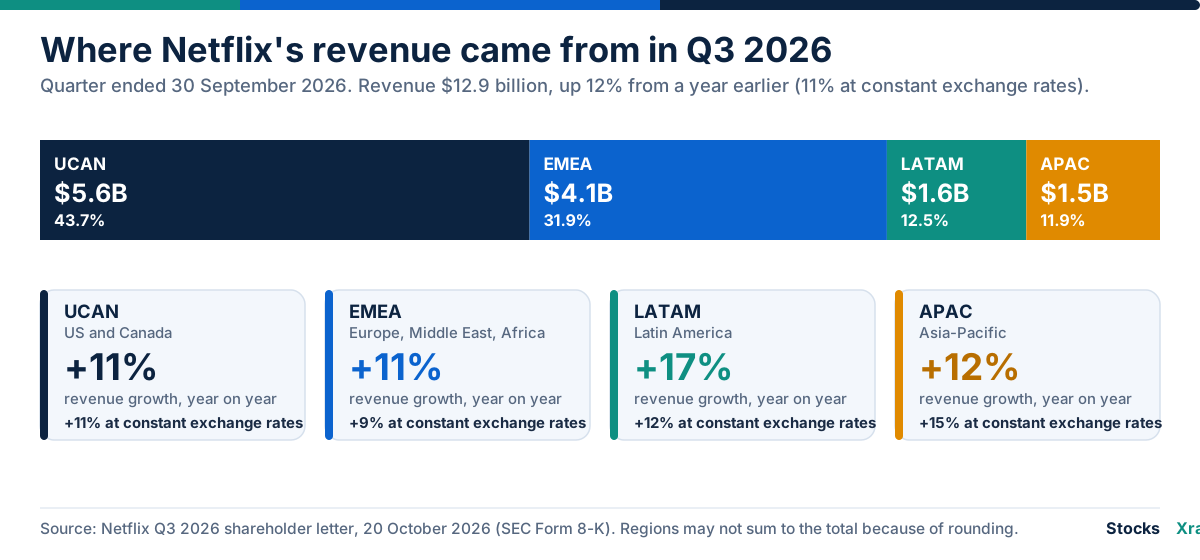
Exchange rates matter because about 56% of revenue comes from outside the US and Canada. In the September 2026 quarter, revenue growth in EMEA was 11% as reported but 9% at constant exchange rates, LATAM grew 17% as reported but 12% at constant rates, and APAC grew 12% as reported and 15% at constant rates. UCAN grew 11% on both measures.
The biggest cost is content. Netflix capitalizes what it spends on series and films and then charges it against profit over time as amortization: $12.8 billion in the first nine months of 2026, up 9.5%. Because that charge is largely fixed in the short run, extra revenue from price rises and new members flows strongly to operating income, the effect our guide to operating leverage describes. Netflix stopped reporting membership numbers every quarter from 2025 and now announces them only at milestones; it passed 325 million paid memberships in the fourth quarter of 2025.
Netflix's results record
Five years
| Year | Revenue | Operating income | Operating margin | Net income | Diluted EPS | Free cash flow |
|---|---|---|---|---|---|---|
| 2021 | $29.7B | $6.2B | 20.9% | $5.1B | $1.12 | -$0.1B |
| 2022 | $31.6B | $5.6B | 17.8% | $4.5B | $1.00 | $1.6B |
| 2023 | $33.7B | $7.0B | 20.6% | $5.4B | $1.20 | $6.9B |
| 2024 | $39.0B | $10.4B | 26.7% | $8.7B | $1.98 | $6.9B |
| 2025 | $45.2B | $13.3B | 29.5% | $11.0B | $2.53 | $9.5B |
All figures are GAAP except free cash flow, which Netflix defines as operating cash flow minus purchases of property and equipment. Earnings per share are adjusted for the ten-for-one stock split that took effect after the close on 14 November 2025; Netflix reported $11.24 for 2021 and $9.95 for 2022 before the split, which we divided by ten. Our Netflix stock split page lists the company's splits, and our guide to stock splits explains why they do not change what a holding is worth.
Growth slowed to 6.5% in 2022 and 6.7% in 2023, then picked up to 16% in both 2024 and 2025. Netflix attributes recent growth mainly to more members, higher prices and advertising, and it has also enforced its rules against sharing an account outside one household. With cost of revenues, mostly content amortization, growing more slowly than revenue, operating margin went from 17.8% in 2022 to 29.5% in 2025, and net income more than doubled between 2021 and 2025.
The last six quarters
| Quarter | Revenue ($M) | Growth | Operating income ($M) | Operating margin | Net income ($M) | Diluted EPS | Free cash flow ($M) |
|---|---|---|---|---|---|---|---|
| Q2 2025 | 11,079 | 15.9% | 3,775 | 34.1% | 3,125 | $0.72 | 2,267 |
| Q3 2025 | 11,510 | 17.2% | 3,248 | 28.2% | 2,547 | $0.59 | 2,660 |
| Q4 2025 | 12,051 | 17.6% | 2,957 | 24.5% | 2,419 | $0.56 | 1,872 |
| Q1 2026 | 12,250 | 16.2% | 3,957 | 32.3% | 5,283 | $1.23 | 5,094 |
| Q2 2026 | 12,560 | 13.4% | 4,193 | 33.4% | 3,401 | $0.80 | 1,525 |
| Q3 2026 | 12,874 | 11.8% | 4,459 | 34.6% | 3,664 | $0.87 | 2,884 |
Revenue over the four quarters to September 2026 added up to $49.7 billion and net income to $14.8 billion. Growth has slowed through 2026, from 16.2% in the first quarter to 11.8% in the third.
What moved the numbers
Price, members and ads. Netflix's 10-Q puts the September 2026 quarter's $1.36 billion revenue increase down to $1.06 billion more subscription revenue, from more members and higher prices, $256 million more advertising revenue and a $101 million boost from exchange rates. Operating income rose 37% to $4.5 billion, and Netflix said the margin beat its guidance mainly because of the timing of expenses.
The seasonal margin pattern. Netflix's margin dips late in the year, when bigger slates of new titles raise content amortization and marketing costs: it was 22.2% in the December 2024 quarter and 24.5% in the December 2025 quarter, against 34.1% in the June 2025 quarter. The guidance for the December 2026 quarter, 26.0% after 34.6% in September, follows the same pattern.
A tax charge in 2025. The September 2025 quarter included an expense of about $619 million from a dispute with Brazilian tax authorities over non-income taxes covering 2022 to 2025. It was booked in cost of revenues and cut that quarter's margin by more than five percentage points.
Worked example: the March 2026 quarter. Operating income was $3,957 million. Interest expense took $262 million. "Interest and other income" added $2,852 million, almost all of it the $2.8 billion termination fee from the Warner Bros. deal. Pre-tax income was therefore $6,547 million; after $1,264 million of tax, net income was $5,283 million, or $1.23 a diluted share, against the $0.76 Netflix had guided. Netflix raised its 2026 free cash flow outlook by $1.5 billion, mainly for the fee after tax. The lesson: the fee is a one-off, so compare operating income, not net income, when judging the trend. The same quarter lifts the trailing price-to-earnings ratio discussed below. Our guide to basic and diluted EPS explains the per-share arithmetic.
How results compared with Netflix's own guidance
Netflix gives a single-number forecast for the next quarter's revenue, operating margin, net income and EPS, and says these are its actual internal forecasts. Over the last five quarters reported revenue was within 0.8% of the guided figure every time: 0.1% below it twice and between 0.1% and 0.8% above it three times. Operating margin came in above guidance in four quarters and below it once.
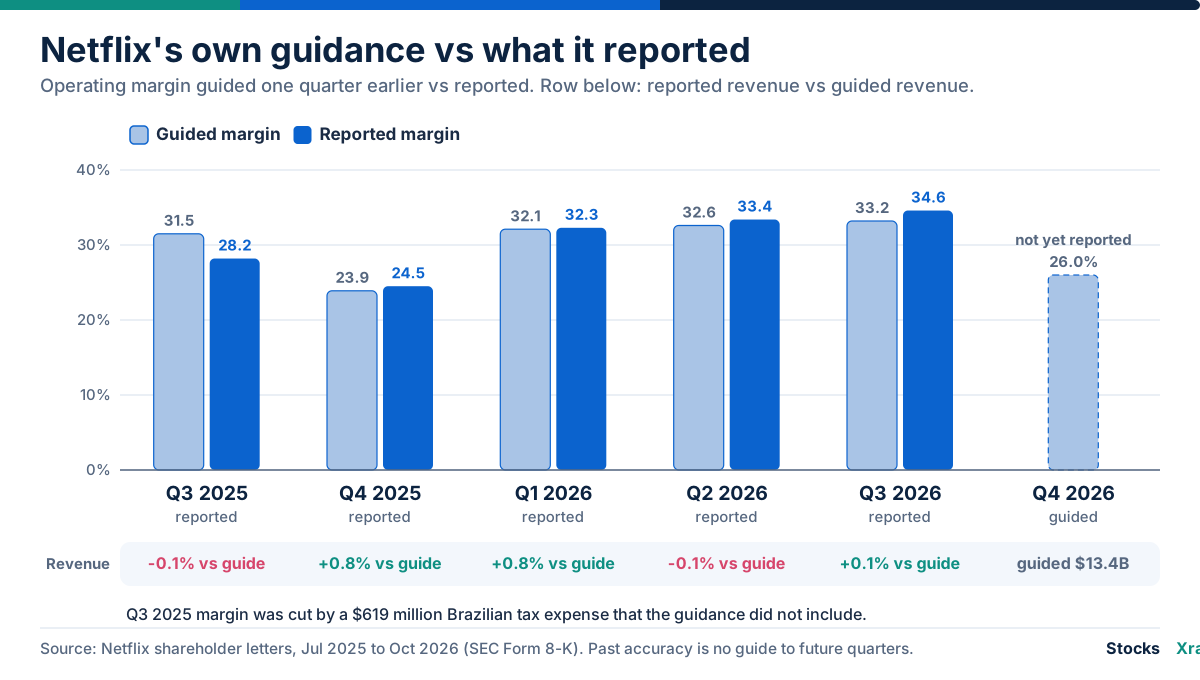
For the quarter ending 31 December 2026, Netflix guided on 20 October to revenue of $13.4 billion, up 12%, an operating margin of 26.0% and diluted EPS of $0.67. The margin includes a hit of about 1.2 percentage points from headcount reductions it had just announced. For the full year it now expects revenue of $51.1 billion, 0.2% below the midpoint of its previous range: subscription revenue has done better than it expected, but it now sees advertising revenue of about $2.7 billion rather than roughly $3 billion. It still expects an operating margin of 31.5%, against 29.5% in 2025. This is Netflix's guidance, not ours. Our guide to earnings season and guidance explains why share prices often move on the gap between results and expectations rather than on the results themselves.
Netflix news as of 14 November 2026
The Warner Bros. deal that did not happen. On 5 December 2025 Netflix agreed to buy Warner Bros., including its film and TV studios and HBO Max, at $27.75 per Warner Bros. Discovery share, an enterprise value of about $82.7 billion, and in January 2026 it switched the offer to all cash. On 26 February 2026 the Warner Bros. Discovery board judged a revised offer from Paramount Skydance superior, and Netflix declined to raise its bid. The agreement was terminated the next day, Paramount Skydance paid the $2.8 billion termination fee on Warner Bros. Discovery's behalf, and the bank financing Netflix had lined up was cancelled.
Job cuts and outlook changes. Netflix's third-quarter letter refers to recently announced headcount reductions; the Associated Press reported on 14 October 2026, citing an internal memo, that they affect nearly 1,000 jobs, about 6% of staff. The same letter lowered the 2026 free cash flow outlook to about $12.0 billion from $12.5 billion, mainly because of a real estate transaction expected to close in the fourth quarter.
Board and financing. Co-founder Reed Hastings left the board at the annual meeting on 4 June 2026, and Jay Hoag, previously lead independent director, became chair. Director Anne Sweeney resigned on 26 July 2026. In July Netflix sold $1 billion of 5.25% notes due 2036 to repay notes maturing in 2026. The only 8-K in the 90 days to 14 November was the third-quarter results filing.
Business news. The letter highlighted a licensing deal with Disney, a partnership with French broadcaster TF1 and plans to launch the ad-supported plan in 15 more countries in 2027.
Market reaction. The shares closed at $68.69 on 20 October, before the letter, and at $65.04 the next day, down 5.3%. They closed at $62.15 on 13 November 2026, within a 52-week range of $61.39 to $116.73. The Netflix chart shows the full history.
Why Netflix pays no dividend
Netflix does not pay a dividend. Its 2025 annual report says it has never declared or paid cash dividends and does not currently expect to pay any in the foreseeable future. That answers a common search: there is no Netflix dividend to calendar, and no ex-dividend date.
Netflix returns cash through buybacks instead. It repurchased $9.1 billion of stock in 2025 and $10.8 billion in the first nine months of 2026, including 63.9 million shares for $4.8 billion in the third quarter, its largest quarter yet. In April 2026 the board added $25 billion to the authorization, and $22.3 billion of capacity remained after the third quarter. Diluted shares fell from 4,340 million to 4,195 million over the year to September 2026. Our guide to share buybacks explains when repurchases help owners. Readers who want income can compare Netflix with our best dividend stocks list or check upcoming payments on the dividend calendar.
Balance sheet and cash flow
At 30 September 2026 Netflix held $8.2 billion of cash and cash equivalents against gross debt of $15.3 billion. Its streaming content obligations, including amounts not yet on the balance sheet, totaled $25.2 billion, and content assets were $34.6 billion.
Free cash flow was $9.5 billion in 2025 and $9.5 billion in the first nine months of 2026, of which the termination fee contributed $2.8 billion in the first quarter. The second quarter was weaker, at $1.5 billion, partly because of higher cash tax payments linked to the fee. Netflix expects about $12.0 billion of free cash flow for 2026 and cash spending on content of about 1.1 times the amortization charge. Our guides to free cash flow and operating cash flow versus net income explain why the two can differ for a company that pays for content before it amortizes it.
How StocksXray scores Netflix
On 13 November 2026 Netflix's StocksXray X-Ray score was 62.8 out of 100, shown as 63 on the stock page. The lenses read: valuation 59.1, growth 63.2, profitability 63.3 and financial health 66.2. There is no dividend score because Netflix pays none. On our scale 70 to 100 is strong, 50 to 69 fair and under 50 weak, each judged against Communication Services peers. Our guides to how the X-Ray score works and the five lenses explain the method, and our communication services sector guide covers the peer group.
GAAP diluted EPS over the four quarters to September 2026 added up to $3.46, so the $62.15 close on 13 November 2026 was about 18 times trailing earnings. That figure includes the one-off termination fee, so it understates the multiple on recurring profit. Our guide to the price-to-earnings ratio explains its limits.
The Netflix stock page has the current price, the five lenses and our valuation models, the Netflix research report gathers key indicators and the X-Ray breakdown on one page, and the Netflix forecast page shows probability ranges built from past price moves, which are ranges and not targets.
Risks Netflix lists
Netflix's 2025 annual report lists many risk factors. These are the ones most tied to its earnings:
- Attracting and keeping members. Members cancel for many reasons, and because content costs are largely fixed, slower growth could squeeze margins.
- Competition. Rivals include other streamers, broadcasters, video games, user-generated video platforms and piracy, and Netflix flags generative AI as a fast-changing factor.
- Content commitments and debt. Long-term, largely fixed content obligations and substantial debt limit flexibility.
- Advertising. Netflix says it has limited experience selling ads and ad revenue may not grow as expected; it has already cut its 2026 ad estimate.
- Taxes in many countries. Disputes such as the Brazilian matter can bring unexpected charges.
- Technology and people. Netflix relies on Amazon Web Services for parts of its service, and it may lose key employees or face labor disputes.
Common mistakes when reading Netflix's earnings
- Comparing EPS across the 2025 split. Per-share figures from before November 2025 must be divided by ten.
- Counting the termination fee as recurring. It added $2.8 billion before tax to the March 2026 quarter.
- Comparing the fourth quarter with the third. Netflix's margin has been lowest in the fourth quarter in recent years.
- Looking for quarterly member counts. Netflix stopped reporting them in 2025; revenue, operating margin and free cash flow are its main measures.
- Ignoring exchange rates. More than half of revenue is earned outside the US and Canada.
- Reading guidance as a promise. It is management's forecast at the time, and past accuracy says nothing certain about the next quarter.
Frequently asked questions
When does Netflix report earnings? Netflix reports 16 to 21 days after each quarter ends: in the third week of January, mid-April, mid-July and the third week of October. In 2026 it reported on 20 January, 16 April, 16 July and 20 October, just after the US market close; the July and October letters were posted at about 1:01 p.m. Pacific.
When is Netflix's next earnings date? As of 14 November 2026, Netflix had not announced the date for its fourth-quarter 2026 results, for the quarter ending 31 December 2026. The two previous fourth-quarter reports came on 21 January 2025 and 20 January 2026, and Netflix usually announces the date four to five weeks in advance.
What time is the Netflix earnings call? Netflix holds a live video interview instead of a conventional call. It starts at 1:45 p.m. Pacific (4:45 p.m. Eastern) on results day on the Netflix investor relations YouTube channel, with management answering questions from sell-side analysts.
What were Netflix's third-quarter 2026 earnings? For the quarter ended 30 September 2026, reported on 20 October 2026, Netflix had revenue of $12.9 billion, up 12%, operating income of $4.5 billion, a 34.6% operating margin, and net income of $3.7 billion, or $0.87 a diluted share.
What are Netflix's earnings expectations for the fourth quarter of 2026? Netflix's own guidance, given on 20 October 2026, is revenue of $13.4 billion, an operating margin of 26.0% and diluted EPS of $0.67 for the quarter ending 31 December 2026. Analysts publish their own estimates, which can differ from the company's guidance.
Does Netflix stock pay a dividend? No. Netflix has never declared or paid a cash dividend and says it does not expect to in the foreseeable future. It returns cash through share buybacks, $10.8 billion in the first nine months of 2026.
Why did Netflix's profit jump in early 2026? Net income of $5.3 billion in the March 2026 quarter included a $2.8 billion termination fee paid after Warner Bros. Discovery ended its merger agreement with Netflix. Operating income rose a more modest 18%, to $4.0 billion.
Sources and data notes
- Netflix Form 10-K for 2025, filed 23 January 2026.
- Netflix Form 10-Q for the quarter ended 30 September 2026, filed 21 October 2026.
- Netflix shareholder letters filed on Form 8-K, July 2025 to October 2026, for example the Q3 2026 letter and the Q1 2026 letter.
- Netflix Forms 8-K on the Warner Bros. agreement and its termination, the stock split, the annual meeting and new chair and the buyback authorization.
- Netflix investor relations, including the 14 September 2026 notice of the third-quarter results, read 14 November 2026.
- Prices and X-Ray scores: StocksXray, closing data to 13 November 2026.
This page covers results through the quarter ended 30 September 2026 and news to 14 November 2026. It contains no forecasts of our own; the guidance figures quoted are Netflix's.
Educational information, not financial advice.
Related reading
Stocks in this article
Educational only, not financial advice. Examples use illustrative numbers.