









NAB Dividend: History, Dates, DRP and Why It Has Held at 85 Cents
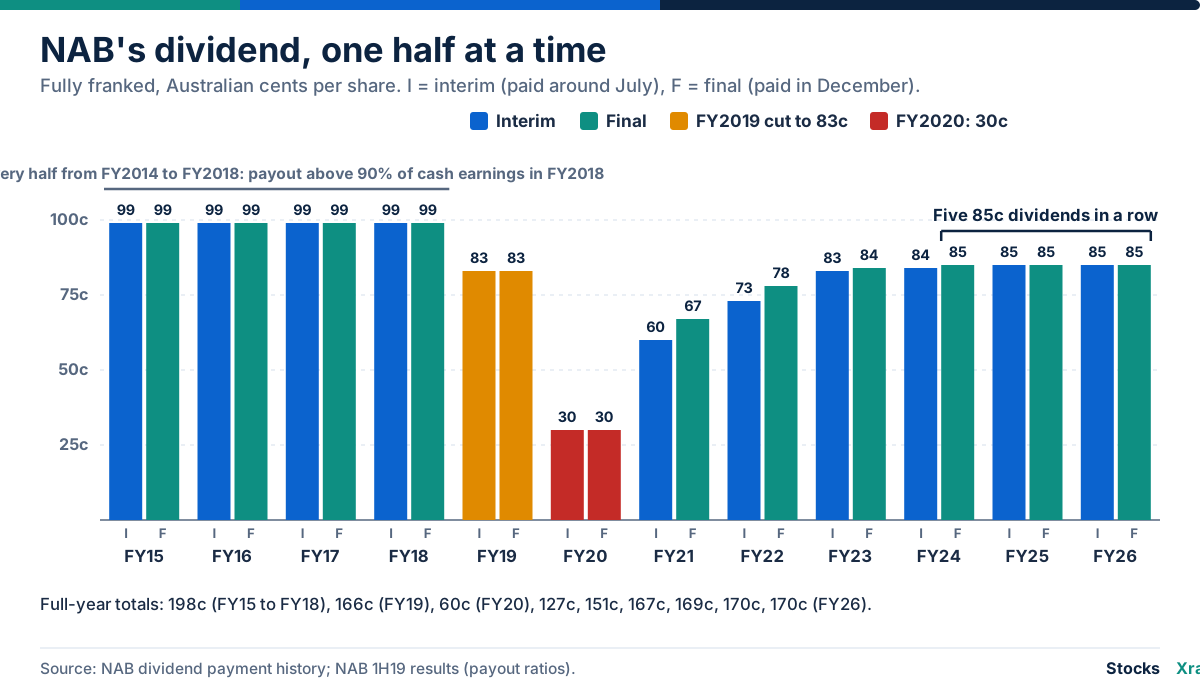
National Australia Bank (ASX: NAB) pays two fully franked dividends a year. For the year to 30 September 2026 (FY2026) it declared 170 cents a share, the same as FY2025: an 85 cent interim paid on 2 July 2026 and an 85 cent final that went ex-dividend on 10 November and is due on 15 December 2026. That makes five 85 cent dividends in a row. This guide covers the history since 2015, the dates through 2027, the newly discounted dividend reinvestment plan, franking and the results behind the payout.
Key takeaways
- NAB's FY2026 dividend was 170 cents a share, fully franked, unchanged from FY2025. Each half-year dividend since the FY2024 final has been 85 cents.
- The FY2026 final of 85 cents has a record date of 11 November 2026 and is payable on 15 December 2026. Buyers on or after the 10 November ex-dividend date do not receive it.
- As of 14 November 2026, NAB's 2027 financial calendar schedules the FY2027 interim for announcement on 5 May 2027, ex-dividend on 10 May and payment on 2 July 2027. The amount is not set.
- The payout was 73.7% of cash earnings excluding a $949 million software write-down, inside NAB's 65% to 75% guide. Counting the write-down, it was 85.1%.
- In 2026 NAB switched its dividend reinvestment plan (DRP) from buying shares on market to issuing new shares at a 1.5% discount, raising $1.8 billion from the interim and an expected $0.9 billion from the final to build capital.
What NAB does and where its profit comes from
NAB serves about 10 million customers with more than 43,000 staff. It has three customer-facing units in Australia, Business and Private Banking, Corporate and Institutional Banking, and Personal Banking, plus the digital bank Ubank and Bank of New Zealand (BNZ).
The defining feature of NAB's profit mix is how much of it comes from business customers. NAB's main profit measure is cash earnings: statutory profit excluding hedging and fair value volatility, amortisation of acquired intangibles, and the effects of buying, selling or closing businesses. By division, cash earnings excluding large notable items were:
| Division | What it covers | FY2026 (A$m) | FY2025 (A$m) | Change |
|---|---|---|---|---|
| Business and Private Banking | Small and mid-sized businesses, agribusiness, private banking, JBWere | 3,685 | 3,330 | +10.7% |
| Personal Banking | Home loans, cards and deposits for households | 1,362 | 1,253 | +8.7% |
| Corporate and Institutional Banking | Large companies, institutions, markets | 1,740 | 1,854 | -6.1% |
| New Zealand Banking (A$) | Bank of New Zealand | 1,163 | 1,353 | -14.0% |
| Corporate Functions and Other | Ubank, Treasury, technology and other central units | (860) | (699) | n/a |
| Group | 7,090 | 7,091 | 0% |
Business and Private Banking alone produced 52% of the group's cash earnings excluding large notable items, and its business lending grew 10.5% in FY2026. Personal Banking, the home-loan-heavy division, produced 19%. New Zealand's fall was partly currency: in New Zealand dollars, BNZ's cash earnings were down 7.0%, with higher bad-debt charges the main cause.
As at other banks, most income is interest. Net interest income was $18.5 billion of $22.0 billion in net operating income, about 84%. The net interest margin rose 6 basis points (0.06 percentage points) to 1.80%, which NAB attributed mainly to higher earnings on the portfolios that invest its deposits and capital, partly offset by lending competition.
NAB results, FY2022 to FY2026
NAB sets its dividend on cash earnings. The table uses that basis; FY2026 excludes the large notable item described below.
| Year to 30 September | Cash earnings (A$m) | Cash EPS (cents) | Cash ROE | Dividend (cents) | Payout, cash | CET1 ratio |
|---|---|---|---|---|---|---|
| FY2022 | 7,104 | 221 | 11.7% | 151 | 68.4% | 11.51% |
| FY2023 | 7,731 | 247 | 12.9% | 167 | 67.7% | 12.22% |
| FY2024 | 7,102 | 229 | 11.6% | 169 | 73.7% | 12.35% |
| FY2025 | 7,091 | 232 | 11.4% | 170 | 73.3% | 11.70% |
| FY2026 | 7,090 | 231 | 11.4% | 170 | 73.7% | 11.87% |
Cash EPS is cash earnings per share; cash ROE is cash earnings as a share of shareholders' equity. CET1 is Common Equity Tier 1 capital, a bank's core capital, as a share of risk-weighted assets.
The table shows a bank whose earnings peaked in FY2023 and have since been flat at about $7.1 billion, while the dividend kept edging up from 167 to 170 cents. That is why the payout ratio climbed from the high 60s to the low 70s.
What happened in FY2026
Three things shaped the year:
- A $1.35 billion software write-down. In the first half NAB shortened the useful life of its capitalised software and raised the threshold for capitalising software from $5 million to $20 million, to align with peers. That produced a one-off charge of $1,347 million before tax, $949 million after tax, which NAB classed as a large notable item. Including it, cash earnings were $6,141 million and statutory profit fell 9.1% to $6,143 million. The charge is an accounting write-down of software already paid for, not new spending.
- Higher bad-debt charges. Credit impairment charges rose 86% to $1,547 million. That included $1,083 million of charges against individual borrowers, mainly business customers, and a $403 million top-up to forward-looking provisions. NAB described the environment as one of slowing growth, declining house prices, higher interest rates and inflationary pressures; its results presentation shows the Reserve Bank's cash rate target at 4.85% after 1.25 percentage points of increases since February 2026.
- Solid underlying growth. Revenue rose 5.8% and, excluding the write-down, underlying profit, earnings before bad-debt charges and tax, rose 6.9%. The extra bad debts absorbed that gain, so cash earnings excluding the write-down were flat at $7,090 million.
Since the year ended, NAB announced on 20 October 2026 that it plans to cut up to 2,500 roles, about 6% of its workforce, in FY2027, with a restructuring charge of about $300 million before tax. On 9 November it named Ian Saines as chair-elect, to succeed Philip Chronican in July 2027. Our guide to the financials sector explains how bank earnings and provisions work.
NAB dividend history since FY2015
NAB's payment history goes back to 1983. Every dividend since the FY2007 final, paid in December 2007, has been 100% franked; between 2005 and mid-2007 several were franked at only 80% or 90%. The table shows the last 12 financial years with NAB's payment dates.
| Financial year | Interim | Paid | Final | Paid | Total |
|---|---|---|---|---|---|
| FY2015 | 99c | 3 Jul 2015 | 99c | 15 Dec 2015 | 198c |
| FY2016 | 99c | 5 Jul 2016 | 99c | 13 Dec 2016 | 198c |
| FY2017 | 99c | 5 Jul 2017 | 99c | 13 Dec 2017 | 198c |
| FY2018 | 99c | 5 Jul 2018 | 99c | 14 Dec 2018 | 198c |
| FY2019 | 83c | 3 Jul 2019 | 83c | 12 Dec 2019 | 166c |
| FY2020 | 30c | 3 Jul 2020 | 30c | 10 Dec 2020 | 60c |
| FY2021 | 60c | 2 Jul 2021 | 67c | 15 Dec 2021 | 127c |
| FY2022 | 73c | 5 Jul 2022 | 78c | 14 Dec 2022 | 151c |
| FY2023 | 83c | 5 Jul 2023 | 84c | 15 Dec 2023 | 167c |
| FY2024 | 84c | 3 Jul 2024 | 85c | 16 Dec 2024 | 169c |
| FY2025 | 85c | 2 Jul 2025 | 85c | 12 Dec 2025 | 170c |
| FY2026 | 85c | 2 Jul 2026 | 85c | 15 Dec 2026 (due) | 170c |
NAB's year ends on 30 September, and the final is paid in December, so each financial year's two dividends fall in the same calendar year. In calendar 2025 NAB paid 170 cents; in calendar 2026 it pays 170 cents once the final arrives on 15 December.
Two cuts in two years: 2019 and 2020
NAB paid 99 cents every half from FY2014 to FY2018, which by FY2018 meant paying out more than 90% of cash earnings. In May 2019 it cut the interim by 16% to 83 cents and, to rebuild capital, offered a 1.5% discount on its DRP with a partial underwrite of up to $1 billion.
A year later came the pandemic. On 27 April 2020 NAB cut its interim by 64% to 30 cents and announced a $3 billion share placement plus a share purchase plan targeting about $500 million. APRA had said that month that any bank dividends should be at a materially reduced level. The FY2020 final was also 30 cents, which NAB said reflected the uncertain outlook and APRA's revised dividend guidance; it was 49.8% of second-half statutory earnings from continuing operations.
The climb back, and the plateau
From 127 cents in FY2021 the dividend rose to 170 cents by FY2025, a gain of 34%. Measured over the five years to FY2026, that is about 6% a year compounded. Since FY2025 it has not moved, and it remains 14% below the 198 cents of FY2015 to FY2018. Our guide to dividend growth investing covers why a long flat run can matter as much as the growth rate.
NAB dividend dates for 2025, 2026 and 2027
NAB announces its interim dividend with half-year results in early May and its final with full-year results in early November. A buyer on or after the ex-dividend date does not receive the coming dividend; the record date, the next business day, is when NAB checks its register. Our explainer on ex-dividend and record dates covers the mechanics.
| Dividend | Announced | Ex-dividend | Record date | Payment |
|---|---|---|---|---|
| FY2025 interim (85c) | 7 May 2025 | 12 May 2025 | 13 May 2025 | 2 Jul 2025 |
| FY2025 final (85c) | 6 Nov 2025 | 11 Nov 2025 | 12 Nov 2025 | 12 Dec 2025 |
| FY2026 interim (85c) | 4 May 2026 | 7 May 2026 | 8 May 2026 | 2 Jul 2026 |
| FY2026 final (85c) | 5 Nov 2026 | 10 Nov 2026 | 11 Nov 2026 | 15 Dec 2026 |
| FY2027 interim (not yet set) | 5 May 2027 | 10 May 2027 | 11 May 2027 | 2 Jul 2027 |
| FY2027 final (not yet set) | 9 Nov 2027 | 12 Nov 2027 | 15 Nov 2027 | 16 Dec 2027 |
The 2027 dates come from the financial calendar NAB lodged with the ASX on 5 November 2026; NAB says the ASX will be told of any changes. The wait for cash differs by half: 35 days from ex-date to payment for the FY2026 final, but 56 days for the FY2026 interim, because NAB pays its interim in early July. Our dividend calendar lists upcoming ex-dates as they approach.
The dividend reinvestment plan: from neutral to discounted
NAB's DRP lets eligible shareholders take new NAB shares instead of cash. Outside Australia, it is open only to holders with registered addresses in France, Hong Kong, Ireland, Japan, Malaysia, New Zealand, Singapore and the United Kingdom. A separate Bonus Share Plan has been closed to new members since May 2007.
For three dividends in a row, the FY2024 final and both FY2025 dividends, NAB bought the DRP shares on market, so the share count did not grow. In 2026 it reversed course:
- FY2026 interim: new shares at a 1.5% discount, with part of the DRP underwritten, so more shares were issued than holders alone elected to take. The DRP price was $36.48, and the plan raised $1.8 billion of capital.
- FY2026 final: new shares at a 1.5% discount, with no participation limit and no underwrite. Elections closed at 5pm (AEDT) on 12 November 2026. The price is the average daily volume-weighted price over the 10 trading days from 17 to 30 November 2026, less 1.5%, and the shares are issued on 15 December. NAB expects about $0.9 billion.
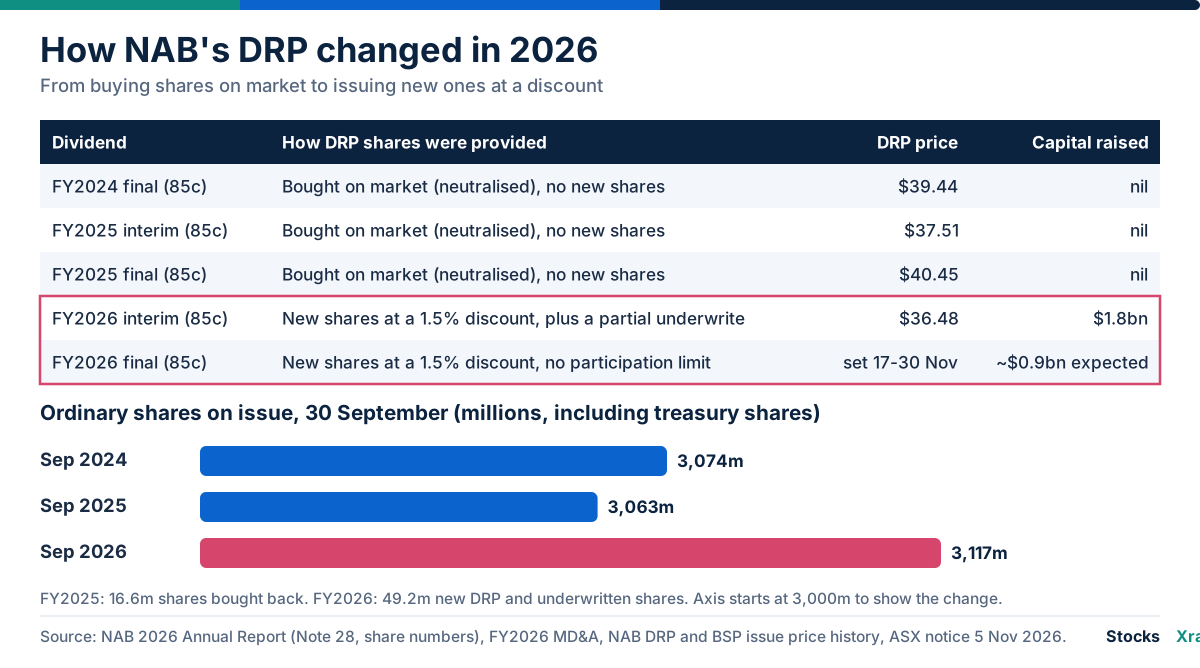
The chair, Philip Chronican, wrote in the 2026 Annual Report that NAB retains the objective of holding or reducing its share count over time, but that given considerable global and economic uncertainty it was prudent to strengthen capital. NAB has used the same tool before: the 1.5% discount and partial underwrite of May 2019 were part of rebuilding capital after that year's cut.
Worked example: what the 2026 DRP did to a cash holder
The FY2026 interim DRP and its underwrite created 49.2 million new shares, on top of 3,063 million at the start of the year, an increase of about 1.6%. Take an illustrative holder of 10,000 shares who took cash. Their stake in NAB was 10,000 out of 3,063 million before and 10,000 out of about 3,112 million after, so their share of the bank, and of its future profits and dividends, fell by about 1.6%. A holder who reinvested at $36.48 instead added shares at a price 1.5% below the market average used. In FY2025, by contrast, NAB bought back 16.6 million shares, which nudged every remaining holder's stake up. Our guide to share dilution explains why new shares matter even when the dividend per share is unchanged.
The payout policy and the capital behind it
NAB says its dividend payout ratio is guided by a range of 65% to 75% of cash earnings, subject to the board's judgment at the time. It measures the ratio on cash earnings per share excluding large notable items.
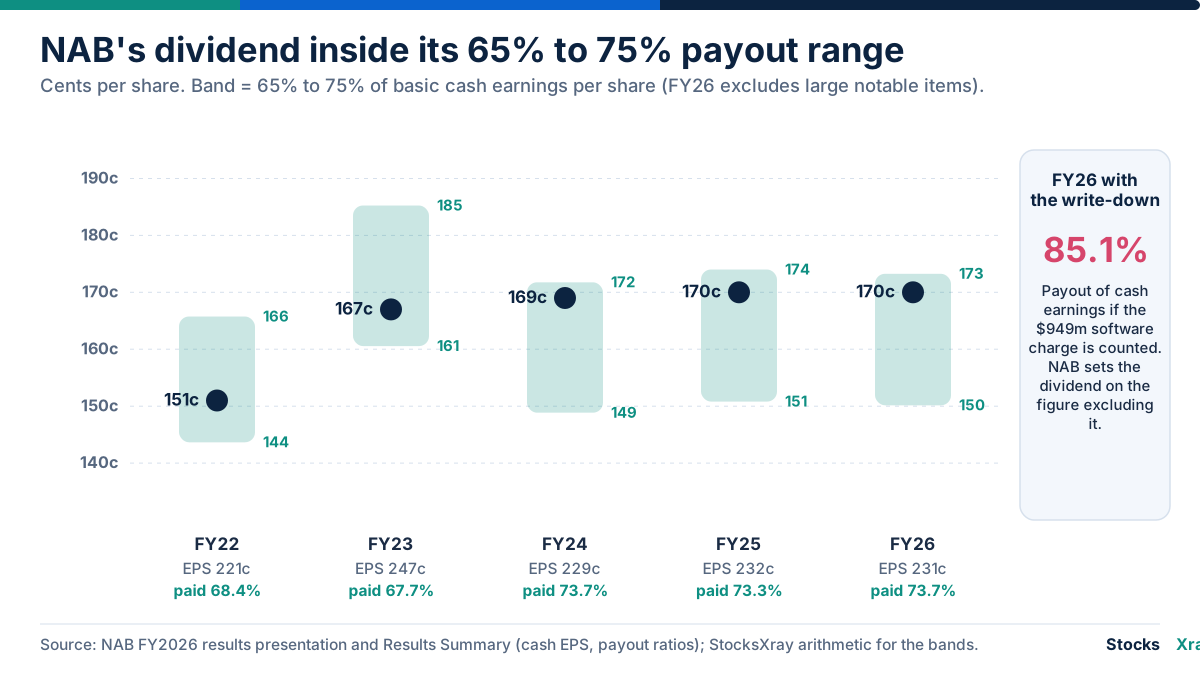
FY2026 cash EPS excluding the write-down was 230.7 cents. On that profit, the range spans about 150 to 173 cents a share, and the 170 cents paid sits 3 cents below the top. In FY2022 and FY2023 the dividend sat in the lower half of the band; since FY2024 it has been near the ceiling. With the payout already at 73.7%, the room left in the range is small, so within the stated policy the size of future dividends depends mostly on future cash earnings. Our guide to the dividend payout ratio explains how to read a ratio near the top of a range.
On capital, NAB's CET1 ratio was 11.87% at 30 September 2026 and 12.07% pro forma, including the expected DRP proceeds, against its operating target of above 11.25%. APRA's minimum is 10.25%, rising to 10.5% from 1 January 2027, when APRA begins phasing out Additional Tier 1 capital. The planned $300 million restructuring charge is expected to take about 0.05 percentage points off CET1 in the first quarter of FY2027.
Franking: a thin account
NAB estimated its available franking credits at only $306 million at 30 September 2026, down from $409 million a year earlier, after allowing for tax payable. The 85 cent final, about $2,650 million in total, needs roughly $1,136 million of credits to be fully franked. NAB says the final will use up the balance and that tax instalments paid after 30 September will generate enough credits to frank it fully. It also says franking is not guaranteed and depends on capital management and the level of profits taxed in Australia. Alongside Australian franking, NAB attaches New Zealand imputation credits, NZ$0.15 a share on the FY2026 final.
Worked example: 1,000 shares and the 85 cent final
- Cash: 1,000 x 85 cents = A$850.
- Franking credit: A$850 x 30/70 = A$364.29. An Australian resident adds this to taxable income, A$1,214.29 grossed up, and deducts the same amount from tax. At a 30% marginal rate the credit exactly covers the tax on the dividend; below that, eligible individuals can get the excess refunded.
- New Zealand imputation credit: NZ$150, usable only by people who file New Zealand tax returns.
- Paid in another currency: NAB pays cash dividends in Australian, New Zealand and US dollars and British pounds. At the rates it fixed at 4pm Sydney time on 13 November 2026, A$850 became US$578.00, NZ$1,041.85 or GBP436.73. The Australian Taxation Office says no withholding tax has to be deducted from fully franked dividends paid to foreign residents, though their home country may tax them. Our AUD to USD converter shows the current rate.
NAB dividend yield, with dates
NAB closed at A$38.86 on 13 November 2026. The two dividends that went ex in the previous 12 months, 85 cents each, total $1.70, a cash yield of 4.4%. Including franking credits, the grossed-up yield was 6.2%.
That figure looks back, not forward, and moves with the share price every day. NAB has not set its FY2027 dividends. Our explainer on dividend yield shows how to compare yields fairly, and our best dividend stocks list ranks income stocks across markets. The NAB stock page shows the latest price and yield, the interactive chart the price history, and the ASX 200 page the wider market.
How StocksXray scores NAB
On 13 November 2026 NAB had a Market X-Ray score of 78 out of 100, with high confidence, ranking 191st of 1,820 ASX stocks on our stock page. The Market X-Ray is price-based: it ranks how the shares have traded against other ASX stocks. The five lenses read trend 69, momentum 66, stability 89, liquidity 100 and income 70.
The income lens scores the cash dividend yield and the regularity of payments, without franking credits, so a 4.4% yield paid every year scores 70. Trend and momentum are lower: on that date the shares were 3.7% below their 200-day average and 21% below their 52-week high. The score says nothing about NAB's capital, credit quality or dividend safety; our fundamental X-Ray, built from financial statements, is not yet available for Australian stocks. The NAB research report collects the data on one page, and how the X-Ray Score works explains the method.
Risks NAB itself lists
NAB's 2026 Annual Report sets out its principal risks and says it gives no assurance of future distributions. Those that bear most directly on the dividend:
- Business credit. Adverse business conditions in Australia and New Zealand could raise defaults. NAB names construction, transport and manufacturing as exposed to rising input costs, and retail, tourism and hospitality as exposed to weaker consumer spending. With 52% of cash earnings coming from Business and Private Banking, this is the risk most closely tied to NAB's largest division.
- Property values. Home loans and commercial property loans are a large part of NAB's book, so falling property prices can increase losses when borrowers default. In August 2026 NAB said the Middle East conflict, higher interest rates and Federal Budget tax changes were creating challenges for customers, and its home loan applications were down 15% on the previous quarter.
- Agriculture. NAB says it has a large share of lending to Australian and New Zealand agriculture, which is exposed to commodity prices, input costs such as fertiliser and fuel, trade restrictions and disease.
- Capital rules. Prudential requirements may limit dividends or require NAB to raise more capital, and APRA's capital framework changes from 1 January 2027.
- Competition and technology. NAB lists online banks, private credit funds and large technology companies as competitors, and AI as both an opportunity and a risk.
- Financial crime. AUSTRAC cancelled NAB's 2022 enforceable undertaking on anti-money laundering compliance in July 2025, but NAB says it continues to find, report and fix compliance issues.
Common mistakes when reading NAB's dividend
- Reading the 85.1% payout as a warning sign on its own. It includes a non-cash software write-down; on NAB's own measure the payout was 73.7%.
- Ignoring dilution. The dividend per share was flat in FY2026, but new DRP shares mean the bank's total dividend is shared among about 1.8% more shares.
- Assuming the December payment date is the cut-off. The final goes ex-dividend in early November.
- Expecting full franking forever. NAB's franking account is thin and it says franking is not guaranteed.
- Treating the yield as a promise. A 4.4% trailing yield reflects past dividends and one day's price.
Frequently asked questions
When is the next NAB dividend paid? The next payment is the FY2026 final of 85 cents a share, fully franked, payable on 15 December 2026 to shareholders on the register on 11 November 2026. The shares went ex-dividend on 10 November 2026. As of 14 November 2026, the next scheduled ex-dividend date is 10 May 2027, for the FY2027 interim, which is due to be paid on 2 July 2027.
What are the NAB dividend dates for 2026? The FY2026 interim of 85 cents went ex-dividend on 7 May 2026, had a record date of 8 May and was paid on 2 July 2026. The FY2026 final of 85 cents went ex-dividend on 10 November 2026, has a record date of 11 November and is payable on 15 December 2026.
What were the NAB dividend dates for 2025? The FY2025 interim of 85 cents went ex-dividend on 12 May 2025 and was paid on 2 July 2025. The FY2025 final of 85 cents went ex-dividend on 11 November 2025 and was paid on 12 December 2025. Both were fully franked, 170 cents in total.
How much has NAB paid in dividends over time? NAB paid 198 cents a year from FY2015 to FY2018, cut to 166 cents in FY2019 and 60 cents in FY2020, then rose to 127, 151, 167 and 169 cents before reaching 170 cents in FY2025 and FY2026. Every dividend since December 2007 has been fully franked.
What is the NAB dividend yield? Based on the $1.70 of dividends that went ex in the 12 months to 13 November 2026 and that day's close of A$38.86, the cash yield was 4.4%, or 6.2% including franking credits. The yield changes with the share price and each new dividend.
Does NAB have a dividend reinvestment plan? Yes. Eligible shareholders can take new shares instead of cash. For the FY2026 final the DRP price is the average over 17 to 30 November 2026 less a 1.5% discount, with shares issued on 15 December 2026. The election deadline was 5pm (AEDT) on 12 November 2026.
Are NAB dividends fully franked? Yes, at the 30% company tax rate, so each 85 cent dividend carries a franking credit of about 36 cents. NAB says franking is not guaranteed and its available franking credits were $306 million at 30 September 2026. The FY2026 final also carries a NZ$0.15 New Zealand imputation credit.
Has NAB announced its 2027 dividends? No amounts have been announced. As of 14 November 2026, NAB's calendar schedules the FY2027 interim with half-year results on 5 May 2027 and the FY2027 final with full-year results on 9 November 2027. StocksXray does not project future dividends.
Sources and data notes
- NAB, 2026 Full Year Results Summary, Management Discussion and Analysis and Investor Presentation, 5 November 2026.
- NAB, 2026 Annual Report (chair's message, Note 28 dividends and franking, risk factors).
- NAB, ASX dividend notice and 2027 financial calendar, 5 November 2026; currency update, 13 November 2026.
- NAB, dividend payment history, dividend information and DRP and BSP issue prices, read on 14 November 2026.
- NAB ASX releases of 17 August, 20 October and 9 November 2026; NAB 2019 and 2020 half-year and 2020 full-year results.
- ATO guidance on franking credits and withholding from dividends paid to foreign residents.
- Share price and Market X-Ray scores: StocksXray, close of 13 November 2026.
This guide covers NAB's dividends and results to 14 November 2026. It does not include dividend forecasts or personal tax advice; tax outcomes depend on your residence and circumstances.
Educational information, not financial advice.
Related reading
Educational only, not financial advice. Examples use illustrative numbers.