











Intel Earnings and Dividend: Results, Report Dates and Valuation
Intel lost $267 million in 2025, or $0.06 a share, on revenue of $52.9 billion, after losing $18.8 billion in 2024. Sales have since picked up: revenue in the third quarter of 2026 rose 21% to $16.5 billion and diluted earnings per share were $0.60. Intel reports about four weeks after each quarter, usually on a Thursday in late January, April, July and October. It has paid no dividend since September 2024. This guide covers its results, report dates, dividend record and valuation measures.
Key takeaways
- Revenue was flat in 2025 at $52.9 billion, a third below the $79.0 billion of 2021. On Intel's adjusted (non-GAAP) basis, 2025 EPS was $0.42.
- Growth returned in 2026: revenue rose 7%, 25% and 21% in the first three quarters, and Data Center and AI sales rose 78% in the third quarter.
- GAAP profit swings with a non-cash item: shares held in escrow for the US government are valued at the share price, which produced a $12.5 billion loss in the second quarter of 2026 and a $1.0 billion gain in the third.
- Intel suspended its dividend from the fourth quarter of 2024. Its investor-relations page said on 14 November 2026 that no future dividends were declared.
- Intel raised $23.0 billion by selling shares at $95 in August 2026. On 26 September 2026 it held $54.0 billion of cash and short-term investments against $50.1 billion of debt.
How Intel makes money
Intel designs processors and, unlike many technology companies that outsource production, makes most of them in its own wafer plants and assembly and test sites. Its fiscal year is 52 or 53 weeks long and ends on the last Saturday in December; the third quarter of 2026 ended on 26 September.
It reports these businesses:
- Client Computing and Physical AI Group (CCPG), called the Client Computing Group until early 2026, sells processors for PCs and edge devices. It brought in $32.2 billion in 2025, down 3%, with $9.3 billion of operating income.
- Data Center and AI (DCAI) sells server processors, mainly the Xeon family, and related data-center products. Revenue was $16.9 billion in 2025, up 5%, with $3.4 billion of operating income.
- Intel Foundry runs the factories and process technology. It sells mostly to Intel's own product groups and is building an outside customer base. Revenue was $17.8 billion in 2025, and it lost $10.3 billion at the operating level.
- All other includes Mobileye, IMS and, until it was deconsolidated on 12 September 2025 after Intel sold 51% of it, the Altera programmable-chip business. It brought in $3.6 billion.
Segment revenues add up to more than the total because Intel Foundry's sales to Intel's own product groups appear in both and are then removed: these eliminations were $17.7 billion in 2025.
The third quarter of 2026 shows where growth is coming from. CCPG revenue fell 5% to $8.1 billion, while DCAI rose 78% to $7.3 billion and earned $3.0 billion of operating income. Foundry revenue rose 58% to $6.7 billion and its operating loss narrowed to $1.9 billion from $2.3 billion. Intel's chief financial officer said he sees the PC slowdown continuing at least through the first half of 2027, while the chief executive pointed to demand for Xeon processors beyond Intel's current supply.
Intel's earnings record, 2021 to 2025
| Year | Revenue | Gross margin | Operating income (loss) | Net income (loss) attributable to Intel | Diluted EPS | Dividends declared per share |
|---|---|---|---|---|---|---|
| 2021 | $79.0 billion | 55.4% | $19.5 billion | $19.9 billion | $4.86 | $1.39 |
| 2022 | $63.1 billion | 42.6% | $2.3 billion | $8.0 billion | $1.94 | $1.46 |
| 2023 | $54.2 billion | 40.0% | $0.1 billion | $1.7 billion | $0.40 | $0.74 |
| 2024 | $53.1 billion | 32.7% | -$11.7 billion | -$18.8 billion | -$4.38 | $0.38 |
| 2025 | $52.9 billion | 34.8% | -$2.2 billion | -$0.3 billion | -$0.06 | none |
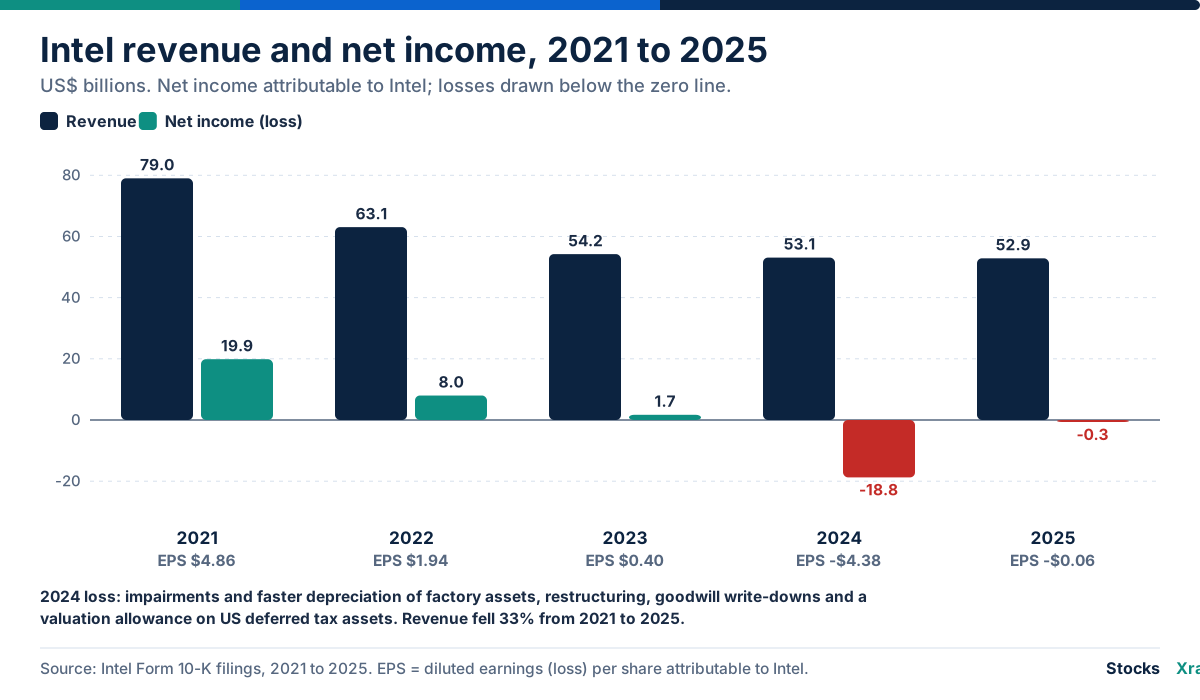
Revenue fell 33% from 2021 to 2025. Intel's annual report points to intense competition across its product range and to a shift in data-center spending toward GPUs for AI workloads. Gross margin fell from 55.4% in 2021 to 32.7% in 2024, the year of large write-downs of factory assets, and recovered to 34.8% in 2025.
The 2024 loss of $18.8 billion came mostly from non-cash charges. Intel's annual report lists impairments and faster depreciation of manufacturing assets, restructuring under its 2024 plan, goodwill write-downs and a $9.9 billion valuation allowance against US deferred tax assets, which alone cost $2.32 a share. In 2025 the operating loss narrowed to $2.2 billion as research, marketing and administrative costs fell 17% and restructuring charges shrank, and $5.3 billion of gains on divestitures, mainly Altera, kept the net loss to $0.3 billion.
Why Intel's GAAP and non-GAAP earnings differ
Intel's non-GAAP figures exclude share-based compensation, amortization of acquired intangibles, restructuring and impairments, gains and losses on investments and divestitures, and, since 2025, the mark-to-market of escrowed shares. That last item needs explaining.
In August 2025 the US Department of Commerce took an equity stake in Intel in exchange for CHIPS Act funds: 275 million shares, warrants over 241 million more, and 159 million shares placed in escrow to be released as Intel receives money under the Secure Enclave program. Intel accounts for the escrowed shares as a liability valued at the share price. When the price rises, the liability grows and Intel books a loss; when it falls, Intel books a gain. The liability stood at $13.7 billion on 26 September 2026, and Intel's 10-Q says further gains or losses will follow the share price. Our guide to stock-based compensation and dilution covers the other large adjustment.
The latest five quarters
| Quarter (period end) | Reported | Revenue | Change | Net income (loss) | Diluted EPS | Non-GAAP EPS |
|---|---|---|---|---|---|---|
| Q3 2025 (27 Sep 2025) | 23 Oct 2025 | $13.65 billion | +3% | $4.06 billion | $0.90 | $0.23 |
| Q4 2025 (27 Dec 2025) | 22 Jan 2026 | $13.67 billion | -4% | -$0.59 billion | -$0.12 | $0.15 |
| Q1 2026 (28 Mar 2026) | 23 Apr 2026 | $13.58 billion | +7% | -$3.73 billion | -$0.73 | $0.29 |
| Q2 2026 (27 Jun 2026) | 23 Jul 2026 | $16.13 billion | +25% | -$11.03 billion | -$2.16 | $0.42 |
| Q3 2026 (26 Sep 2026) | 29 Oct 2026 | $16.51 billion | +21% | $3.32 billion | $0.60 | $0.52 |
Net income is the amount attributable to Intel. Changes are against the same quarter a year earlier.
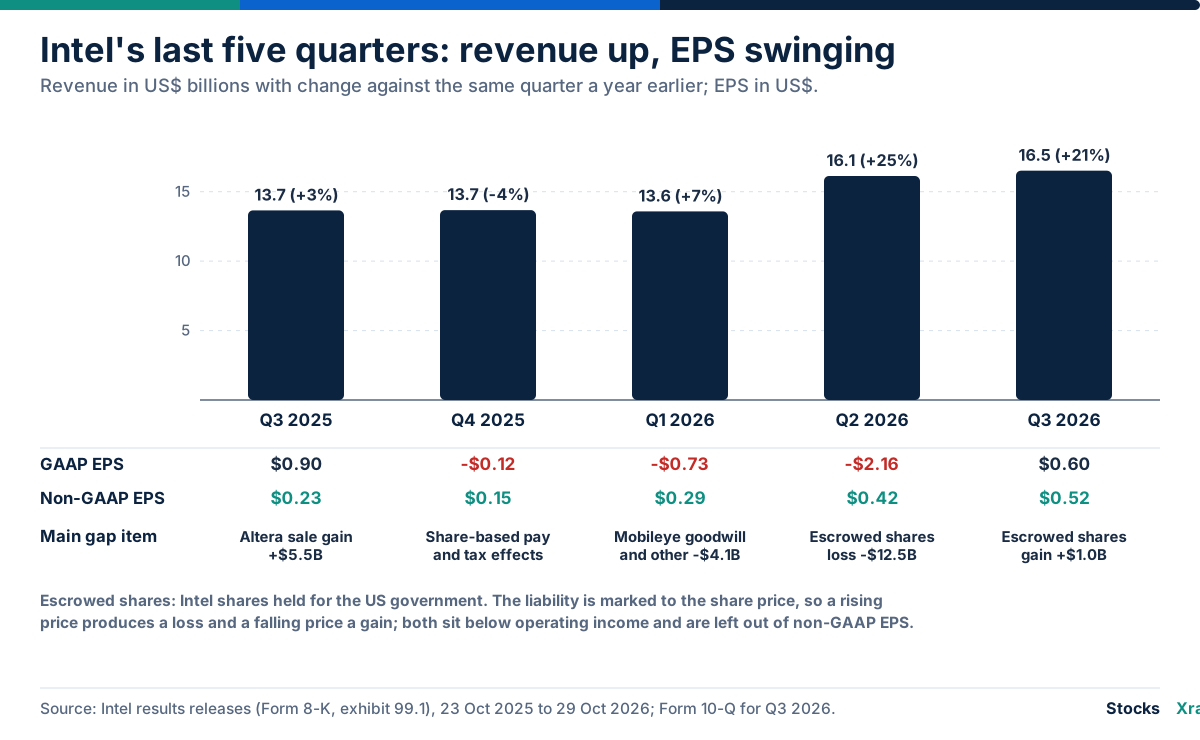
The GAAP line is noisy for specific reasons. The September 2025 quarter included a $5.5 billion gain on the Altera sale. The March 2026 quarter carried $4.1 billion of restructuring and other charges, mainly a goodwill impairment at Mobileye. The June 2026 quarter carried the $12.5 billion escrowed-share loss after a sharp rise in the share price, and the September quarter reversed $1.0 billion of it when the price fell. Underneath, operations improved: the GAAP operating margin went from 5.0% in the third quarter of 2025 to 15.3% a year later, and gross margin from 38.2% to 43.0%.
When Intel reports earnings
Intel's fiscal quarters end on the last Saturday of March, June, September and December. It reports about four weeks later, usually on a Thursday after the US market closes, with a webcast at 2:00 p.m. Pacific time on intc.com. In the past year the reports came on 23 October 2025, 22 January 2026, 23 April 2026, 23 July 2026 and 29 October 2026. The second-quarter 2026 report, which many searches ask about, was on Thursday, 23 July 2026, and Intel filed its 10-Q the next day.
For the third quarter of 2026 Intel announced the date on 6 October, about three weeks ahead. As of 14 November 2026 Intel's investor-relations calendar listed no upcoming events, so the date for fourth-quarter and full-year 2026 results had not been announced. The fourth-quarter 2025 results came out on 22 January 2026.
Intel gives guidance in its release. On 29 October 2026 it gave a fourth-quarter outlook of $15.0 billion to $16.0 billion of revenue, with GAAP EPS of $0.10 and non-GAAP EPS of $0.25 at the midpoint. Those are the company's figures, not ours. Our guide to earnings season and guidance explains why the outlook can move the shares more than the quarter itself, and how to read a 10-K covers the annual report.
Intel's dividend: suspended since 2024
Intel does not currently pay a dividend. It paid its last one, $0.125 a share, on 1 September 2024 to shareholders of record on 7 August 2024. With its second-quarter 2024 results on 1 August 2024 it said it was suspending the dividend from the fourth quarter to protect liquidity for the investments its strategy needs, and it repeated a long-term commitment to a competitive dividend once cash flows improve to sustainably higher levels. As of 14 November 2026 its investor-relations page showed no future dividends declared, and Intel paid nothing to shareholders in dividends in 2025 or the first nine months of 2026.
Two filings bear on when payments could resume. The annual report for 2024 said Intel had agreed under its CHIPS Act commercial agreement to forgo dividends for two years and to accept limits for three years after that, and did not expect to pay dividends until cash flows improve. That agreement was amended in August 2025 when the government took its equity stake; the annual report for 2025 does not repeat the dividend language and gives no timetable for resuming payments.
Intel's dividend history
Intel's published dividend history begins with a payment on 1 December 1992. Its last stock split was 2-for-1 in July 2000, so amounts from 2000 onward need no split adjustment and the table below is on today's share count. Intel's own history page lists 1990s payments as they were paid, before five 2-for-1 splits between 1993 and 2000; divide those by up to 32 (for payments before June 1993) to compare.
| Year | Quarterly rate | Paid per share in the year | Change in the quarterly rate |
|---|---|---|---|
| 2015 | $0.24 | $0.96 | +6.7% |
| 2016 | $0.26 | $1.04 | +8.3% |
| 2017 | $0.26, then $0.2725 | $1.0775 | +4.8% |
| 2018 | $0.30 | $1.20 | +10.1% |
| 2019 | $0.315 | $1.26 | +5.0% |
| 2020 | $0.33 | $1.32 | +4.8% |
| 2021 | $0.3475 | $1.39 | +5.3% |
| 2022 | $0.365 | $1.46 | +5.0% |
| 2023 | $0.365, then $0.125 | $0.74 | -65.8% |
| 2024 | $0.125, then suspended | $0.375 | suspended |
| 2025 | none | none | none |
| 2026 (to 14 Nov) | none | none | none |
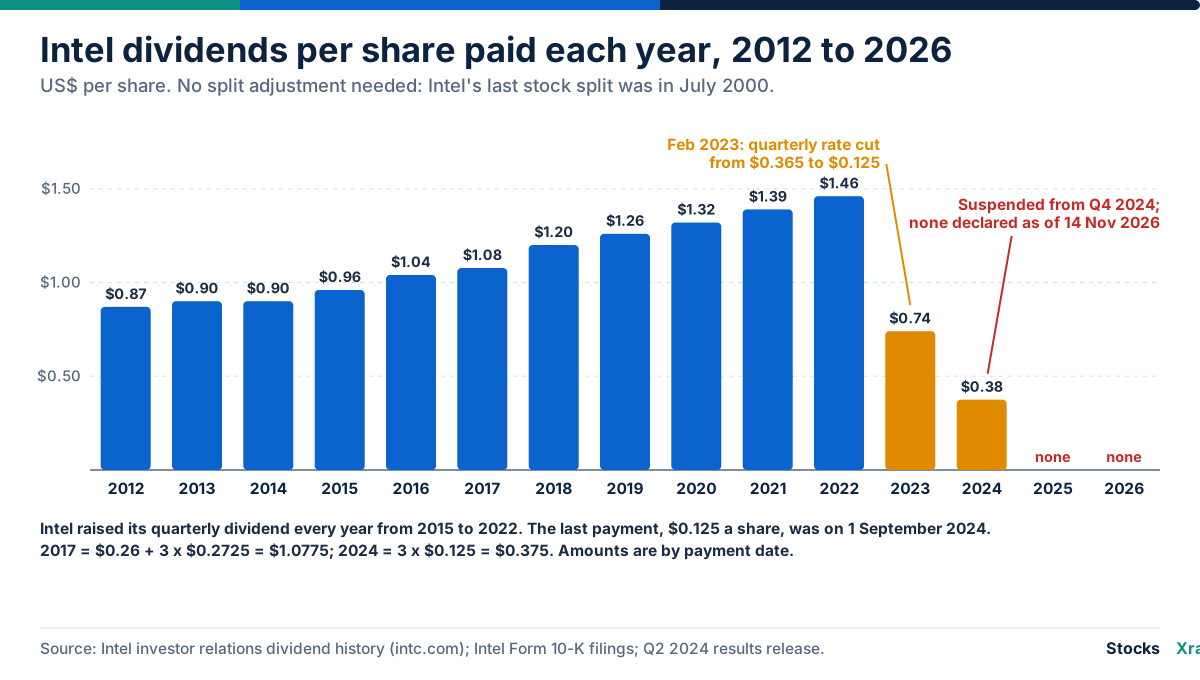
Intel raised the payment every year from 2015 to 2022, then cut the quarterly rate by two-thirds, to $0.125, in a declaration of 22 February 2023, and stopped after the September 2024 payment. Payments fell on the first day of March, June, September and December, with record dates on the 7th of the month before. Our guides to ex-dividend and record dates and dividend yield explain the terms, and the dividend calendar lists US companies that do pay.
Intel's dividend yield is therefore zero; a yield above zero quoted for Intel rests on payments made in 2024 or earlier. Intel has also made no buybacks under its repurchase program since the first quarter of 2021; its investor-relations page showed $7.24 billion of authorization left on 28 March 2026. Our best dividend stocks list ranks S&P 500 companies that do pay, with yields between 2% and 8%.
INTC stock valuation in plain numbers
Because Intel's GAAP earnings are negative over the last four quarters, the usual price-to-earnings ratio does not work. Other measures still describe what the market price implied on a given day, without saying whether that is cheap or dear.
Worked example. At the close on 13 November 2026 the shares were $59.66. Intel had 5,315 million shares outstanding on 23 October 2026, so the market value was about $317.1 billion. Over the four quarters to 26 September 2026:
| Measure | Inputs | Result on 13 Nov 2026 |
|---|---|---|
| Price to GAAP earnings | EPS of -$0.12 - $0.73 - $2.16 + $0.60 = -$2.41 | not meaningful (loss) |
| Price to non-GAAP earnings | EPS of $0.15 + $0.29 + $0.42 + $0.52 = $1.38 | 43.2 |
| Price to sales | revenue of $59.9 billion | 5.3 |
| Price to book | Intel stockholders' equity of $114.9 billion, or $21.64 a share | 2.76 |
The non-GAAP ratio can be computed only because Intel leaves out escrowed-share losses, restructuring and share-based pay; on GAAP earnings there is no positive ratio at all. Book value matters more for Intel than for most chip designers because it owns $105.3 billion of factories and equipment, net of depreciation. Our guides to price-to-earnings, price-to-sales and price-to-book ratios explain each measure, and cyclical stocks and normalised earnings covers why one year's profit can mislead in this industry. None of these numbers is a verdict on the shares.
Cash flow, capital spending and the balance sheet
| Year | Cash from operations | Gross capital spending | Adjusted free cash flow | Dividends paid |
|---|---|---|---|---|
| 2021 | $29.5 billion | $18.7 billion | $10.9 billion | $5.6 billion |
| 2022 | $15.4 billion | $24.8 billion | -$4.1 billion | $6.0 billion |
| 2023 | $11.5 billion | $25.8 billion | -$11.9 billion | $3.1 billion |
| 2024 | $8.3 billion | $25.1 billion | -$2.2 billion | $1.6 billion |
| 2025 | $9.7 billion | $17.7 billion | -$1.6 billion | none |
Adjusted free cash flow is Intel's own measure: cash from operations minus capital spending, after adding government incentives and partners' contributions to factory projects and deducting finance-lease payments. Partners such as Brookfield in Arizona and, until 2026, Apollo in Ireland paid for part of the new fabs, which is why Intel's measure comes out much higher than cash from operations minus gross spending. Our guides to capital expenditure and free cash flow explain the terms.
The table shows why the dividend went: adjusted free cash flow was negative every year from 2022 to 2025, even after partner money, while dividends still cost $10.7 billion over 2022 to 2024. In 2026 cash from operations reached $13.2 billion in nine months, but adjusted free cash flow was -$8.8 billion, mainly because Intel paid $14.2 billion in April to buy back Apollo's 49% stake in the Fab 34 venture in Ireland.
Intel filled the gap with outside money. Between August and December 2025 it received $5.7 billion from the US government, $2.0 billion from SoftBank and $5.0 billion from Nvidia, in exchange for new shares and, in the government's case, warrants and escrowed shares. In 2026 it borrowed $6.5 billion in notes in April and sold about 242 million shares at $95 in August for $23.0 billion gross ($22.6 billion net). On 26 September 2026 it held $21.8 billion of cash and $32.2 billion of short-term investments against $3.8 billion of short-term and $46.3 billion of long-term debt, and its two revolving credit lines, enlarged to $4.8 billion and $9.7 billion, were undrawn. The cost is dilution: shares outstanding rose from 4,330 million at the end of 2024 to 5,315 million in October 2026, about 23% more.
How StocksXray scores Intel
On 13 November 2026 Intel had a StocksXray X-Ray Score of 19 out of 100, with medium confidence, which our ranking placed at the bottom of the information technology sector on that date. Each lens is scored from 0 to 100 against the sector:
| Lens | Score on 13 Nov 2026 |
|---|---|
| Valuation | 5 |
| Growth | 6 |
| Profitability | 20 |
| Financial health | 47 |
| Dividends | no score (no dividend) |
The growth lens looks back three years, when revenue fell about 6% a year, so it does not yet reflect the 2026 recovery. Financial health scores best because cash and short-term investments exceed debt, though operating profit covered interest only about 1.5 times. Read the five lenses and how the X-Ray Score works for the method, and check the Intel stock page for the current score.
For the share price, use the interactive Intel chart. The Intel research report gathers valuation history, our fair-value models and a fundamentals checklist, the Intel forecast page shows probability ranges built from past price moves rather than targets, and the Intel stock split page lists its five splits between 1993 and 2000.
Intel news in 2026 from its filings
- Factory buyback and debt. On 8 April 2026 Intel bought Apollo's 49% stake in its Fab 34 joint venture in Ireland for $14.2 billion, using cash and a $6.5 billion bridge loan, and on 30 April it issued $6.5 billion of notes due between 2031 and 2066.
- Leadership. Lip-Bu Tan has been chief executive since 18 March 2025. Craig Barratt became independent chair after the annual meeting on 13 May 2026, succeeding Frank Yeary. The chief legal officer left on 1 June 2026, the chief accounting officer resigned on 24 April 2026, and Dean Jarnac was named chief sales officer.
- Share sale. The $23.0 billion offering closed on 12 August 2026; Intel said the money is for general purposes, including capital spending and working capital.
- Deals. In October 2026 Intel agreed to buy Classiq Technologies, a quantum software company, for about $1.9 billion plus up to $350 million tied to milestones, with closing expected in the first half of 2027. It also announced a wider collaboration with Oracle on Xeon-based cloud computing.
- Accident in Israel. In mid-October 2026 an accident at Intel's plant in Kiryat Gat caused employee casualties and injuries and halted production for about two weeks, with a restart expected by the end of October. Intel said it expects charges in the fourth quarter and higher costs into the first half of 2027, and could not yet estimate the financial impact.
Risks Intel lists in its annual report
The 2025 Form 10-K and the latest 10-Q list many risks. These weigh most on earnings:
- Competition. Intel faces AMD and Qualcomm in processors, Nvidia and AMD in accelerators, and rivals whose chips are made by TSMC or Samsung, whose process improvements have helped those rivals.
- Heavy, risky investment. Factory and process spending is above historical levels and may not earn a favorable return.
- Intel 14A. If Intel cannot win a significant outside foundry customer for its next process, it may pause or stop leading-edge development, which would leave its products dependent on outside foundries and put some of its more than $100 billion of property, plant and equipment at risk.
- Government ownership and financing. The US government's large equity stake and Intel's partner financing deals bring their own risks and complexity.
- Demand and supply. Demand can shift, for example toward GPUs in data centers, and Intel cites industry-wide substrate and memory shortages in its supply chain.
Common mistakes when reading Intel's results
- Reading the Q2 2026 loss as an operating loss. Intel's operating margin that quarter was 11.1%; the $11.0 billion net loss came from the escrowed-share revaluation.
- Adding up segment revenue. Intel Foundry's sales are mostly to Intel's own product groups and are eliminated in the total.
- Comparing across the Altera sale. Results before September 2025 include Altera; later ones do not.
- Using an old dividend yield. Intel has paid no dividend since September 2024, so any yield above zero is stale.
- Ignoring dilution. The share count has risen by about 23% since the end of 2024, so per-share figures grow more slowly than totals.
Frequently asked questions
When does Intel report earnings? Intel reports four times a year, about four weeks after its quarters end, usually on a Thursday in late January, April, July and October, after the US market closes. A webcast follows at 2:00 p.m. Pacific time on intc.com. The latest report, for the quarter to 26 September 2026, came out on 29 October 2026.
When is Intel's next earnings date? As of 14 November 2026 Intel had not announced the date for its fourth-quarter and full-year 2026 results, and its investor-relations calendar listed no upcoming events. The comparable report last year came out on 22 January 2026. For the third quarter of 2026 Intel gave the date about three weeks ahead.
Does Intel pay dividends? No. Intel suspended its quarterly dividend from the fourth quarter of 2024 to preserve cash for investment. The last payment was $0.125 a share on 1 September 2024, and as of 14 November 2026 no future dividend had been declared.
Why did Intel stop paying a dividend? Intel said it needed to prioritize liquidity for its factory and technology investments; from 2022 to 2024 its capital spending exceeded the cash its operations generated. Its 2024 annual report also said it had agreed under its CHIPS Act agreement to forgo dividends for two years; that agreement was amended in 2025. Intel says it remains committed to a competitive dividend once cash flows are sustainably higher.
What is Intel's dividend history? Intel's published dividend history starts in 1992. It paid $0.96 a share in 2015, raised the payment every year to $1.46 in 2022, cut the quarterly rate to $0.125 in 2023, and suspended it after the September 2024 payment. Amounts since 2000 need no adjustment for stock splits.
When were Intel's Q2 2026 earnings? Intel reported second-quarter 2026 results on Thursday, 23 July 2026. Revenue rose 25% to $16.1 billion, non-GAAP EPS was $0.42, and GAAP EPS was a loss of $2.16 because of a $12.5 billion non-cash loss on escrowed shares.
How is INTC stock valued? At the $59.66 close on 13 November 2026, Intel traded at about 43 times its last four quarters of non-GAAP earnings, 5.3 times sales and 2.8 times book value. GAAP earnings over those quarters were negative, so a GAAP price-to-earnings ratio is not meaningful. These measures describe the price; they do not say whether it is high or low.
Sources and data notes
- Intel Form 10-K for 2025, filed 23 January 2026, and earlier 10-K filings for 2021 to 2024: SEC EDGAR, Intel filings.
- Intel Form 10-Q for the quarter ended 26 September 2026, filed 30 October 2026.
- Intel results releases (Form 8-K, exhibit 99.1) of 23 October 2025, 22 January, 23 April, 23 July and 29 October 2026, and of 1 August 2024 for the dividend suspension.
- Intel Form 8-K filings of 14 March 2025, 12 November and 29 December 2025, and 23 January, 3 March, 3 April, 8 April, 24 April, 30 April and 12 August 2026.
- Intel investor relations: dividends and buybacks, IR calendar and press releases, checked 14 November 2026.
- Share price and X-Ray scores: StocksXray data as of the 13 November 2026 close.
This article covers reported results to the quarter ended 26 September 2026 and company announcements to 14 November 2026. It reports the company's own guidance once, with attribution, and includes no analyst estimates and no view on where the shares are heading.
Educational information, not financial advice.
Related reading
Stocks in this article
Educational only, not financial advice. Examples use illustrative numbers.