











Broadcom Earnings and Dividend: Results, Report Dates and History
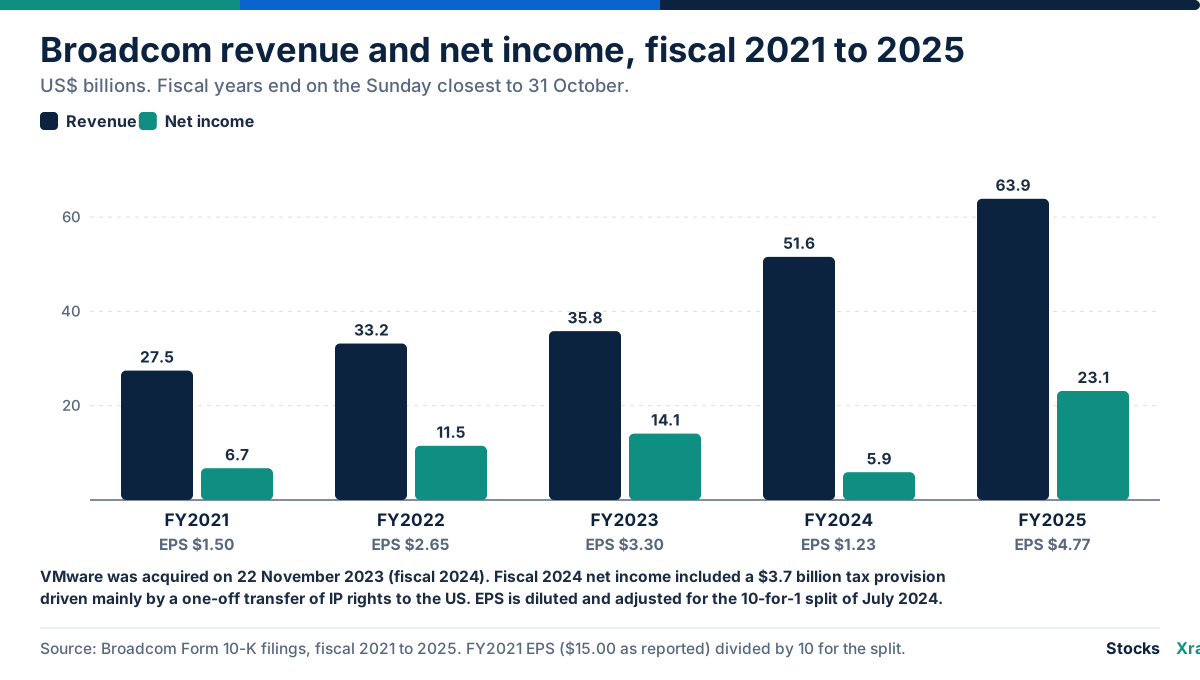
Broadcom earned $23.1 billion on revenue of $63.9 billion in the fiscal year that ended on 2 November 2025, and diluted earnings per share rose to $4.77 from $1.23. Growth has since sped up: revenue in the quarter to 2 August 2026 rose 86% to $29.6 billion, led by chips for AI data centers. Broadcom reports about a month after each quarter ends, next on 9 December 2026, and pays a quarterly dividend of $0.65 a share. This guide covers its results, report dates and split-adjusted dividend record.
Key takeaways
- Fiscal 2025 revenue rose 24% to $63.9 billion. Net income almost quadrupled to $23.1 billion, because fiscal 2024 had carried a $3.7 billion tax charge and heavy VMware integration costs.
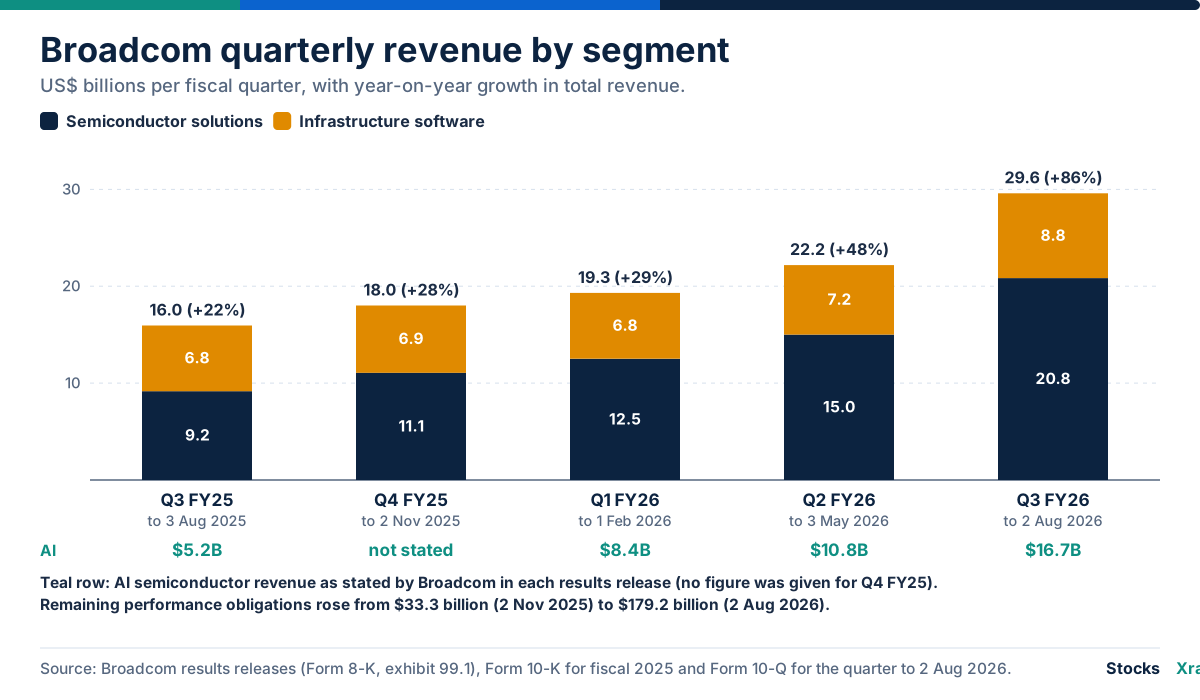
- AI semiconductor revenue reached $16.7 billion in the quarter to 2 August 2026, up 221% from a year earlier and more than half of all revenue.
- Broadcom has confirmed that it will report fourth-quarter and fiscal 2026 results on Wednesday, 9 December 2026, after the US market closes, with a call at 2:00 p.m. Pacific time.
- The dividend is $0.65 a quarter, or $2.60 for fiscal 2026, after a 10% raise in December 2025. Split-adjusted, the annual dividend has risen every year since Broadcom started paying in fiscal 2011.
- In filings since September 2026 Broadcom has disclosed two backstops on financing for AI hardware leased to customers, with maximum potential liabilities of about $29 billion and $43 billion.
How Broadcom makes money
Broadcom designs chips and sells infrastructure software. It outsources most of its chip manufacturing, with the majority of front-end wafer production done by outside foundries including TSMC, which is why its capital spending is small next to its revenue. Its fiscal year is 52 or 53 weeks long and ends on the Sunday closest to 31 October, so fiscal 2026 runs from 3 November 2025 to 1 November 2026.
It reports two segments:
- Semiconductor solutions covers custom AI accelerators (Broadcom calls them XPUs), Ethernet switching and networking chips for data centers, and older lines in broadband, wireless, storage and industrial markets. It produced $36.9 billion of revenue in fiscal 2025, 58% of the total, up 22%.
- Infrastructure software is mostly VMware, bought on 22 November 2023 for about $30.8 billion in cash plus 544 million shares (split-adjusted) worth $53.4 billion. Its main product is VMware Cloud Foundation, a platform for running private clouds. The segment also sells mainframe, cybersecurity, enterprise and storage-network management software. It produced $27.0 billion in fiscal 2025, 42%, up 26%.
The mix has swung toward chips in fiscal 2026. In the quarter to 2 August 2026 semiconductor solutions brought in $20.8 billion, 70% of revenue and up 127%, while software grew 29% to $8.8 billion. AI revenue alone was about 80% of semiconductor sales.
Two disclosures show how concentrated that growth is. Direct sales to one semiconductor customer, a distributor, made up 50% of revenue in that quarter, against 32% in fiscal 2025. Broadcom estimates that its top five end customers, counted through all channels, took about 55%. Its contracted backlog, reported as remaining performance obligations, jumped from $33.3 billion on 2 November 2025 to $179.2 billion on 2 August 2026, helped by a long-term contract for custom AI accelerators signed in the May 2026 quarter. Broadcom expects to recognize about 25% of that amount as revenue over the next 12 months. Our guide to deferred revenue explains how contracted amounts reach the income statement.
Broadcom's earnings record, fiscal 2021 to 2025
| Fiscal year | Revenue | Operating margin | Net income | Diluted EPS (split-adjusted) | Dividends per share (split-adjusted) |
|---|---|---|---|---|---|
| 2021 | $27.5 billion | 31.0% | $6.7 billion | $1.50 | $1.44 |
| 2022 | $33.2 billion | 42.8% | $11.5 billion | $2.65 | $1.64 |
| 2023 | $35.8 billion | 45.2% | $14.1 billion | $3.30 | $1.84 |
| 2024 | $51.6 billion | 26.1% | $5.9 billion | $1.23 | $2.11 |
| 2025 | $63.9 billion | 39.9% | $23.1 billion | $4.77 | $2.36 |
Broadcom split its stock 10-for-1 on 12 July 2024, so per-share figures from before then are divided by 10 in this table. Broadcom's later filings show fiscal 2022 and 2023 on the new share count; fiscal 2021 EPS was reported as $15.00 and appears here as $1.50.
Revenue rose 21% in fiscal 2022 and 8% in fiscal 2023, then 44% in fiscal 2024 as VMware joined, and 24% in fiscal 2025. Profit took a different path. In fiscal 2024 the operating margin fell to 26.1% as Broadcom amortized VMware's intangible assets and paid for restructuring, and a $3.7 billion tax provision, mainly from a one-off transfer of intellectual property rights to the United States, cut net income to $5.9 billion. In fiscal 2025 the margin recovered to 39.9% on demand for custom AI accelerators and networking chips, higher software license revenue and lower VMware labor costs, and a $397 million tax benefit replaced the charge.
Why Broadcom's GAAP and non-GAAP earnings differ
Broadcom's releases lead with non-GAAP figures that exclude amortization of acquired intangible assets, stock-based compensation, restructuring and some tax items. The gap is wide because acquisitions, chiefly VMware, left $26.3 billion of intangible assets still being written down on 2 August 2026, and stock awards cost $7.6 billion in fiscal 2025. For fiscal 2025, non-GAAP net income was $33.7 billion against $23.1 billion under GAAP, and non-GAAP EPS was $6.82 against $4.77. Broadcom also reports adjusted EBITDA, which was $43.0 billion. Our guides to stock-based compensation and dilution and goodwill and intangible assets explain why the two sets of numbers drift apart.
The latest five quarters
| Quarter (period end) | Reported | Revenue | Change | Net income | Diluted EPS | Non-GAAP EPS |
|---|---|---|---|---|---|---|
| Q3 FY2025 (3 Aug 2025) | 4 Sep 2025 | $15.95 billion | +22% | $4.14 billion | $0.85 | $1.69 |
| Q4 FY2025 (2 Nov 2025) | 11 Dec 2025 | $18.02 billion | +28% | $8.52 billion | $1.74 | $1.95 |
| Q1 FY2026 (1 Feb 2026) | 4 Mar 2026 | $19.31 billion | +29% | $7.35 billion | $1.50 | $2.05 |
| Q2 FY2026 (3 May 2026) | 3 Jun 2026 | $22.19 billion | +48% | $9.31 billion | $1.91 | $2.44 |
| Q3 FY2026 (2 Aug 2026) | 2 Sep 2026 | $29.59 billion | +86% | $13.09 billion | $2.68 | $3.32 |
Changes are against the same quarter a year earlier.
AI semiconductor revenue explains most of the acceleration. Broadcom put it at $5.2 billion in the quarter to August 2025, $8.4 billion in the quarter to February 2026, $10.8 billion in the quarter to May 2026 and $16.7 billion in the quarter to August 2026, a rise of 54% in three months. The fourth-quarter fiscal 2025 release gave a growth rate (74%) but no dollar figure.
In the August 2026 quarter, GAAP operating income rose 171% to $16.0 billion, or 54% of revenue, and cash from operations nearly doubled to $14.2 billion. For the first three quarters of fiscal 2026, revenue was $71.1 billion, up 55%, and diluted EPS was $6.09, against $3.02 a year earlier.
When Broadcom reports earnings
Broadcom's fiscal quarters end in early February, early May, early August and early November. It reports about a month later for the first three quarters, in early March, early June and early September, and five to six weeks later for the full year, in the second week of December. In the past year the releases came on 4 September 2025, 11 December 2025, 4 March 2026, 3 June 2026 and 2 September 2026, each followed by a call at 2:00 p.m. Pacific time.
Broadcom announces each date about a month ahead. On 9 November 2026 it confirmed that fourth-quarter and fiscal 2026 results will come out on Wednesday, 9 December 2026, after the close, with a conference call at 2:00 p.m. Pacific time (5:00 p.m. Eastern). The call is webcast at investors.broadcom.com, and an audio replay stays there for a year. The quarterly report on Form 10-Q, or the annual 10-K, follows about a week after the release.
Broadcom puts its guidance for the next quarter in the release itself. On 2 September 2026 it gave a fourth-quarter outlook of about $34.8 billion of revenue, which would be 93% more than a year earlier, and about $21.7 billion of AI semiconductor revenue. Those are the company's own numbers, not ours, and the December release will show how the quarter turned out. Our guide to earnings season and guidance explains why the outlook often moves the shares more than the quarter just ended, and how to read a 10-K covers the annual report.
Broadcom's dividend: history, dates and payout
Dividend per share since fiscal 2017
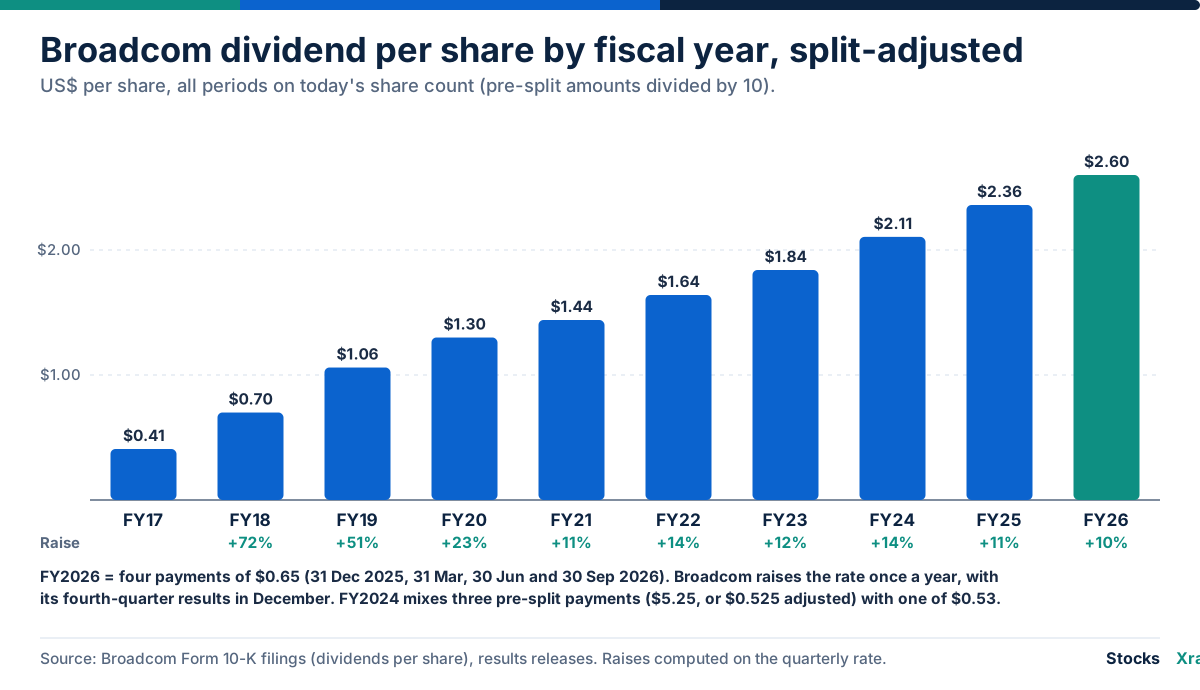
Broadcom pays a cash dividend every quarter and sets the rate for the whole fiscal year when it reports fourth-quarter results in December. The raise is tied to cash flow: in December 2025 the company linked its 10% increase, to $0.65, to higher cash flow in fiscal 2025, and called the planned $2.60 for fiscal 2026 the fifteenth consecutive annual increase since dividends began in fiscal 2011.
All amounts below are adjusted for the 10-for-1 split of July 2024 (pre-split amounts divided by 10).
| Fiscal year | Quarterly dividend | Total for the year | Raise in the quarterly rate |
|---|---|---|---|
| 2019 | $0.265 | $1.06 | 51% |
| 2020 | $0.325 | $1.30 | 23% |
| 2021 | $0.36 | $1.44 | 11% |
| 2022 | $0.41 | $1.64 | 14% |
| 2023 | $0.46 | $1.84 | 12% |
| 2024 | $0.525, then $0.53 | $2.105 | 14% |
| 2025 | $0.59 | $2.36 | 11% |
| 2026 | $0.65 | $2.60 | 10% |
Fiscal 2024 looks odd because of the split: three payments of $5.25 were made before it ($0.525 each on today's share count) and one of $0.53 after it. Broadcom measures the fiscal 2025 raise of 11% from that $0.53. The raises have shrunk from 51% to about 10% a year as the dividend has grown larger.
Broadcom dividend dates
The board approves each dividend with the quarterly results, sets a record date two to three weeks later and pays at the end of the same month: 31 December, 31 March, 30 June and 30 September.
| Announced | Record and ex-dividend date | Paid | Amount |
|---|---|---|---|
| 4 Sep 2025 | 22 Sep 2025 | 30 Sep 2025 | $0.59 |
| 11 Dec 2025 | 22 Dec 2025 | 31 Dec 2025 | $0.65 |
| 4 Mar 2026 | 23 Mar 2026 | 31 Mar 2026 | $0.65 |
| 3 Jun 2026 | 22 Jun 2026 | 30 Jun 2026 | $0.65 |
| 2 Sep 2026 | 21 Sep 2026 | 30 Sep 2026 | $0.65 |
Since the US moved to one-day (T+1) settlement on 28 May 2024, FINRA's rules set the ex-dividend date on the record date when that is a business day, so an investor must own the shares before the record date to receive the payment. As of 14 November 2026 the next dividend had not been declared; by Broadcom's usual pattern it would come with the results on 9 December 2026. Our guide to ex-dividend and record dates explains the timeline, and the dividend calendar lists upcoming dates for US stocks.
Payout ratio, yield and buybacks
In fiscal 2025 the dividend of $2.36 a share took 49.5% of GAAP diluted EPS and 35% of non-GAAP EPS. Measured in cash, the $11.1 billion paid was 41% of free cash flow of $26.9 billion. Over the four quarters to 2 August 2026, dividends of $12.1 billion were about 31% of free cash flow of $39.4 billion, because cash flow grew faster than the dividend. Our article on the dividend payout ratio explains both versions.
At $2.60 a year and the closing price of $347.01 on 13 November 2026, the dividend yield was about 0.75%. The yield is low because the shares have risen much faster than the dividend: split-adjusted, they closed 2021 at $66.54, while the annual dividend went from $1.44 in fiscal 2021 to $2.60. Our explainer on dividend yield covers why that happens, and the best dividend stocks list ranks S&P 500 payers yielding between 2% and 8%.
Broadcom also buys back stock. It repurchased 25 million shares for $8.45 billion in the first three quarters of fiscal 2026, and $10.1 billion of its two authorizations, both running to 31 December 2026, remained on 2 August 2026. The 10-K adds the usual caution: the board can reduce or stop the dividend at any time. Our guide to share buybacks explains how buybacks and dividends compare.
Price to earnings, worked through with Broadcom's figures
The price-to-earnings ratio divides the share price by earnings per share over the last four reported quarters. For Broadcom the choice between GAAP and non-GAAP earnings changes the answer a great deal.
Worked example. The four quarters to 2 August 2026 produced GAAP diluted EPS of $1.74 + $1.50 + $1.91 + $2.68 = $7.83. On Broadcom's non-GAAP basis, the same quarters give $1.95 + $2.05 + $2.44 + $3.32 = $9.76. With the shares at $347.01 at the close on 13 November 2026:
| Earnings measure | Last four quarters | Price-to-earnings ratio on 13 Nov 2026 |
|---|---|---|
| GAAP diluted EPS | $7.83 | 44.3 |
| Non-GAAP diluted EPS | $9.76 | 35.6 |
The nine-point gap comes mostly from VMware amortization and stock-based compensation, which non-GAAP figures leave out. A ratio on trailing earnings also says nothing about how fast those earnings are changing; with quarterly EPS up 215% in the latest quarter, a trailing ratio can look very different a few quarters later. Our guides to the price-to-earnings ratio and forward versus trailing P/E explain how to read either number. Neither says on its own whether the shares are cheap or expensive.
Cash flow, debt and the balance sheet
| Fiscal year | Cash from operations | Capital expenditure | Free cash flow | Dividends paid | Buybacks under programs |
|---|---|---|---|---|---|
| 2021 | $13.8 billion | $0.44 billion | $13.3 billion | $5.9 billion | none |
| 2022 | $16.7 billion | $0.42 billion | $16.3 billion | $6.7 billion | $7.0 billion |
| 2023 | $18.1 billion | $0.45 billion | $17.6 billion | $7.6 billion | $5.8 billion |
| 2024 | $20.0 billion | $0.55 billion | $19.4 billion | $9.8 billion | $7.2 billion |
| 2025 | $27.5 billion | $0.62 billion | $26.9 billion | $11.1 billion | $2.5 billion |
Free cash flow here is cash from operations minus purchases of property, plant and equipment, the definition Broadcom uses. Because capital spending is around 1% of revenue, almost all operating cash becomes free cash flow, unlike the cloud companies that buy its chips and spend heavily on data centers. In the first three quarters of fiscal 2026 free cash flow was $31.9 billion, up from $19.4 billion. Our guide to free cash flow explains the measure.
Debt is the legacy of acquisitions. On 2 August 2026 Broadcom owed $61.1 billion in principal, with $2.3 billion due within 12 months, against $24.0 billion of cash. It has been refinancing rather than adding: it sold $4.5 billion of notes in January 2026, bought back about $2.9 billion of older notes in a June 2026 tender offer, and made $10.5 billion of debt payments in the nine months. Stockholders' equity was $99.7 billion, and goodwill of $97.8 billion, mostly from past deals, was the largest asset.
The newer item is off the balance sheet. Some AI customers lease racks of Broadcom-designed accelerators from financial partners instead of buying them, and Broadcom guarantees part of the value. The 10-Q for the August 2026 quarter describes a backstop on one customer's five-year leases with a maximum potential liability of about $29 billion. On 26 October 2026 Broadcom disclosed a second arrangement, tied to a $63 billion financing by Bank of America, Blackstone, Citi and Morgan Stanley for compute capacity leased to Anthropic, with a maximum of about $43 billion. Broadcom says it sees a low probability of paying, and no amounts had been paid under the first backstop.
How StocksXray scores Broadcom
On 13 November 2026 Broadcom had a StocksXray X-Ray Score of 58 out of 100, with high confidence, better than 71% of information technology stocks. Each of the five lenses is scored from 0 to 100 against other stocks in the sector:
| Lens | Score on 13 Nov 2026 |
|---|---|
| Valuation | 47 |
| Growth | 71 |
| Profitability | 54 |
| Financial health | 63 |
| Dividends | 58 |
Growth is the strongest lens, reflecting revenue growth of about 24% a year over three years. Valuation is the weakest, because earnings and cash-flow yields at the 13 November price were low next to the sector. Read the five lenses and how the X-Ray Score works for the method, and check the Broadcom stock page for the current score, which changes with prices and new filings.
For the share price itself, use the interactive Broadcom chart. The Broadcom research report gathers valuation history, our fair-value models and a fundamentals checklist, the Broadcom forecast page shows probability ranges built from past price moves rather than targets, and the Broadcom stock split page covers the 10-for-1 split of July 2024.
Company developments in 2026
- AI customers. On 6 April 2026 Broadcom disclosed a long-term agreement to develop and supply custom Tensor Processing Units for future generations of Google's TPUs, plus networking parts for Google's AI racks through up to 2031. Anthropic is to access about 3.5 gigawatts of TPU-based capacity through Broadcom from 2027. On 6 July 2026 Broadcom said it had extended its custom chip work with Apple through 2031.
- Finance chief. Kirsten Spears retired as chief financial officer on 12 June 2026. Amie Thuener, previously chief accounting officer of Alphabet, succeeded her.
- Lease financing. The $63 billion financing structure and the related backstop of up to about $43 billion were announced on 26 October 2026, with deliveries expected to start in calendar 2027.
- Board and debt. Director Eddy Hartenstein retired at the annual meeting on 20 April 2026, cutting the board to eight members. The January note sale and June tender offer reshaped the debt maturities.
Risks Broadcom lists in its annual report
The fiscal 2025 Form 10-K and the latest 10-Q list many risks. These weigh most on earnings:
- Customer concentration. A few large customers drive the AI business, and some have asked to lease accelerators or have required Broadcom to buy full AI racks and lease them on, which can bring backstops and less revenue or cash than a direct sale. Losing or shrinking one of them would hit revenue hard.
- An industry changing fast. Broadcom calls the semiconductor industry highly cyclical and "undergoing profound change due to AI". Large research spending on custom chips may not pay off.
- Suppliers. It depends on a limited number of contract manufacturers and suppliers of critical materials, and on forecasting demand well enough to secure capacity.
- Debt and guarantees. Substantial borrowing, plus backstops and guarantees, could raise fixed obligations, expose Broadcom to counterparty credit risk and affect its credit ratings.
- Software and tax. VMware's growth depends on customers accepting its products and subscription model. Broadcom also expects global minimum tax rules to materially raise its tax rate and cash taxes in fiscal 2026.
Common mistakes when reading Broadcom's results
- Mixing fiscal and calendar years. "Q2 2026" means the quarter to 3 May 2026, reported on 3 June 2026, not April to June.
- Ignoring the split. Per-share figures from before July 2024 are ten times larger unless adjusted, which makes old dividends and EPS look out of line.
- Comparing GAAP with non-GAAP. Headlines often quote non-GAAP EPS; the GAAP figure was 19% to 27% lower in the first three quarters of fiscal 2026.
- Reading fiscal 2024 as a collapse. Revenue rose 44% that year; net income fell because of VMware costs and a one-off tax charge.
- Treating backlog or backstops as settled. Remaining performance obligations are contracts, not cash, and the lease backstops are contingent liabilities that do not appear in debt totals.
Frequently asked questions
When does Broadcom report earnings? Broadcom reports four times a year, about a month after its fiscal quarters end in early February, May and August, and five to six weeks after the year ends in early November. Results come out after the US market closes, with a call at 2:00 p.m. Pacific time the same day. The latest report, for the quarter to 2 August 2026, came out on 2 September 2026.
When is Broadcom's next earnings date? Broadcom has said it will report fourth-quarter and fiscal 2026 results on Wednesday, 9 December 2026, after the close, and host a call at 2:00 p.m. Pacific time (5:00 p.m. Eastern). The company announced the date on 9 November 2026.
Does Broadcom pay a dividend? Yes. Broadcom pays a quarterly cash dividend of $0.65 a share, or $2.60 for fiscal 2026, after a 10% increase announced in December 2025. It has raised the annual dividend every year since it started paying in fiscal 2011, and it usually sets each year's rate with its December results.
What is Broadcom's dividend yield? Dividend yield is the annual dividend divided by the share price. At $2.60 a year and the closing price of $347.01 on 13 November 2026, the yield was about 0.75%. It changes daily with the price; the Broadcom stock page shows the current figure.
What is Broadcom's dividend history? Adjusted for the 10-for-1 split of July 2024, Broadcom paid $1.06 a share in fiscal 2019, $1.44 in fiscal 2021, $1.84 in fiscal 2023, $2.36 in fiscal 2025 and $2.60 in fiscal 2026. Annual raises have slowed from 51% in fiscal 2019 to 10% in fiscal 2026.
What were Broadcom's Q2 2026 earnings results? For its second fiscal quarter, which ended on 3 May 2026 and was reported on 3 June 2026, Broadcom posted revenue of $22.19 billion, up 48%. Net income was $9.31 billion, GAAP diluted EPS was $1.91 and non-GAAP EPS was $2.44. AI semiconductor revenue was $10.8 billion, up 143%.
Where can I listen to the Broadcom earnings call? The call is webcast live in the Investors section of Broadcom's website, investors.broadcom.com, at 2:00 p.m. Pacific time on results day. An audio replay stays available there for one year.
Sources and data notes
- Broadcom Form 10-K for fiscal 2025, filed 18 December 2025, and earlier 10-K filings for fiscal 2021 to 2024: SEC EDGAR, Broadcom filings.
- Broadcom Form 10-Q for the quarter ended 2 August 2026, filed 10 September 2026.
- Broadcom results releases (Form 8-K, exhibit 99.1) of 4 September 2025, 11 December 2025, 4 March, 3 June and 2 September 2026, and of 12 December 2024 for the fiscal 2025 dividend raise.
- Broadcom Form 8-K filings of 12 July 2024 (stock split), 13 January, 2 March, 2 April, 6 April, 21 April, 18 June, 6 July and 27 October 2026.
- Broadcom investor relations: results date announcement of 9 November 2026 and the financing announcement of 26 October 2026.
- FINRA Regulatory Notice 24-04 on ex-dividend dates under T+1 settlement.
- Share price and X-Ray scores: StocksXray data as of the 13 November 2026 close.
This article covers reported results to the quarter ended 2 August 2026 and company announcements to 14 November 2026. It reports the company's own guidance once, with attribution, and includes no analyst estimates and no view on where the shares are heading.
Educational information, not financial advice.
Related reading
Stocks in this article
Educational only, not financial advice. Examples use illustrative numbers.