











Tesla Earnings: Quarterly Results, Report Dates and What Drives Them
Tesla's earnings are the quarterly results it publishes in an "Update" letter after the US market closes, followed the same afternoon by a live question-and-answer webcast. The latest report, on 21 October 2026, covered the third quarter of 2026: revenue of $28.0 billion, roughly flat from a year earlier, net income of $787 million and $0.22 of earnings per diluted share under GAAP, the US accounting rules. As of 14 November 2026 Tesla had not announced its next report date. This guide sets out the record from Tesla's filings, what moved it, cash flow and spending, and the risks Tesla lists.
Key takeaways
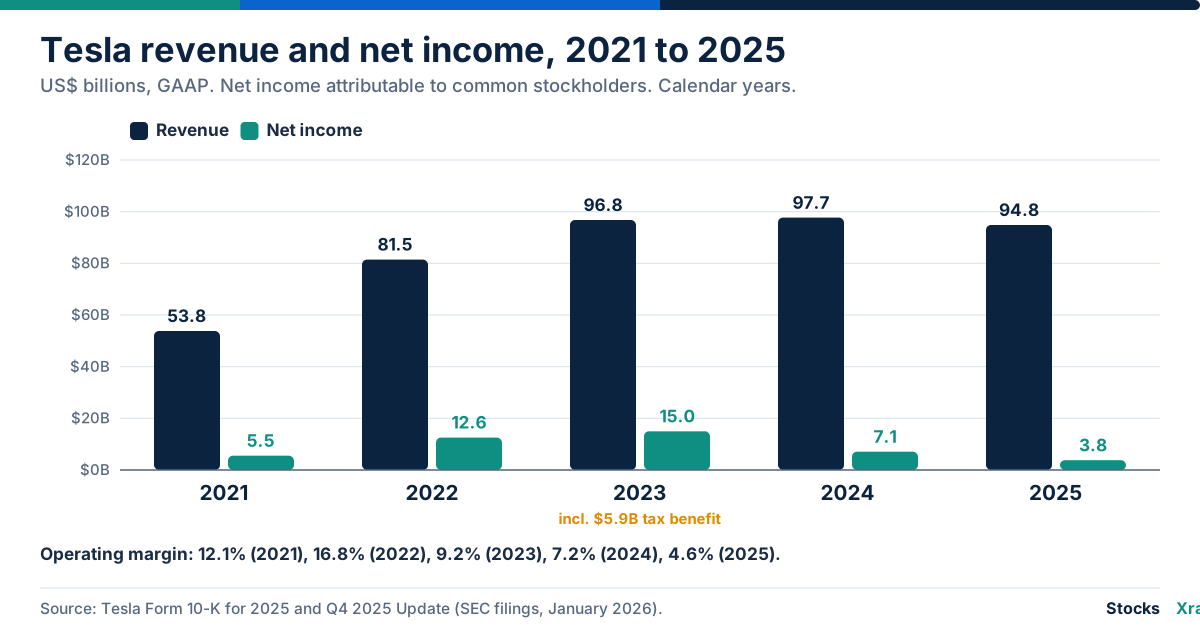
- Tesla's 2025 revenue was $94.8 billion, down 2.9% from 2024, and GAAP net income fell 46% to $3.8 billion. Operating margin was 4.6%, against 16.8% in 2022.
- Revenue has grown again in 2026: $78.7 billion in the first nine months, 12.5% more than a year earlier. Net income has not followed, at $2.38 billion against $2.95 billion.
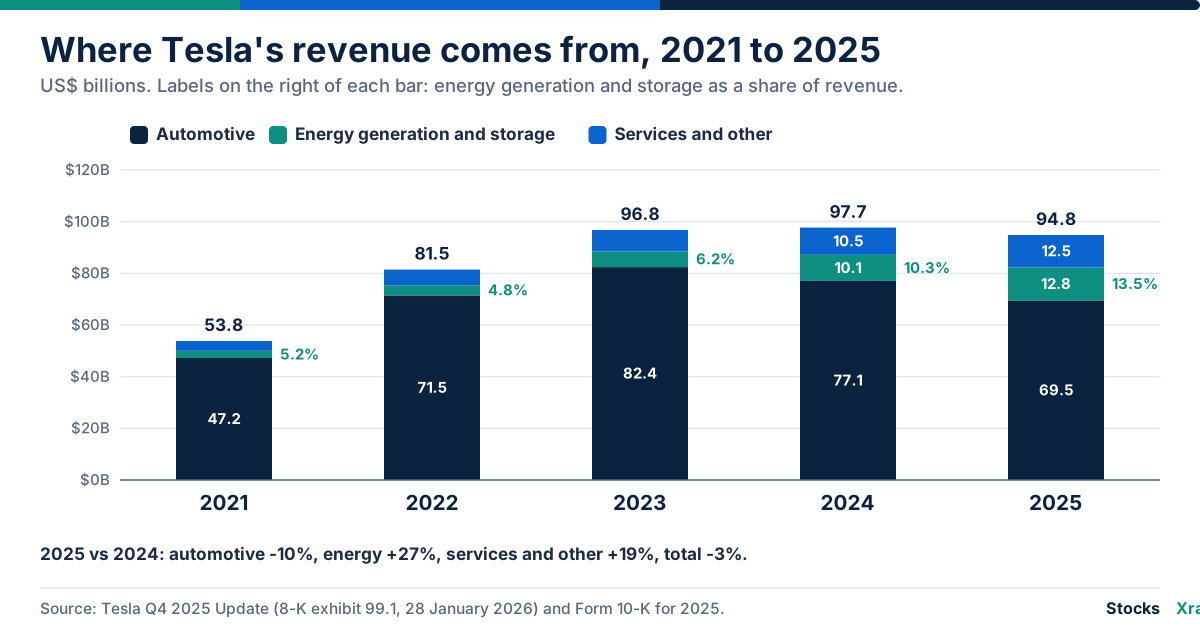
- Energy generation and storage is the fastest-growing business. It made up 13.5% of revenue in 2025, up from 5.2% in 2021.
- Spending is climbing. Tesla expects capital expenditures above $20 billion in 2026, spent $13.0 billion in the first nine months and had negative free cash flow in the second quarter.
- Tesla has never paid a dividend and says it does not expect to pay one in the foreseeable future.
When Tesla reports earnings
Tesla's financial year is the calendar year, and it follows the same two-step routine every quarter. About two days after a quarter ends it publishes production and delivery figures, and that release also gives the date of the earnings report. Roughly three weeks later it posts the Update letter on ir.tesla.com after the close and files it with the SEC on Form 8-K. Management then takes questions on a live webcast at 4:30 p.m. Central time (5:30 p.m. Eastern). The quarterly report on Form 10-Q, or the annual 10-K, has followed the next day.
| Quarter | Deliveries report | Results released | Form 10-Q or 10-K filed |
|---|---|---|---|
| Q3 2025 | Thu 2 Oct 2025 | Wed 22 Oct 2025 | 23 Oct 2025 |
| Q4 2025 | Fri 2 Jan 2026 | Wed 28 Jan 2026 | 29 Jan 2026 |
| Q1 2026 | Thu 2 Apr 2026 | Wed 22 Apr 2026 | 23 Apr 2026 |
| Q2 2026 | Thu 2 Jul 2026 | Wed 22 Jul 2026 | 23 Jul 2026 |
| Q3 2026 | Fri 2 Oct 2026 | Wed 21 Oct 2026 | 22 Oct 2026 |
The next report will cover the fourth quarter and the full year 2026. As of 14 November 2026 Tesla had not published its date. Last year the fourth-quarter report came on Wednesday, 28 January 2026, and Tesla announced that date in its deliveries release of 2 January. Because results arrive after 4 p.m. Eastern, the first price reaction happens in extended-hours trading; see our guide to pre-market and after-hours trading. The Tesla stock page shows the latest price and filings.
What Tesla sells and how it makes money
Tesla reports two segments. Automotive covers designing, making, selling and leasing electric vehicles, plus sales of regulatory credits to other carmakers, and it also contains "services and other": used cars, paid Supercharging, maintenance and collision repair, insurance and parts. Energy generation and storage covers designing, making, installing, selling and leasing storage and solar products, such as the Megapack and Powerwall batteries.
In 2025 automotive revenue was $69.5 billion (73.3% of the total), energy generation and storage $12.8 billion (13.5%) and services and other $12.5 billion (13.2%). Tesla's 10-K explains the shift. Automotive sales revenue fell 9% because cash deliveries fell about 8% and the average selling price was lower, as a result of sales mix and customer incentives such as financing offers. Energy revenue rose 27% on more Megapack and Powerwall deployments, partly offset by a lower average Megapack price.
Regulatory credits deserve attention because they are sold to other carmakers, which use them to comply with emission standards, rather than paid for by Tesla's own vehicle buyers. They brought in $2.76 billion in 2024 and $1.99 billion in 2025, a 28% fall that Tesla partly attributes to government action, including the 2025 federal tax and spending law known as the One Big Beautiful Bill Act, restricting some credit programs. In the third quarter of 2026 they were $113 million, against $417 million a year earlier. Tesla also reports automotive gross margin without them: 15.4% in 2025, against 17.8% including them.
The newer businesses are not reported as separate revenue lines, but they feature heavily in the Update letters. At the end of September 2026 Tesla counted 1.74 million active subscriptions or purchases of FSD (Supervised), its driver-assistance software, which requires active driver supervision. It began giving Robotaxi rides in Cybercab vehicles in Austin on 3 September 2026, began volume production of the Tesla Semi truck, and started production at a new Megapack factory in Texas. For how car makers fit their sector, see our consumer discretionary sector guide.
Tesla's results record
Five years
| Year | Revenue | Gross margin | Operating income | Operating margin | Net income | Diluted EPS | Deliveries |
|---|---|---|---|---|---|---|---|
| 2021 | $53.8B | 25.3% | $6.5B | 12.1% | $5.5B | $1.63 | 936,222 |
| 2022 | $81.5B | 25.6% | $13.7B | 16.8% | $12.6B | $3.62 | 1,313,851 |
| 2023 | $96.8B | 18.2% | $8.9B | 9.2% | $15.0B | $4.30 | 1,808,581 |
| 2024 | $97.7B | 17.9% | $7.1B | 7.2% | $7.1B | $2.04 | 1,789,226 |
| 2025 | $94.8B | 18.0% | $4.4B | 4.6% | $3.8B | $1.08 | 1,636,129 |
Net income is the amount attributable to common stockholders. Earnings per share already reflect Tesla's past stock splits, listed on our Tesla stock split page.
The table shows two phases. From 2021 to 2023 deliveries nearly doubled and revenue rose 80%. Since then deliveries have fallen, by 1.1% in 2024 and 8.6% in 2025, and revenue has stalled. Gross margin dropped from 25.6% in 2022 to about 18% and has stayed there, while operating expenses rose from $7.2 billion in 2022 to $12.7 billion in 2025; research and development alone went from $3.1 billion to $6.4 billion. When costs rise faster than sales, operating profit shrinks faster than revenue, an effect our guide to operating leverage explains.
The 2023 net income figure needs a warning label. It includes a $5.93 billion gain from releasing a valuation allowance on deferred tax assets, an accounting entry that recognized future tax savings. Without it Tesla's own non-GAAP net income for 2023 was $10.9 billion, below 2022's $14.3 billion.
The last five quarters
| Quarter | Released | Revenue | Gross margin | Operating income | Net income | EPS (GAAP) | EPS (non-GAAP) | Deliveries |
|---|---|---|---|---|---|---|---|---|
| Q3 2025 | 22 Oct 2025 | $28.1B | 18.0% | $1.62B | $1.37B | $0.39 | $0.50 | 497,099 |
| Q4 2025 | 28 Jan 2026 | $24.9B | 20.1% | $1.41B | $0.84B | $0.24 | $0.50 | 418,227 |
| Q1 2026 | 22 Apr 2026 | $22.4B | 21.1% | $0.94B | $0.48B | $0.13 | $0.41 | 358,023 |
| Q2 2026 | 22 Jul 2026 | $28.2B | 16.8% | $0.40B | $1.11B | $0.32 | $0.33 | 480,126 |
| Q3 2026 | 21 Oct 2026 | $28.0B | 19.6% | $0.72B | $0.79B | $0.22 | $0.48 | 486,532 |
What moved the numbers in 2026
Volumes came back. Deliveries rose from 358,023 in the first quarter to 486,532 in the third. Tesla said battery availability was the limiting factor in raising vehicle output in the third quarter, and that it ended the quarter with its largest passenger-vehicle order backlog in four years. Services and other revenue reached $4.6 billion in that quarter, up 33% from a year earlier, while energy revenue fell 16% to $2.9 billion, which Tesla partly attributed to tariff-related refunds to customers.
Costs grew faster. Third-quarter operating expenses were $4.8 billion, up 39% from a year earlier, and research and development rose 69% to $2.8 billion. Tesla pointed to spending on super intelligence ("SI", its term for its AI work) and other R&D projects, and to stock-based compensation, which includes the 2025 CEO Performance Award approved by shareholders on 6 November 2025. Stock-based compensation was $1.17 billion in the quarter, against $0.66 billion a year earlier.
Investment marks added noise. In March 2026 Tesla invested $2.0 billion in SpaceX common stock, a stake of less than 1% that it carries at fair value. It booked a $1.0 billion unrealized gain on it in the second quarter and a $142 million loss in the third. That gain is why second-quarter net income of $1.11 billion was larger than operating income of $0.40 billion.
Worked example: why Q3 2026 EPS was $0.22 or $0.48. Tesla's GAAP net income for the quarter was $787 million, or $0.22 a share on 3,541 million diluted shares. Its non-GAAP figure adds back $982 million of stock-based compensation (after tax) and $108 million of SpaceX loss, adds $44 million for certain tax items, and removes a $224 million gain on its bitcoin holdings. The result, $787 + $982 + $108 + $44 - $224, is $1,697 million, or $0.48 a share. Neither number is wrong. GAAP counts every item; Tesla's adjusted figure strips out items it considers non-operating or non-cash. Headlines often quote the adjusted figure, so check which one is meant.
Tesla's recent Update letters give no numeric revenue or delivery targets. They describe priorities instead: maximum use of factory capacity, a strong balance sheet, and over time more profit from SI, software and fleet services alongside hardware. The one firm number is spending, covered below. Our guide to earnings season and guidance explains how markets judge results against expectations when a company gives little guidance.
Why Tesla pays no dividend
Tesla does not pay a dividend. Its 2025 annual report says it has never declared or paid cash dividends on its common stock and does not currently expect to pay any in the foreseeable future; any change would be for its board to decide.
The share count has crept up instead. Shares used for diluted EPS rose from 3,386 million in 2021 to 3,541 million in the third quarter of 2026, about 4.6%; our guide to stock-based compensation and dilution explains how share-based pay adds shares and why that matters. Investors who want income from stocks can browse our best dividend stocks list and dividend calendar, and our guide to dividend yield explains how yields are measured.
Balance sheet and cash flow
On 30 September 2026 Tesla held $45.4 billion of cash, cash equivalents and short-term investments. Debt and finance leases totaled $9.5 billion, of which $9.3 billion was non-recourse debt, meaning lenders can claim only specific assets, not Tesla as a whole. In September 2026 Tesla signed three unsecured credit agreements worth $30 billion in total: a $20 billion three-year delayed-draw term loan, an $8 billion five-year revolving facility and a $2 billion 364-day facility. They replaced a $5 billion revolving facility, and nothing had been drawn at the end of the quarter.
The reason is capital spending. Tesla's third-quarter 10-Q says it expects 2026 capital expenditures above $20 billion, driven by its SI work, including computing infrastructure and data centers, new manufacturing and R&D lines, and a growing fleet of company-operated vehicles and robots. It spent $8.5 billion in 2025 and $13.0 billion in the first nine months of 2026. Tesla notes that periods of heavy capital spending will require funding beyond its operating cash flow.
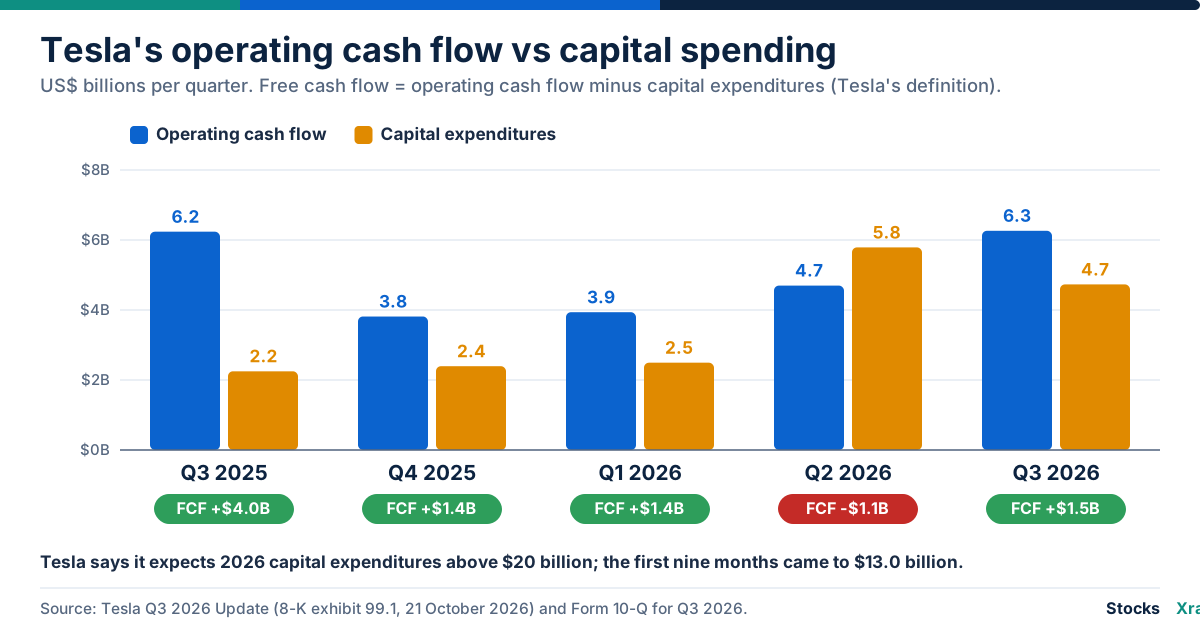
Free cash flow, which Tesla defines as operating cash flow minus capital expenditures, was $6.2 billion in 2025. Over the four quarters to September 2026 it was $3.3 billion, including a negative $1.1 billion in the second quarter, when capital spending of $5.8 billion exceeded operating cash flow of $4.7 billion. Our guides to capital expenditure and free cash flow explain both measures.
Valuation and how StocksXray scores Tesla
Tesla's diluted GAAP EPS over the four quarters to September 2026 added up to $0.91. At the $390.22 close on 13 November 2026, the shares traded at about 429 times those trailing earnings, or about 227 times Tesla's non-GAAP EPS of $1.72 over the same quarters. A ratio that high means the price rests on expectations for future profits far above today's, which is what our guide to the price-to-earnings ratio discusses; it is not by itself a verdict either way.
On 13 November 2026 Tesla's StocksXray X-Ray score was 26.9 out of 100. The lenses read: valuation 3.0, growth 19.6, profitability 26.8 and financial health 64.1; there is no dividend score because Tesla pays none. On our scale 70 to 100 is strong, 50 to 69 fair and under 50 weak, judged against Consumer Discretionary peers. Our guides to how the X-Ray score works and the five lenses explain the method.
The Tesla chart shows the price history, the Tesla research report gathers key indicators, valuation models and the X-Ray breakdown, and the Tesla forecast page shows probability ranges built from past price moves.
Tesla news as of 14 November 2026
A possible deeper tie with SpaceX. Tesla's third-quarter 10-Q says its board has formed a special committee of disinterested directors to explore deepening Tesla's relationship with SpaceX, which could include a business combination. Tesla says there is no assurance any transaction will happen, and any deal would need the committee's recommendation and, if agreed, any required shareholder approval. Elon Musk is chief executive of both companies, and SpaceX also buys Megapacks from Tesla: $626 million of revenue in the first nine months of 2026.
Results reaction. The shares closed at $386.47 on 21 October, the day of the third-quarter report, and at $374.58 the next day. They closed at $390.22 on 13 November 2026.
Annual meeting. Tesla's 2026 annual meeting is set for 3 December 2026 at Gigafactory Texas and online. The proxy statement lists three company proposals: electing three directors, an advisory vote on 2025 executive pay and ratifying the auditor.
Risks Tesla lists
Tesla's 2025 annual report lists dozens of risk factors. These bear most directly on its earnings:
- New product ramps. Delays or cost overruns in launching and ramping products such as Cybercab, Tesla Semi and the Optimus robot could hurt results.
- Battery cells. Tesla must keep and grow its access to cells, including its own, and control their cost; it called battery availability the limit on vehicle output in the third quarter of 2026.
- Demand and competition. Growth depends on demand for electric vehicles and on adoption of autonomous driving, against a growing list of competitors.
- Dependence on Elon Musk. The annual report says Tesla is highly dependent on his services and that he does not devote his full time to Tesla, since he also holds management positions at SpaceX, xAI, Neuralink and The Boring Company.
- Government policy. Changes to incentives, tariffs and regulations, including on credits and autonomous driving, can affect demand, costs and the regulatory credit income described above.
- Share price volatility. Tesla warns that its stock price is likely to remain volatile.
Common mistakes when reading Tesla's earnings
- Treating deliveries as earnings. Tesla itself says deliveries are only two measures of its performance; prices, costs and credits decide profit.
- Mixing GAAP and non-GAAP EPS. In the third quarter of 2026 they were $0.22 and $0.48.
- Missing one-off items. The 2023 tax benefit and the 2026 SpaceX marks moved net income by billions of dollars without changing the business.
- Ignoring regulatory credits. They have fallen from $2.76 billion in 2024 and flatter automotive margins when they are high.
- Looking at operating cash flow without capital spending. With 2026 capex above $20 billion expected, free cash flow tells more.
Frequently asked questions
When does Tesla report earnings? Tesla reports about three weeks after each calendar quarter ends, in late January, April, July and October, after the US market close. Every report from October 2025 to October 2026 came on a Wednesday. It announces the exact date in its quarterly production and deliveries release, published about two days after the quarter ends.
When is Tesla's next earnings date? As of 14 November 2026 Tesla had not announced the date of its fourth-quarter and full-year 2026 report. Last year's equivalent report came on Wednesday, 28 January 2026, and the date was given in the deliveries release of 2 January 2026.
What time is the Tesla earnings call? Tesla holds a live question-and-answer webcast at 4:30 p.m. Central time (5:30 p.m. Eastern) on results day, on ir.tesla.com. The Update letter with the numbers is posted shortly after the market closes, before the webcast, and a replay is kept on the site.
What were Tesla's third-quarter 2026 earnings? For the quarter ended 30 September 2026, reported on 21 October, Tesla had revenue of $28.0 billion, GAAP net income of $787 million and diluted EPS of $0.22, or $0.48 on its non-GAAP measure. It delivered 486,532 vehicles, deployed 13.7 GWh of energy storage and generated $1.5 billion of free cash flow.
What did Tesla report for the second quarter of 2026? On 22 July 2026 Tesla reported revenue of $28.2 billion, up 25.5% from a year earlier, GAAP net income of $1.11 billion and diluted EPS of $0.32. Net income was lifted by a $1.0 billion unrealized gain on its SpaceX stake, operating income was $398 million, and free cash flow was negative $1.1 billion as capital spending reached $5.8 billion.
Does Tesla pay a dividend? No. Tesla has never declared or paid a cash dividend on its common stock, and its 2025 annual report says it does not expect to pay one in the foreseeable future.
What is Tesla's P/E ratio? On 13 November 2026, at a closing price of $390.22, Tesla traded at about 429 times its GAAP diluted EPS of $0.91 for the four quarters to September 2026. The ratio changes with every price move and every quarterly report, so check the date of any figure you see quoted.
Sources and data notes
- Tesla Form 10-K for 2025, filed 29 January 2026.
- Tesla Form 10-Q for the quarter ended 30 September 2026, filed 22 October 2026.
- Tesla Q3 2026 Update, 21 October 2026 (Form 8-K exhibit 99.1).
- Tesla Q4 2025 Update, 28 January 2026 (Form 8-K exhibit 99.1), and the Q1 and Q2 2026 Updates.
- Tesla production and deliveries releases, the Form 8-K on credit agreements of 29 September 2026 and the 2026 proxy statement, all on SEC EDGAR.
- Prices and X-Ray scores: StocksXray, closing data to 13 November 2026.
This page covers results through the quarter ended 30 September 2026 and news to 14 November 2026. It does not include Tesla's fourth-quarter 2026 results and contains no forecasts of our own.
Educational information, not financial advice.
Related reading
Stocks in this article
Educational only, not financial advice. Examples use illustrative numbers.