











Apple Earnings and Dividend: Results, Dividend History and Dates
Apple earned $132.2 billion on revenue of $478.8 billion in the fiscal year that ended on 26 September 2026, the highest figures it has reported, and diluted earnings per share rose 20% to $8.98. It reports results four times a year, about five weeks after each quarter closes, and pays a quarterly dividend of $0.27 a share. This guide lays out Apple's earnings record from its own filings, how the business makes its money, when it reports, and its dividend history, payout ratio and yield.
Key takeaways
- In fiscal 2026 Apple's revenue rose 15% to $478.8 billion, net income rose 18% to $132.2 billion and diluted EPS rose 20% to $8.98. Each of the four quarters set a revenue record for that quarter of the year.
- The iPhone brought in $254.1 billion, or 53% of sales. Services brought in $123.3 billion, 26% of sales but 40% of gross margin, because their margin rate is almost twice that of hardware.
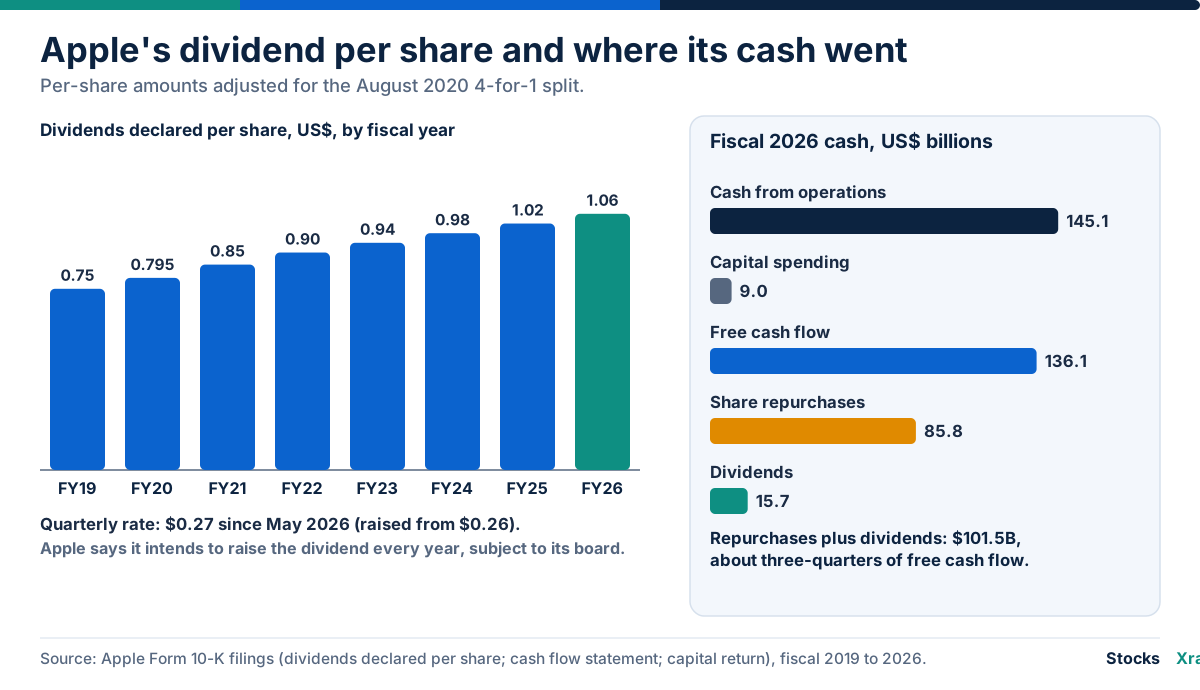
- The quarterly dividend has been $0.27 since May 2026. Apple declared $1.06 a share in fiscal 2026, about 12% of its EPS, and says it intends to raise the dividend every year, subject to its board.
- Share repurchases are far larger than dividends: $85.8 billion against $15.7 billion in fiscal 2026. Together they used about three-quarters of the year's $136.1 billion of free cash flow.
- As of 14 November 2026 Apple had not announced the date of its next report. The December-quarter results came out on 29 January in 2026.
How Apple makes money
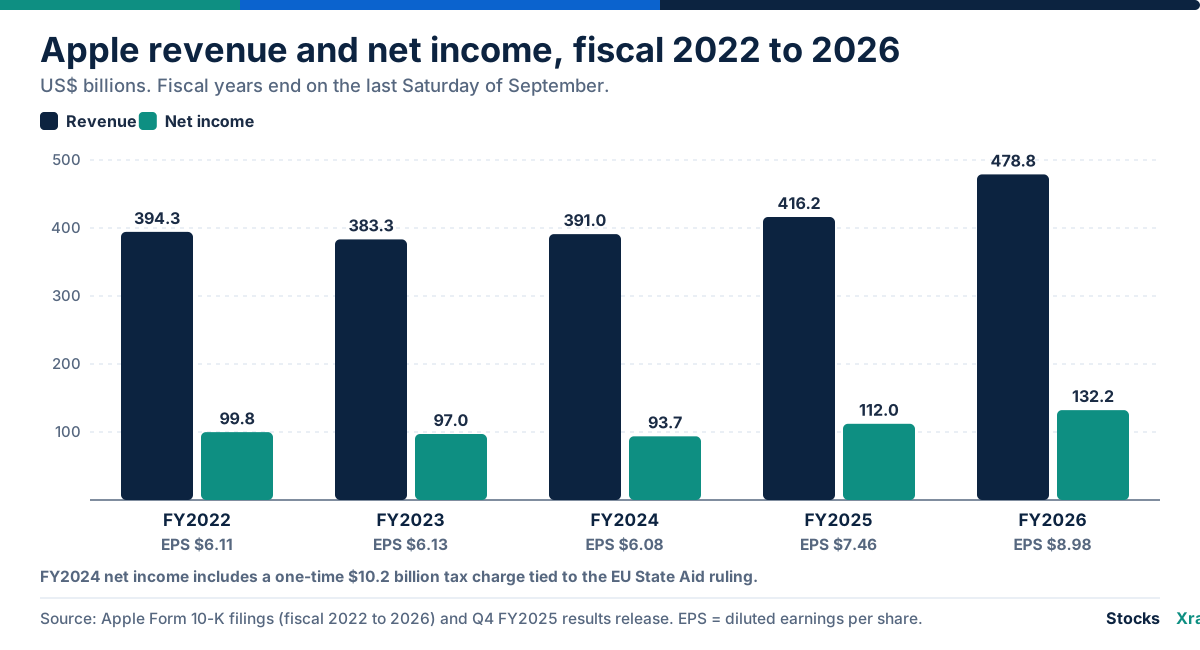
Apple designs and sells smartphones, personal computers, tablets, wearables and accessories, and a range of services that run on those devices. It reports sales in five categories. Four are hardware: iPhone, Mac, iPad, and Wearables, Home and Accessories (Apple Watch, AirPods, Beats, Apple Vision Pro, Apple TV, HomePod and accessories). The fifth, Services, covers advertising, AppleCare support plans, iCloud and other cloud services, the App Store and other digital content, and payment services such as Apple Pay and Apple Card.
| Category | Fiscal 2026 net sales | Share of total | Change vs fiscal 2025 |
|---|---|---|---|
| iPhone | $254.1 billion | 53.1% | +21% |
| Services | $123.3 billion | 25.8% | +13% |
| Mac | $37.9 billion | 7.9% | +13% |
| Wearables, Home and Accessories | $35.6 billion | 7.4% | Flat |
| iPad | $27.9 billion | 5.8% | Flat |
| Total | $478.8 billion | 100% | +15% |
In its annual report Apple attributes the iPhone gain to higher sales of Pro models, the Mac gain to laptops and the Services gain mainly to advertising and cloud services. iPad and Wearables, Home and Accessories were roughly flat.
The table understates how much Services matter for profit. Apple reports gross margin, sales minus the direct cost of those sales, separately for its two halves. In fiscal 2026 Products earned a gross margin of 39.3% and Services 76.2%, for 48.8% overall. That is why Services, at a quarter of revenue, produced $93.9 billion of the $233.6 billion total gross margin, while Products turned $355.5 billion of sales into $139.7 billion. Our guide to gross, operating and net margin explains the three measures.
Apple's reportable segments are geographic. In fiscal 2026 the Americas (North and South America) produced $198.1 billion of sales, up 11%. Europe, which in Apple's reporting also includes India, the Middle East and Africa, produced $127.6 billion, up 15%. Greater China (mainland China, Hong Kong and Taiwan) rose 28% to $82.4 billion, after a 4% decline the year before. Rest of Asia Pacific rose 18% to $39.9 billion and Japan 8% to $30.9 billion.
Apple's earnings record over five fiscal years
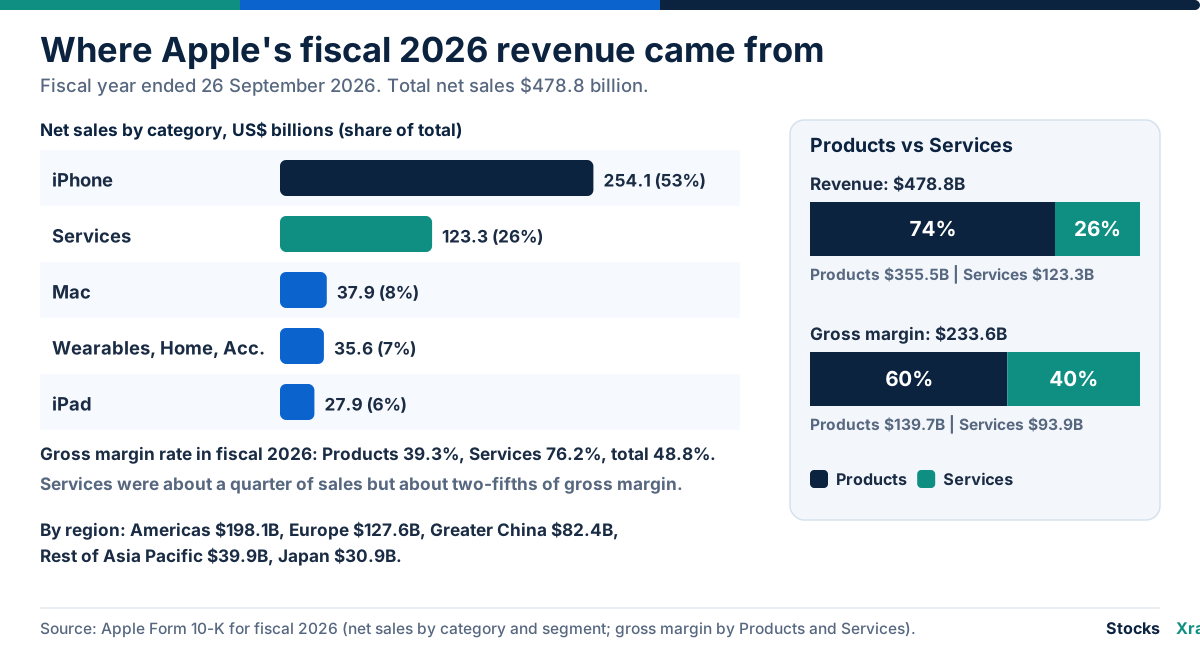
Apple's fiscal year is a 52- or 53-week period that ends on the last Saturday of September, so fiscal 2026 ran from 28 September 2025 to 26 September 2026. All figures below are as reported under US accounting rules (GAAP).
| Fiscal year | Revenue | Gross margin | Net income | Diluted EPS | Dividends declared per share |
|---|---|---|---|---|---|
| 2022 | $394.3 billion | 43.3% | $99.8 billion | $6.11 | $0.90 |
| 2023 | $383.3 billion | 44.1% | $97.0 billion | $6.13 | $0.94 |
| 2024 | $391.0 billion | 46.2% | $93.7 billion | $6.08 | $0.98 |
| 2025 | $416.2 billion | 46.9% | $112.0 billion | $7.46 | $1.02 |
| 2026 | $478.8 billion | 48.8% | $132.2 billion | $8.98 | $1.06 |
Three things stand out. First, revenue barely moved for three years: it fell 2.8% in fiscal 2023 and rose 2.0% in fiscal 2024, before growing 6.4% in fiscal 2025 and 15.1% in fiscal 2026. Second, the gross margin rate rose every year, from 43.3% to 48.8%, as Services grew as a share of the mix.
Third, the fiscal 2024 dip in net income was a tax event, not a weaker business. On 10 September 2024 the European Court of Justice upheld the European Commission's 2016 State Aid decision on Apple's taxes in Ireland. Apple booked a one-time income tax charge of $10.2 billion, net, in the September 2024 quarter. Excluding it, Apple's own reconciliation puts fiscal 2024 net income at $104.0 billion and diluted EPS at $6.75.
Earnings per share grew faster than profit because the share count keeps falling. From fiscal 2022 to fiscal 2026 net income rose 32% while diluted EPS rose 47%, because the diluted share count fell by about 10%, from 16.33 billion to 14.72 billion shares, as Apple bought back stock. Our explainer on basic and diluted EPS shows how the count is built.
Fiscal 2026 quarter by quarter
| Quarter (period end) | Reported | Revenue | Change | Net income | Diluted EPS | EPS change |
|---|---|---|---|---|---|---|
| Q1 (27 Dec 2025) | 29 Jan 2026 | $143.8 billion | +16% | $42.1 billion | $2.84 | +19% |
| Q2 (28 Mar 2026) | 30 Apr 2026 | $111.2 billion | +17% | $29.6 billion | $2.01 | +22% |
| Q3 (27 Jun 2026) | 30 Jul 2026 | $109.4 billion | +16% | $29.8 billion | $2.02 | +29% |
| Q4 (26 Sep 2026) | 2 Nov 2026 | $114.5 billion | +12% | $30.7 billion | $2.10 | +14% |
Changes are against the same quarter a year earlier, as Apple reports them.
The first fiscal quarter, October to December, was the largest of the year in each of the last three fiscal years. It covers the holiday season and follows Apple's September iPhone launches. In that quarter Apple reported iPhone revenue of $85.3 billion and said its installed base had passed 2.5 billion active devices.
The middle of the year was lifted by an unusual item. On 20 February 2026 the US Supreme Court struck down tariffs that had been imposed under the International Emergency Economic Powers Act. Apple applied for refunds of tariffs it had paid and records refunds as a reduction in the cost of its products. It said the refunds added about 2 percentage points to its gross margin and $0.11 to EPS in the June quarter, and about 1 point and $0.05 in the September quarter. Gross margin was 50.1% in the June quarter and 47.9% in the September quarter.
Two cost pressures pull the other way. Research and development spending rose 32% in fiscal 2026 to $45.8 billion. And Apple's annual report says it faces supply constraints and rising prices for advanced chips, memory and storage, and expects the memory and storage trends to intensify.
When Apple reports earnings
Apple's fiscal quarters end on the last Saturday of December, March, June and September. Results come out four to five weeks later, in late January, late April or early May, late July or early August, and late October or early November. In 2026 the four reports came on 29 January, 30 April, 30 July and 2 November.
On results day Apple publishes a press release with condensed financial statements and sales by category and region, files it with the SEC on Form 8-K, and hosts an earnings call for analysts at 2:00 p.m. Pacific time (5:00 p.m. Eastern), an hour after the regular US trading session ends. The call is streamed at apple.com/investor/earnings-call and stays available for about two weeks. The quarterly report on Form 10-Q, or the annual Form 10-K, followed one day later in each case in 2026. The press release itself contains no outlook figures. For what the release, the 10-Q and the 8-K each contain, see our guide to 10-Q, 8-K and proxy statements, and for why prices can swing on results day, earnings season and guidance.
As of 14 November 2026 Apple had not announced the date of its December-quarter (first fiscal quarter of 2027) report in the sources we checked. Our Apple stock page shows the last six quarters of results and each recent dividend with its ex-dividend date.
Apple's dividend: history, dates and payout
Apple's dividend record since 1987
Apple pays a cash dividend every quarter, currently $0.27 a share, but its record has a long gap. According to its investor relations dividend history, Apple paid quarterly dividends from 1987 to 1995, then stopped. It restarted in 2012 with a quarterly dividend of $2.65 a share, first paid on 16 August 2012.
That $2.65 is not comparable with today's figure without adjustment. Apple has split its stock seven-for-one in June 2014 and four-for-one in August 2020, so one 2012 share is now 28 shares. Adjusted for both splits, the 2012 dividend equals about $0.095 a share per quarter, and today's $0.27 is roughly 2.9 times that. The same arithmetic explains why the payment fell from $0.82 in August 2020 to $0.205 in November 2020: the split divided each share into four, and the dividend per share with it. Our guide to stock splits covers the mechanics, and the Apple stock split page lists its splits since 2000 with the prices on either side.
Dividend per share by fiscal year
| Fiscal year | Dividends declared per share (split-adjusted) | Quarterly rate after the spring raise | Size of raise |
|---|---|---|---|
| 2019 | $0.75 | $0.1925 | 5.5% |
| 2020 | $0.795 | $0.205 | 6.5% |
| 2021 | $0.85 | $0.22 | 7.3% |
| 2022 | $0.90 | $0.23 | 4.5% |
| 2023 | $0.94 | $0.24 | 4.3% |
| 2024 | $0.98 | $0.25 | 4.2% |
| 2025 | $1.02 | $0.26 | 4.0% |
| 2026 | $1.06 | $0.27 | 3.8% |
Apple rounds the 2026 increase to 4% in its press release. In every year shown, the raise came with the March-quarter results in late April or early May.
Apple dividend dates
Apple declares each dividend with its quarterly results and pays it about two weeks later. The four dividends declared in calendar 2026:
| Declared | Record date | Paid | Amount |
|---|---|---|---|
| 29 Jan 2026 | 9 Feb 2026 | 12 Feb 2026 | $0.26 |
| 30 Apr 2026 | 11 May 2026 | 14 May 2026 | $0.27 |
| 30 Jul 2026 | 10 Aug 2026 | 13 Aug 2026 | $0.27 |
| 2 Nov 2026 | 12 Nov 2026 | 16 Nov 2026 | $0.27 |
To receive a dividend, an investor has to own the shares before the ex-dividend date. Under the one-day (T+1) settlement cycle the US adopted on 28 May 2024, FINRA's rules set the ex-dividend date on the record date when the record date is a business day, so for the latest Apple dividend both fell on 12 November 2026. Our guide to ex-dividend and record dates walks through the timeline, and the dividend calendar lists upcoming dates across US stocks. The next declaration would normally come with the December-quarter results; Apple had not announced it as of 14 November 2026.
Payout ratio and yield
The payout ratio is the share of profit paid out as dividends. Apple declared $1.06 a share against diluted EPS of $8.98 in fiscal 2026, a ratio of 11.8%. Measured in cash, the $15.7 billion of dividends and dividend equivalents it paid was 11.9% of net income and 11.6% of free cash flow. Our article on the dividend payout ratio explains why a low ratio leaves room to keep paying in a weak year.
Worked example. The current annual rate is four payments of $0.27, or $1.08 a share. The shares closed at $356.27 on 13 November 2026, so the dividend yield on that date was $1.08 divided by $356.27, about 0.30%. An investor holding 100 shares receives $27 a quarter, or $108 a year at the current rate, before any tax. The same $108 at a 2% yield would require a holding worth $5,400 instead of about $35,600 (illustrative comparison). See dividend yield explained for why a low yield can still sit on a growing dividend, and our best dividend stocks list, which ranks S&P 500 payers yielding between 2% and 8% by our dividend score.
Apple's annual report says it intends to increase its dividend on an annual basis, subject to declaration by its board. It also warns that future dividends are not guaranteed and that its repurchase programs do not oblige it to buy any minimum amount of stock.
Buybacks do most of the work
Apple returns far more cash through share repurchases than through dividends. On 30 April 2026 its board authorized a further program of up to $100 billion. With $14.0 billion left under the May 2025 program, about $114.0 billion was available at the end of fiscal 2026. During the year Apple repurchased 297 million shares for $85.8 billion, and shares outstanding fell 1.6%, from 14.77 billion to 14.53 billion. Repurchases and dividends together came to $101.5 billion. Our guide to share buybacks explains when repurchases help remaining owners.
Balance sheet and cash flow in plain words
Apple's business throws off much more cash than it needs to reinvest. In fiscal 2026 cash generated by operations rose 30% to $145.1 billion. Spending on property, plant and equipment was $9.0 billion, leaving free cash flow, the cash left after that investment, of $136.1 billion. Our explainer on free cash flow shows the calculation.
At 26 September 2026 Apple held $136.9 billion in cash and marketable securities: $36.3 billion of cash and equivalents, $20.4 billion of short-term securities and $80.2 billion of long-term securities. Against that it owed $80.1 billion: $2.0 billion of commercial paper and $78.1 billion of term debt. That leaves about $56.8 billion more in cash and securities than debt. On 9 November 2026, after the year ended, Apple sold $7.5 billion of new notes maturing between 2028 and 2036.
Two other balance-sheet lines moved sharply. Inventories rose from $5.7 billion to $14.5 billion during the year. Shareholders' equity rose from $73.7 billion to $112.1 billion, as the year's profit outran dividends and repurchases. The company had approximately 167,000 full-time equivalent employees at the year end.
How StocksXray scores Apple
On 13 November 2026 Apple had a StocksXray X-Ray Score of 56 out of 100, with high confidence. The score combines five lenses, each scored from 0 to 100 against other stocks in the information technology sector:
| Lens | Score on 13 Nov 2026 |
|---|---|
| Valuation | 27 |
| Growth | 55 |
| Profitability | 78 |
| Financial health | 69 |
| Dividends | 45 |
Profitability is the strongest lens, reflecting margins and returns on capital. Valuation is the weakest: on our measures the shares are expensive against the sector on earnings and cash flow. Dividends score 45: the yield is low, while the payout ratio is small and the payment rises every year. Scores change as prices and filings change, so check the Apple stock page for the current score. Our posts on the five lenses and how the X-Ray Score works explain the method.
For the current share price and history, use the interactive Apple chart. The Apple research report gathers valuation history, our fair-value models and a fundamentals checklist on one page, and the Apple forecast page shows probability ranges built from past price moves, which are ranges and not targets.
Company developments in 2026
- Leadership. On 20 April 2026 Apple announced that Tim Cook would become executive chair and that John Ternus, its senior vice president of hardware engineering, would become chief executive, both effective 1 September 2026. Kevan Parekh remained chief financial officer.
- Tariffs. The Supreme Court ruling of 20 February 2026 led to the refunds described above. Apple's annual report notes that other US tariffs remain and that further changes, including sector tariffs on semiconductors, could follow.
- Capital return. The $100 billion repurchase authorization and the dividend rise to $0.27 were announced on 30 April 2026.
- Products. Apple's 10-K lists the iPhone Duo, iPhone 18 Pro and Pro Max, MacBook Neo and Siri AI among the year's introductions.
- App Store litigation. On 30 June 2026 the Supreme Court agreed to review part of the Epic Games case over the legal standard for civil contempt, which bears on the commissions Apple can charge on purchases made through links outside apps.
Risks Apple lists in its annual report
Apple's fiscal 2026 Form 10-K lists many risk factors. Five matter most for reading its earnings:
- Economic and geopolitical conditions. A majority of Apple's sales come from outside the US, and a majority of its supplier facilities, including manufacturing and assembly sites, are abroad, so trade disputes, conflicts and natural disasters can hit both demand and supply.
- Tariffs and trade restrictions. New or higher tariffs can raise costs or limit product availability, and Apple warns it may not be able to collect tariff refunds if tariffs are rescinded.
- Components and costs. Apple depends on outside partners for components, manufacturing, compute capacity and storage, and says shortages and price rises, particularly for memory and storage, can hurt revenue and gross margin.
- Competition and new products. Its markets change quickly, and it must keep introducing products and services, including artificial intelligence features, that customers want.
- Legal and regulatory pressure. Apple faces the US Department of Justice antitrust suit filed in March 2024, investigations under the EU Digital Markets Act and App Store litigation, any of which could cut what it earns from its platforms.
Apple also lists currency movements, credit risk in its investment portfolio and tax changes. The full list is in Item 1A of the 10-K; our guide on how to read a 10-K shows where to find it.
Common mistakes when reading Apple's results
- Mixing fiscal and calendar years. Apple's first fiscal quarter is October to December. "Q1 2026" means the holiday quarter of 2025.
- Comparing quarters in a row. The December quarter has been the biggest each year, so a drop in the March quarter is normal. Compare each quarter with the same quarter a year earlier.
- Reading fiscal 2024 as a bad year. Net income fell because of a one-time $10.2 billion tax charge, not because the business shrank.
- Treating tariff refunds as permanent. They lifted margins in the June and September 2026 quarters and depend on refund claims that Apple warns may not succeed.
- Using unadjusted dividend history. Older dividends must be divided by 4 (since 2020) or 28 (since 2012) to compare with today's payment.
- Judging shareholder returns by the yield alone. Apple spent more than five times as much on buybacks as on dividends in fiscal 2026.
Frequently asked questions
When does Apple report earnings? Apple reports four times a year, usually four to five weeks after each fiscal quarter ends. In 2026 it reported on 29 January, 30 April, 30 July and 2 November, with an analyst call at 2:00 p.m. Pacific time each day. As of 14 November 2026 it had not announced the date of its next report.
Does Apple pay dividends? Yes. Apple pays a quarterly cash dividend of $0.27 a share, a rate set in April 2026. It paid dividends from 1987 to 1995, stopped, and restarted in 2012. It has raised the payment every spring since 2013 and says it intends to raise it annually, subject to its board.
What is Apple's dividend yield? Dividend yield is the annual dividend divided by the share price. At the current rate of $1.08 a year and the closing price of $356.27 on 13 November 2026, Apple's yield was about 0.30%. The yield moves every day with the share price, so check the Apple stock page for the current figure.
When does Apple pay its dividend? Apple declares each dividend with its quarterly results and pays it about two weeks later, in February, May, August and November. The latest dividend of $0.27 was paid on 16 November 2026 to shareholders of record on 12 November 2026, which was also the ex-dividend date.
How much did Apple earn in fiscal 2026? In the fiscal year that ended on 26 September 2026 Apple earned net income of $132.2 billion on revenue of $478.8 billion. Diluted earnings per share were $8.98, up 20% from $7.46 a year earlier.
Where can I listen to the Apple earnings call? Apple streams the call live at apple.com/investor/earnings-call, starting at 2:00 p.m. Pacific time on results day, and keeps a replay available for about two weeks. The press release and the financial statements are posted on investor.apple.com and filed with the SEC on Form 8-K the same day.
Why did Apple's dividend fall from $0.82 to $0.205 in 2020? It did not fall in value. Apple split its stock four-for-one in August 2020, with shares trading on the new basis from 31 August, so each old share became four new ones and the per-share dividend was divided by four. $0.82 divided by 4 is $0.205, and the next raise in 2021 took it to $0.22.
Sources and data notes
- Apple Form 10-K for fiscal 2026, filed 3 November 2026, and earlier 10-K filings for fiscal 2022 to 2025: SEC EDGAR, Apple filings.
- Apple quarterly results press releases (Form 8-K, exhibit 99.1) of 30 October 2025, 29 January, 30 April, 30 July and 2 November 2026, and the Q3 fiscal 2026 Form 10-Q.
- Apple Form 8-K of 20 April 2026 (leadership change) and 9 November 2026 (notes issue).
- Apple investor relations dividend history.
- FINRA Regulatory Notice 24-04 and the SEC announcement of T+1 settlement.
- Share price and X-Ray scores: StocksXray data as of the 13 November 2026 close.
This article covers reported results to the September 2026 quarter and company announcements to 14 November 2026. It does not include outlooks, analyst estimates or price targets.
Educational information, not financial advice.
Related reading
Stocks in this article
Educational only, not financial advice. Examples use illustrative numbers.