








BHP Dividend History, Dates and Franking: How BHP Pays Shareholders
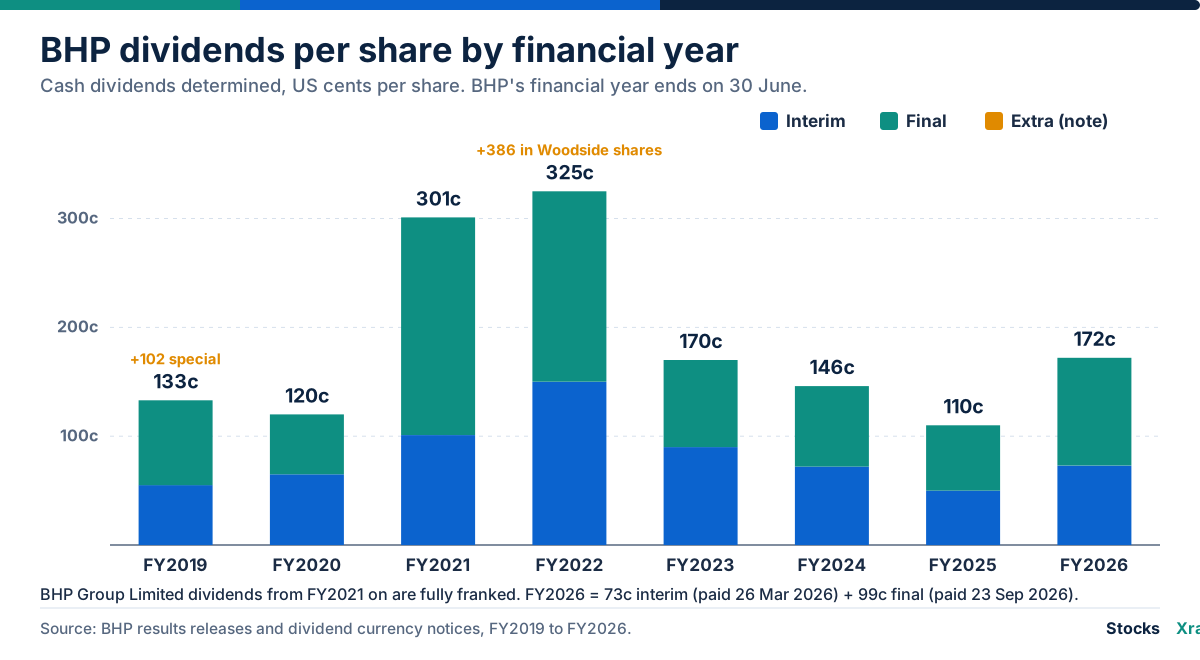
BHP pays a dividend twice a year, declared in US cents and paid to Australian shareholders in Australian dollars, fully franked. For the year to 30 June 2026 (FY2026) it determined 172 US cents a share: a 73 cent interim paid on 26 March 2026 and a 99 cent final, worth A$1.37989 a share, paid on 23 September 2026. This guide covers the full record since FY2019, how the 50% payout policy works, the dates that decide who gets paid, franking credits, and the results that pay for it all.
Key takeaways
- BHP reports in US dollars and declares dividends in US cents. ASX holders receive Australian dollars converted at a rate BHP announces just after the record date, so the A$ amount moves with the exchange rate.
- The policy, in place since February 2016, is a minimum payout of 50% of Underlying attributable profit at every half-year and full-year result. The board can add more: the FY2026 final was a 69 cent minimum plus a 30 cent top-up.
- FY2026 dividends of 172 US cents were the highest in four years, but below FY2021 (301 cents) and FY2022 (325 cents, plus Woodside shares worth 386 cents).
- Copper produced 54% of BHP's FY2026 Underlying EBITDA as BHP measures it, the first year above half. Customers in China accounted for 58% of revenue.
- Dividends from BHP Group Limited are fully franked at the 30% company tax rate. On the FY2026 final, each A$1.37989 of cash carried a franking credit of about A$0.59.
How the BHP dividend works
Declared in US cents, paid in five currencies
BHP Group Limited keeps its books in US dollars, its main functional currency, so the board determines each dividend in US cents. The company then converts it for each register. For the FY2026 final, the Australian amount used the average AUD/USD rate from 28 August to 4 September 2026, which came to 0.717450. Dividing 99 US cents by that rate gives 137.988710 Australian cents, which is the A$1.37989 that ASX holders received.
Shareholders can ask to be paid in Australian dollars, pounds sterling, New Zealand dollars, South African rand or US dollars. Holders of BHP's American Depositary Shares on the New York Stock Exchange get two shares' worth, 198 US cents for the FY2026 final, because each ADS represents two ordinary shares. The practical result: the US cent figure is the real decision, and the Australian figure partly reflects the AUD/USD exchange rate at the time.
The 50% floor and the top-up
BHP adopted its current policy in February 2016. It pays at least 50% of Underlying attributable profit at every reporting period, and the board decides at each result whether to pay more under its Capital Allocation Framework, which ranks dividends against debt reduction, buybacks and growth spending.
Underlying attributable profit is BHP's profit after tax with exceptional items removed, such as impairments and the costs of the November 2015 Fundão dam failure at Samarco in Brazil. That matters for dividends. In FY2026, statutory attributable profit was US$9.8 billion, but Underlying attributable profit, the base for the payout, was US$13.2 billion, because BHP excluded a US$2.3 billion impairment of its Jansen potash project and US$1.1 billion of Samarco costs.
For the second half of FY2026 the minimum dividend was 69 US cents. The board added 30 cents, for a 99 cent final, a 72% payout of second-half underlying profit. The interim was a 60% payout. Across the year, US$8.7 billion of dividends against US$13.2 billion of Underlying attributable profit is about 66%, by our calculation. Our guide to the dividend payout ratio explains why a ratio above 50% leaves less cushion if profits fall.
Worked example: from 99 US cents to a franked Australian dividend
Franking credits are Australia's way of avoiding double tax on company profits. When a company pays a dividend out of profits that have already been taxed at the 30% company rate, it can attach a credit for that tax. The shareholder adds the credit to taxable income, a step called grossing up, and then subtracts the same credit from the tax bill.
The credit on a fully franked dividend equals the cash dividend multiplied by 30/70. Using BHP's FY2026 final:
| Step | Per share | Per 1,000 shares |
|---|---|---|
| Dividend declared | 99 US cents | US$990.00 |
| Cash paid to ASX holders (99 ÷ 0.717450) | 137.99 Australian cents | A$1,379.89 |
| Franking credit (cash × 30/70) | 59.14 Australian cents | A$591.38 |
| Grossed-up amount in taxable income | 197.13 Australian cents | A$1,971.27 |
What the credit is worth depends on the holder. Under Australian Taxation Office (ATO) rules, an eligible resident individual whose tax rate is below 30% can have the excess credit refunded, someone taxed at exactly 30% owes nothing more on the dividend, and someone on a higher rate pays only the difference. As an illustrative case, a holder taxed at 45% on the A$1,971.27 would owe A$887.07, less the A$591.38 credit, leaving A$295.69 to pay.
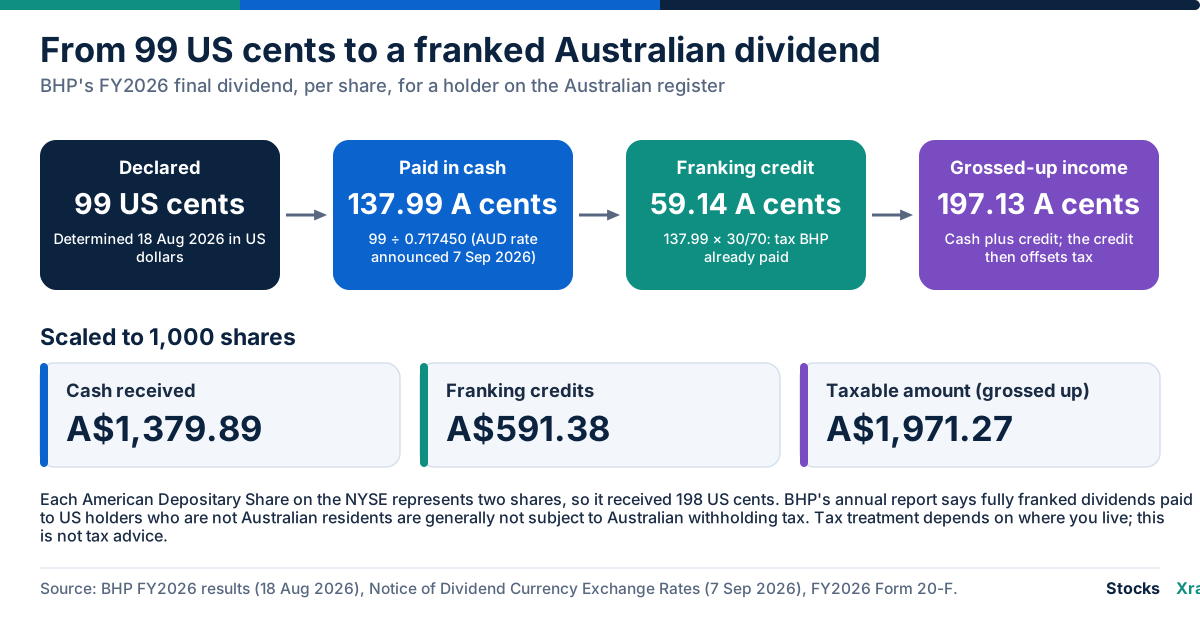
Franking credits are part of the Australian tax system, but franking also matters to shareholders abroad. BHP's annual report says fully franked dividends paid to US holders who are not Australian residents are generally not subject to Australian withholding tax, and the ATO's guidance to payers says no tax needs to be withheld from fully franked dividends paid to foreign residents. Local tax at home still applies.
What BHP does and how it makes money
BHP mines copper, iron ore and coal, and is building a potash mine in Canada. It reports three operating segments plus group items:
- Copper: Escondida and Pampa Norte (Spence) in Chile, a share of Antamina in Peru, and Copper South Australia, which includes Olympic Dam. BHP produced 1,953 thousand tonnes (kt) of copper in FY2026, 3% less than in FY2025, and realized an average US$5.74 a pound, 35% more.
- Iron ore: Western Australia Iron Ore (WAIO) in the Pilbara produced 257 million tonnes on BHP's share, the same as FY2025, with record production and shipments on a 100% basis. BHP also owns half of Samarco in Brazil.
- Coal: steelmaking coal from the BHP Mitsubishi Alliance (BMA) in Queensland and energy coal from New South Wales Energy Coal.
- Group and unallocated: the Jansen potash project in Canada and Western Australia Nickel, which BHP has placed into temporary suspension.
Underlying EBITDA, earnings before interest, tax, depreciation and amortization and excluding exceptional items, was US$32.9 billion in FY2026. Copper contributed US$18.2 billion, iron ore US$14.5 billion and coal US$0.8 billion, while group items cost US$0.6 billion. BHP reports copper's share as 54% (45% in FY2025), measured against the three operating segments.
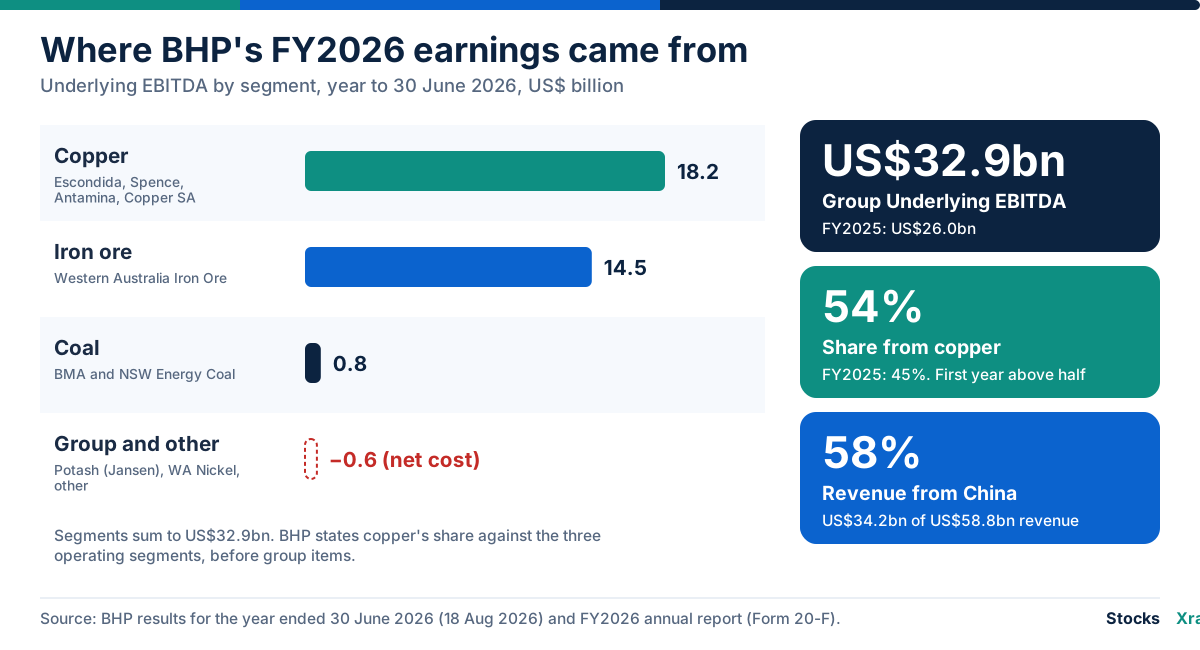
The customer base is concentrated. Of US$58.8 billion of FY2026 revenue, US$34.2 billion came from customers in China, followed by Japan (US$5.8 billion), India (US$3.7 billion) and South Korea (US$3.2 billion). That links BHP's dividend to Chinese steel and copper demand and to copper prices, which helps explain why the dividend has swung so widely. Our guide to cyclical stocks and normalized earnings explains how to read a business like this, and the materials sector guide covers miners more broadly.
The results record, FY2022 to FY2026
| Year to 30 June | Revenue (US$m) | Underlying EBITDA (US$m) | Underlying attributable profit (US$m) | Attributable profit (US$m) | Dividends (US cents) | Payout ratio |
|---|---|---|---|---|---|---|
| FY2022 | 65,098 | 40,634 | 23,815 | 30,900 | 325 | 77% (a) |
| FY2023 | 53,817 | 27,956 | 13,420 | 12,921 | 170 | 64% |
| FY2024 | 55,658 | 29,016 | 13,660 | 7,897 | 146 | 54% |
| FY2025 | 51,262 | 25,978 | 10,157 | 9,019 | 110 | 55% |
| FY2026 | 58,760 | 32,947 | 13,204 | 9,833 | 172 | 66% (b) |
(a) Our calculation: US$16.4 billion of cash dividends against US$21.3 billion of Underlying attributable profit from continuing operations. FY2022 revenue and EBITDA are for continuing operations, after the petroleum business merged into Woodside. (b) Our calculation from BHP's US$8.7 billion and US$13.2 billion; BHP stated 60% for the interim and 72% for the final. Other payout ratios are as BHP stated them.
What moved the numbers:
- FY2022 was the peak of these five years. Attributable profit of US$30.9 billion included a US$7.1 billion after-tax gain on the Woodside merger.
- FY2023: BHP said lower commodity prices were the biggest driver of the fall in earnings, with iron ore prices down 18% and copper 12%.
- FY2024: Attributable profit fell to US$7.9 billion after a US$5.8 billion exceptional loss, which included a US$2.7 billion impairment of Western Australia Nickel and US$3.8 billion of Samarco costs. The dividend followed underlying profit, not this lower figure.
- FY2025: Underlying attributable profit dropped to US$10.2 billion and the dividend to 110 cents.
- FY2026: Strong volumes and higher copper, iron ore and steelmaking coal prices lifted revenue 15% and Underlying attributable profit 30%. Basic earnings per share were 193.6 US cents and underlying earnings per share 260.0 cents.
The latest quarter
BHP reports production quarterly and profits half-yearly. Its operational review for the quarter to 30 September 2026, released on 20 October, showed copper output down 19% on a year earlier to 401 kt, which BHP put down to planned lower ore grades, maintenance, severe weather in Chile and a conveyor failure at Carrapateena. Its average realized copper price was US$7.01 a pound, 53% higher than a year earlier, and WAIO production rose 4%. BHP left its production guidance for FY2027 unchanged. Two people died at its operations around this time, at Peak Downs in July and at Escondida in September 2026.
BHP dividend history
The table lists each ordinary dividend in US cents and the Australian cents BHP paid on its Australian register. Each financial year ends on 30 June, so the FY2026 interim was paid in March 2026 and the final in September 2026.
| Financial year | Interim (US c) | Interim (A c) | Final (US c) | Final (A c) | Total (US c) |
|---|---|---|---|---|---|
| FY2019 | 55 | 78.08 | 78 | 113.70 | 133 |
| FY2020 | 65 | 99.40 | 55 | 75.46 | 120 |
| FY2021 | 101 | 131.13 | 200 | 271.53 | 301 |
| FY2022 | 150 | 208.06 | 175 | 255.18 | 325 |
| FY2023 | 90 | 136.36 | 80 | 125.07 | 170 |
| FY2024 | 72 | 109.62 | 74 | 111.00 | 146 |
| FY2025 | 50 | 79.09 | 60 | 91.93 | 110 |
| FY2026 | 73 | 103.85 | 99 | 137.99 | 172 |
The two columns do not move together, because a stronger Australian dollar turns the same US cents into fewer Australian cents. The 74 cent final for FY2024 became 111.00 Australian cents at an exchange rate of 0.666675, while the 73 cent interim for FY2026 became only 103.85 Australian cents at 0.702958.
Special and in-specie dividends
Two extra payments sit outside the table. In December 2018 BHP determined a special dividend of 102 US cents (141.27 Australian cents), which with an off-market buyback returned the net proceeds from selling its Onshore US oil and gas assets. In June 2022 BHP merged its petroleum business into Woodside and paid a fully franked in-specie dividend: one Woodside share for every 5.534 BHP shares, valued at 386 US cents a share (US$19.6 billion). BHP's annual report puts it at A$5.38 a share.
BHP Billiton dividends: the name and the structure changed
Searches for a "BHP Billiton dividend" or "BHP Billiton Plc dividend" refer to the same company under older names. BHP Billiton Limited and BHP Billiton Plc became BHP Group Limited and BHP Group Plc on 19 November 2018. On 31 January 2022 BHP unified its dual listed company structure under BHP Group Limited, and the Plc was renamed BHP Group (UK) Ltd. BHP Group Limited is now the single listed parent.
BHP Group Limited now has its primary listing on the ASX, with secondary listings in London and Johannesburg and American Depositary Shares in New York. All of these holders receive the same dividend from the same company.
BHP dividend dates and how the calendar works
BHP announces its interim dividend with its half-year results in February and its final dividend with its full-year results in August. Each exchange has its own ex-dividend date, the first day the shares trade without the right to the coming dividend. These were the dates for the FY2026 final:
| Event | Date |
|---|---|
| Results and dividend announced | 18 August 2026 |
| Ex-dividend date, Johannesburg | 2 September 2026 |
| Ex-dividend date, ASX and London | 3 September 2026 |
| Ex-dividend date, New York | 4 September 2026 |
| Record date | 4 September 2026 |
| AUD, GBP and NZD rates announced; DRP and currency election deadline | 7 September 2026 |
| Payment date | 23 September 2026 |
| DRP shares allocated (by) | 8 October 2026 |
The FY2026 interim followed the same pattern: ASX ex-dividend on 5 March 2026, record date 6 March and payment on 26 March 2026. The FY2025 dividends went ex on the ASX on 6 March 2025 and 4 September 2025 and were paid on 27 March and 25 September 2025. If you are new to these terms, our explainer on ex-dividend and record dates walks through them.
As of 14 November 2026 we could not find a confirmed date on BHP's own pages for its FY2027 half-year results. In recent years BHP has announced half-year results in the third week of February (21 February 2023, 20 February 2024, 18 February 2025 and 17 February 2026), with ASX ex-dividend dates in early March. Upcoming dates for many ASX and US stocks appear on our dividend calendar once companies announce them.
BHP's dividend reinvestment plan (DRP) buys existing shares on market for participants, so it does not create new shares. The allocation price is the average price paid for those shares.
Dividend yield, with dates
Dividend yield is the past 12 months of dividends divided by the share price. BHP closed at A$58.86 on 13 November 2026. The two dividends paid in the 12 months to then came to A$2.4184 (103.85 plus 137.99 Australian cents), a cash yield of 4.1%. Including franking credits, the grossed-up yield was 5.9%.
These figures move every day with the price, and they look backward. BHP has not determined any dividend for FY2027, so any "2027 yield" is a guess about future profits and exchange rates. Our explainer on dividend yield covers the high-yield trap that cyclical miners can fall into. For the current price, see the BHP stock page and the interactive chart.
Balance sheet and cash flow in plain words
BHP generated US$21.8 billion of net operating cash flow in FY2026, 17% more than in FY2025, and spent US$10.3 billion on capital and exploration. Free cash flow, the cash left after that investment, rose 83% to US$9.8 billion. Our guide to free cash flow explains the measure.
Out of that cash, BHP paid US$6.8 billion of dividends to its own shareholders and US$2.4 billion to minority partners in jointly owned subsidiaries, plus US$2.0 billion of Samarco settlement payments. It also received US$4.3 billion from selling a stream of future silver from Antamina, and in August 2026 a further US$2.0 billion from Global Infrastructure Partners for a stake in a partnership tied to WAIO's inland power use.
Net debt fell from US$12.9 billion to US$8.7 billion, below BHP's own target range of US$10 billion to US$20 billion. That is 0.3 times Underlying EBITDA, and gearing was 13.4%. Moody's rates BHP A1 and Fitch rates it A, both with a stable outlook. Our guide to net debt to EBITDA shows how to read that ratio.
The franking account matters for future franked dividends. BHP reported US$11.2 billion of franking credits at 30 June 2026, and said paying the FY2026 final would use US$2.16 billion of them.
How StocksXray scores BHP
On 13 November 2026 BHP had a Market X-Ray score of 80 out of 100, with high confidence. The Market X-Ray is price-based: it ranks how the share has traded against other stocks on the ASX. Its five lenses read: trend 81, momentum 71, stability 90, liquidity 100 and income 50. The income lens looks at the cash dividend yield and the number of years with dividends; it does not add franking credits.
The score does not measure business health, valuation or the safety of the dividend. Our fundamental X-Ray, which uses financial statements, covers US stocks for now. The BHP stock page shows the latest score, the research report shows the numbers behind each lens, and how the X-Ray Score works explains the method. To compare BHP with other income stocks, see our best dividend stocks list.
Risks BHP itself lists
BHP's FY2026 annual report groups its risk factors into operational, strategic and sustainability risks. The ones that bear most directly on the dividend:
- Commodity prices and market access. Lower prices, tariffs, trade restrictions or disrupted shipping routes can cut realized prices and sales. BHP names US–China trade tensions and conflict in the Middle East, which raised diesel costs in FY2026.
- Operational events. Accidents, geotechnical failures and extreme weather can harm people and stop production. Tropical storms affected BMA and WAIO in FY2026, and there were fatal incidents at Peak Downs and Escondida in 2026.
- Key infrastructure failure. BHP lists the failure of a tailings storage facility, the kind of event behind Samarco, and a blocked Port Hedland channel among the risks to its supply chain.
- Portfolio strategy and projects. Large projects can run over budget or underdeliver. The US$2.3 billion Jansen impairment in FY2026 is an example of how this reaches reported profit.
- Cybersecurity, ethics and compliance. BHP also lists cyber incidents, including attacks that use AI, and legal and regulatory action.
Common mistakes when reading BHP's dividend
- Comparing Australian dollar amounts across years. A change in the A$ figure can come from the exchange rate rather than from the board. Compare the US cent figures.
- Reading the 50% policy as a promise. It is a minimum share of profit, so the dividend falls when profit falls, as it did from 325 cents in FY2022 to 110 cents in FY2025.
- Using statutory profit to check the payout. BHP applies the policy to Underlying attributable profit, which can differ by billions of dollars.
- Mixing up exchanges. The ex-dividend date differs by a day or more between Johannesburg, the ASX and New York.
- Counting the Woodside shares as cash. The FY2022 in-specie dividend was paid in shares and should not be added to cash dividend history.
- Assuming franking is automatic. The ATO's holding-period rule generally requires shares to be held at risk for at least 45 days, not counting the days of purchase and sale, unless the small shareholder exemption applies (total franking credits under A$5,000 for the year).
Frequently asked questions
How much is the BHP dividend? For FY2026 BHP determined 172 US cents a share, fully franked: a 73 cent interim and a 99 cent final. On the ASX register those were worth A$1.03847 and A$1.37989 a share. BHP has not yet announced a dividend for FY2027.
When is BHP's next dividend? BHP determines its interim dividend with its half-year results, which in recent years have come in the third week of February, with ASX ex-dividend dates in early March. As of 14 November 2026 we could not find a confirmed FY2027 date on BHP's own pages. The last dividend, the FY2026 final, was paid on 23 September 2026.
What were the BHP dividend dates in 2026? The FY2026 interim went ex-dividend on the ASX on 5 March 2026, had a record date of 6 March and was paid on 26 March 2026. The FY2026 final went ex-dividend on the ASX on 3 September 2026, had a record date of 4 September and was paid on 23 September 2026.
Are BHP dividends fully franked? Yes. BHP Group Limited's dividends are fully franked at the 30% company tax rate. Each A$1.00 of cash dividend carries a franking credit of about A$0.43, which eligible Australian residents add to taxable income and then claim back against their tax.
What is the BHP dividend yield? Based on the A$2.4184 paid in the 12 months to 13 November 2026 and that day's close of A$58.86, the cash yield was 4.1%, or 5.9% including franking credits. The figure changes with the share price and with each new dividend.
Does BHP Billiton Plc still pay dividends? No separate Plc dividend exists any more. BHP Billiton Plc was renamed BHP Group Plc in November 2018, and on 31 January 2022 BHP unified its structure so that all shareholders hold BHP Group Limited shares and receive the same dividend.
Why does BHP pay its dividend in US dollars? BHP reports in US dollars because the US dollar is its main functional currency, and it determines dividends in US cents. Shareholders on the Australian, UK and South African registers are paid in their local currency at an exchange rate BHP announces near the record date, and can elect other currencies.
Sources and data notes
- BHP, Financial results for the year ended 30 June 2026 (18 August 2026) and half-year results to 31 December 2025 (17 February 2026).
- BHP, Annual Report FY2026 on Form 20-F (dividend policy, risk factors, revenue by customer location, franking account) and annual reports for FY2022 to FY2025 filed with the SEC.
- BHP, Notices of Dividend Currency Exchange Rates, 2018 to 2026, filed with the SEC as Form 6-K (for example the March 2026 notice), and the 7 September 2026 notice for the FY2026 final.
- BHP, Operational review for the quarter ended 30 September 2026 (20 October 2026).
- Income Tax Assessment Act 1997, sections 202-60 and 207-20, on legislation.gov.au; Australian Taxation Office guidance on franking tax offsets, refunds and withholding from dividends paid to foreign residents.
- Share price and Market X-Ray scores: StocksXray, close of 13 November 2026.
This guide covers BHP's dividends and results to 14 November 2026. It does not cover dividend forecasts or personal tax advice; tax outcomes depend on your residence and circumstances.
Educational information, not financial advice.
Related reading
Educational only, not financial advice. Examples use illustrative numbers.