











AMD Earnings Report: Quarterly Results, Dates, Outlook and Risks
AMD's earnings are the quarterly results Advanced Micro Devices publishes after the US market close, 38 days after each quarter ends in every report since early 2025. The latest, released on 3 November 2026, covered the quarter to 26 September 2026: record revenue of $13.4 billion, up 45% from a year earlier, and earnings of $1.46 per diluted share under GAAP, the US accounting rules. This guide sets out AMD's record from its own filings, how results compared with its outlook, the warrants it gave two customers, cash flow and the risks it lists.
Key takeaways
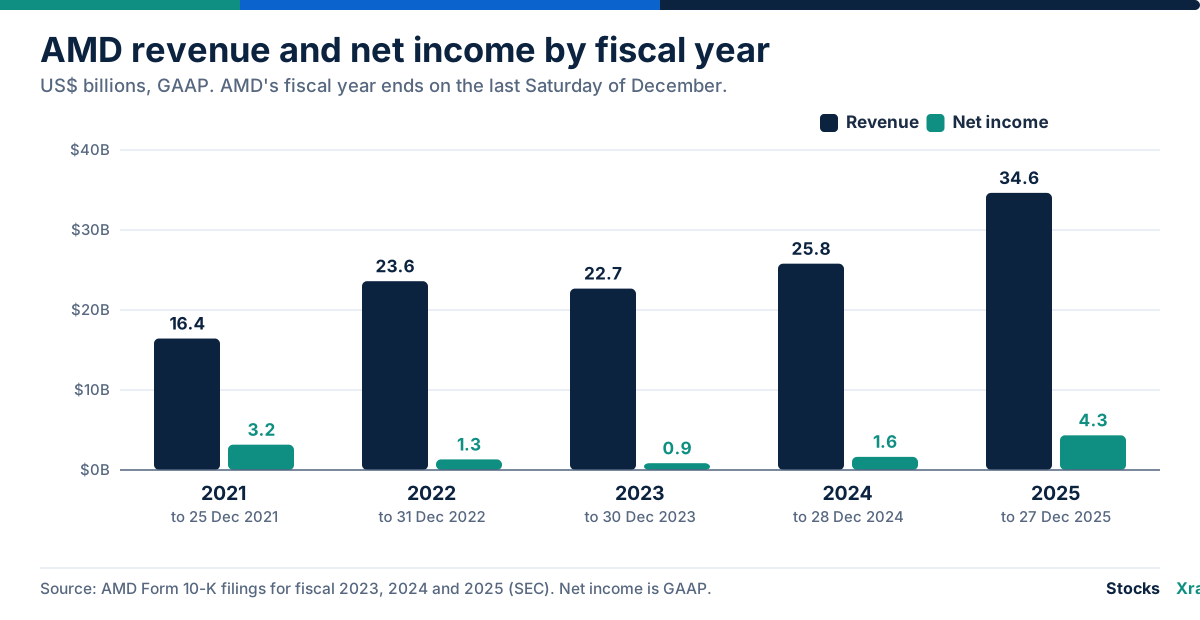
- In 2025 AMD reported record revenue of $34.6 billion, up 34%, and GAAP net income of $4.3 billion, or $2.65 a share. In the first nine months of 2026 revenue rose 44% to $35.2 billion, already more than in all of 2025.
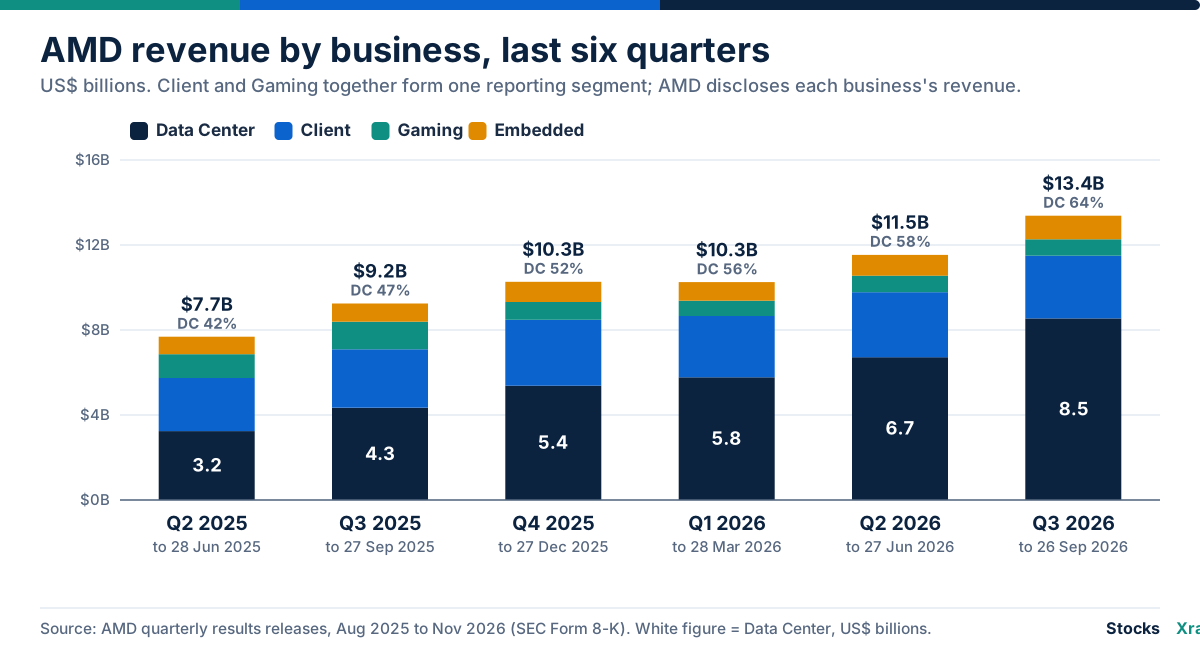
- Data Center now drives the results. Its sales were $8.5 billion in the September 2026 quarter, up 97% and 64% of the total, helped by the launch of AMD's Instinct MI450 accelerators.
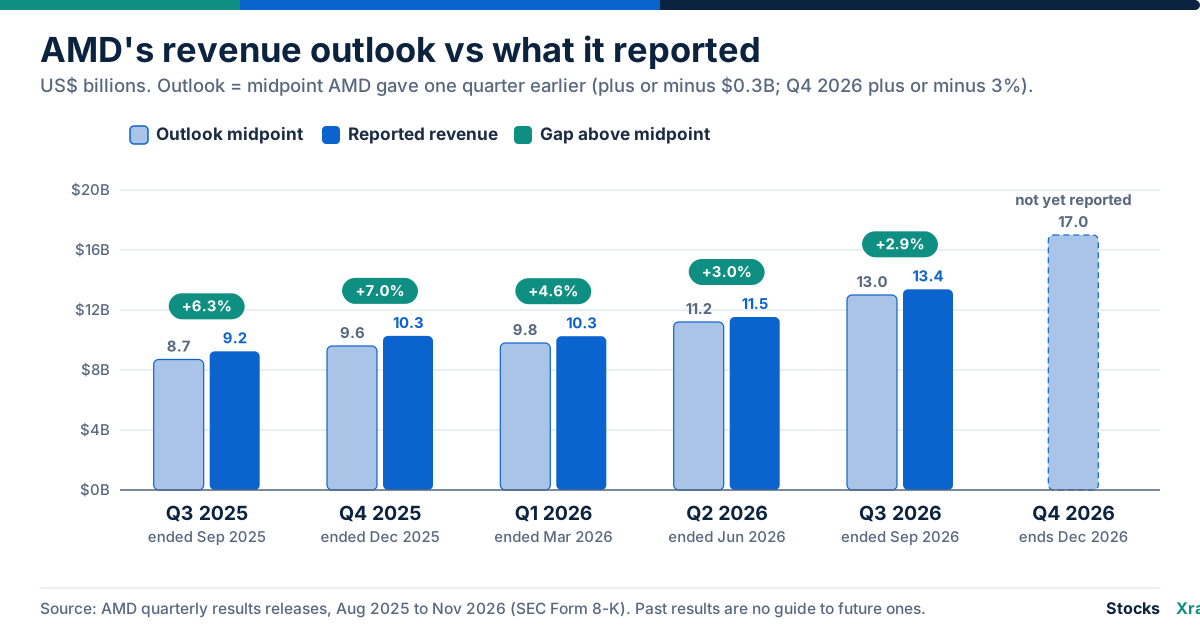
- In each of the five quarters to September 2026, revenue landed above the top of the range AMD had given one quarter earlier. For the December 2026 quarter AMD guided to about $17 billion, plus or minus 3%.
- Warrants for up to 320 million AMD shares, granted to OpenAI and Meta as part of large GPU supply deals, now move GAAP profit. Remeasuring them cost $1.1 billion in the September 2026 quarter.
- AMD pays no dividend and says it does not expect to pay one in the near future. It has a $14 billion buyback program, with $9.2 billion unused at 26 September 2026.
When AMD reports earnings
AMD's fiscal year ends on the last Saturday of December, so its quarters end on Saturdays: fiscal 2026 ends on 26 December 2026. Results come out on a Tuesday after the US market close, followed by a conference call at 2 p.m. Pacific time (5 p.m. Eastern), webcast on AMD's investor relations site.
| Quarter | Quarter end | Results released |
|---|---|---|
| Q4 2024 | 28 Dec 2024 | Tue 4 Feb 2025 |
| Q1 2025 | 29 Mar 2025 | Tue 6 May 2025 |
| Q2 2025 | 28 Jun 2025 | Tue 5 Aug 2025 |
| Q3 2025 | 27 Sep 2025 | Tue 4 Nov 2025 |
| Q4 2025 | 27 Dec 2025 | Tue 3 Feb 2026 |
| Q1 2026 | 28 Mar 2026 | Tue 5 May 2026 |
| Q2 2026 | 27 Jun 2026 | Tue 4 Aug 2026 |
| Q3 2026 | 26 Sep 2026 | Tue 3 Nov 2026 |
| Q4 2026 | 26 Dec 2026 | Not yet announced |
As of 14 November 2026, AMD had not announced the date for its fourth-quarter and full-year 2026 report; its investor calendar listed only two December conferences. The pattern points to early February: last year AMD announced the 3 February 2026 date on 6 January. Each results release is filed with the SEC on Form 8-K together with the slides, and the 10-Q or 10-K has followed one day later every time since February 2025. Our guide to 10-Q and 8-K filings explains what each document holds. Because results arrive after 4 p.m. Eastern, the first price reaction happens in after-hours trading.
What AMD sells and how it makes money
AMD designs processors and accelerators but does not make them. Its 10-K says it relies on Taiwan Semiconductor Manufacturing Company (TSMC) for all wafers at 7 nanometers or smaller and on other contractors for assembly and testing. It reports three segments:
- Data Center: Instinct AI accelerators (GPUs), EPYC server processors (CPUs), networking chips and adaptive chips for data centers.
- Client and Gaming: Ryzen processors for PCs, Radeon graphics cards and semi-custom chips for game consoles. AMD discloses Client and Gaming revenue separately.
- Embedded: processors and adaptive chips (FPGAs) for industrial, automotive, communications, and aerospace and defense equipment, a business that came mainly from the 2022 purchase of Xilinx.
| Business | 2025 revenue | Share | Change from 2024 | Q3 2026 revenue | Change from Q3 2025 |
|---|---|---|---|---|---|
| Data Center | $16.6B | 48% | +32% | $8.5B | +97% |
| Client | $10.6B | 31% | +51% | $2.9B | +7% |
| Gaming | $3.9B | 11% | +51% | $0.8B | -40% |
| Embedded | $3.5B | 10% | -3% | $1.1B | +29% |
| Total | $34.6B | 100% | +34% | $13.4B | +45% |
The mix has shifted fast. Data Center was 42% of revenue in the June 2025 quarter and 64% fifteen months later. Gaming went the other way: after a 51% jump in 2025 on higher sales of semi-custom chips, the ones inside the PlayStation 5 and Xbox Series consoles, it fell 40% in the September 2026 quarter on lower semi-custom and graphics revenue.
Profit is concentrated too. In the September 2026 quarter Data Center earned $2.9 billion of segment operating income, Client and Gaming $0.6 billion and Embedded $0.5 billion. AMD charges $1.1 billion of costs to "All other" rather than to the segments, mainly stock-based pay and amortization of intangible assets from acquisitions. For how chip designers fit into their sector, see our information technology sector guide.
AMD's results record
Five fiscal years
| Fiscal year | Year ended | Revenue | Gross margin | Operating income | Net income | Diluted EPS |
|---|---|---|---|---|---|---|
| 2021 | 25 Dec 2021 | $16.4B | 48.2% | $3.6B | $3.2B | $2.57 |
| 2022 | 31 Dec 2022 | $23.6B | 44.9% | $1.3B | $1.3B | $0.84 |
| 2023 | 30 Dec 2023 | $22.7B | 46.1% | $0.4B | $0.9B | $0.53 |
| 2024 | 28 Dec 2024 | $25.8B | 49.4% | $1.9B | $1.6B | $1.00 |
| 2025 | 27 Dec 2025 | $34.6B | 49.5% | $3.7B | $4.3B | $2.65 |
All figures are GAAP; gross margin is gross profit divided by revenue. Revenue roughly doubled over the four years, but GAAP profit took a different path because of one deal. On 14 February 2022 AMD completed its purchase of Xilinx for $48.8 billion, paid almost entirely in 429 million new shares. That raised the diluted share count from 1,229 million in 2021 to 1,571 million in 2022 and added large charges for amortizing the intangible assets acquired, $2.3 billion in 2025. Operating income fell to $0.4 billion in 2023, when sales of PC processors dropped in a weak PC market and research spending rose, before recovering.
AMD also publishes non-GAAP figures, its own adjusted measures that exclude items such as stock-based pay and acquisition amortization. On that basis 2025 earnings were $4.17 a share, against $2.65 under GAAP. Our guide to basic and diluted EPS explains the per-share arithmetic.
The last six quarters
| Quarter | Ended | Revenue ($M) | Data Center ($M) | Gross margin | Operating income ($M) | Net income ($M) | Diluted EPS |
|---|---|---|---|---|---|---|---|
| Q2 2025 | 28 Jun 2025 | 7,685 | 3,240 | 40% | -134 | 872 | $0.54 |
| Q3 2025 | 27 Sep 2025 | 9,246 | 4,341 | 52% | 1,270 | 1,243 | $0.75 |
| Q4 2025 | 27 Dec 2025 | 10,270 | 5,380 | 54% | 1,752 | 1,511 | $0.92 |
| Q1 2026 | 28 Mar 2026 | 10,253 | 5,775 | 53% | 1,476 | 1,383 | $0.84 |
| Q2 2026 | 27 Jun 2026 | 11,536 | 6,718 | 54% | 1,990 | 2,297 | $1.38 |
| Q3 2026 | 26 Sep 2026 | 13,377 | 8,546 | 54% | 2,832 | 2,428 | $1.46 |
Revenue over the four quarters to September 2026 added up to $45.4 billion. Non-GAAP diluted EPS in the same six quarters was $0.48, $1.20, $1.53, $1.37, $1.66 and $2.09. AMD notes that its revenue has historically been higher in the second half of the year than in the first.
What moved the numbers
AI and server demand. AMD attributes the 97% Data Center jump in the September 2026 quarter to strong demand for EPYC processors and the launch of Instinct MI450 GPUs. Its release said Anthropic, Meta, Microsoft, OpenAI and Oracle were running workloads on the first Helios racks, AMD's complete rack-scale systems.
Export controls. In April 2025 the US government required a license to export AMD's MI308 accelerators to China. AMD took about $800 million of inventory and related charges in the June 2025 quarter, which is why gross margin fell to 40% and operating income turned negative. It later released about $360 million of those reserves in the December 2025 quarter, when it also sold about $390 million of MI308 chips to China under licenses, leaving a net charge of about $440 million for 2025.
Items below operating income. Investment gains, warrants and tax now cause large swings. In the June 2026 quarter, net income of $2.3 billion exceeded operating income of $2.0 billion largely because of $483 million of gains on long-term investments.
Worked example: the September 2026 quarter. Operating income was $2,832 million. Interest expense took $62 million. Other income and expense was a loss of $902 million, because a $1,097 million loss on remeasuring the customer warrants outweighed interest income and investment gains. That left pre-tax income of $1,868 million. AMD then recorded a tax benefit of $555 million, an effective tax rate of minus 29.6%, which included a one-off $772 million benefit linked to stock-based pay. Add $5 million of equity income and net income was $2,428 million, or $1.46 on 1,661 million diluted shares. The non-GAAP figure of $3,471 million, or $2.09, leaves out the warrant loss, stock-based pay of $523 million and amortization of $534 million, and swaps the GAAP tax benefit for a tax charge of $518 million. Neither number is wrong; they answer different questions, so check which one a headline quotes.
The customer warrants
In October 2025 AMD gave OpenAI a warrant to buy up to 160 million AMD shares at $0.01 each, alongside an agreement to supply 6 gigawatts of Instinct GPUs. In February 2026 it gave Meta a matching warrant with its own 6-gigawatt agreement. In each case the first tranche vests when the first gigawatt of GPUs has shipped and the last needs the full 6 gigawatts, and vesting also requires AMD's share price to clear thresholds that rise to $600 for the final tranche. Both expire after five years.
The accounting has two parts. The grant-date value of warrants expected to vest is deducted from revenue as the customer's purchases are recognized, and $4.5 billion of that value was still to be deducted at 26 September 2026. The liability is also remeasured every quarter, with the change in other income; with the share price higher, that produced the $1,097 million loss above. No warrant shares had vested by 26 September 2026. If all 320 million did, they would equal about 20% of the 1,640 million shares outstanding on that date. Our guide to stock-based compensation and dilution explains why new shares matter to existing owners.
How results compared with AMD's own outlook
Each quarter AMD gives an outlook for the next one: a revenue midpoint with a range, plus non-GAAP gross margin. In each of the last five quarters reported revenue came in above the top of that range, by 2.9% to 7.0% above the midpoint.
The margin outlook has been close: non-GAAP gross margin, in whole percentages, matched the guided figure in four of the five quarters. The exception was the December 2025 quarter, at 57% against about 54.5%, which AMD said would have been about 55% without the MI308 reserve release and China sales.
For the quarter ending 26 December 2026, AMD said on 3 November to expect revenue of about $17 billion, plus or minus 3%, or roughly $16.5 billion to $17.5 billion. The midpoint would be about 66% more than a year earlier and 27% more than the September quarter, with non-GAAP gross margin of about 55%. This is AMD's own outlook, not ours, and a record of beating it is no evidence about the next quarter. Our guide to earnings season and guidance explains why share prices often react to the gap between results and expectations.
AMD news as of 14 November 2026
Acquisitions. AMD agreed in August 2026 to buy Taalas, a Toronto developer of specialized inference chips, in a cash and stock deal valued at about $2.9 billion, including up to about $1.4 billion of contingent payments. In September it agreed to buy World Labs, a San Francisco research lab building models of 3D environments, for about $8.2 billion in AMD shares; World Labs co-founder Fei-Fei Li is to join AMD as chief scientist. AMD expects both deals to close by the end of 2026, subject to regulatory approvals.
Customers and investments. Besides the OpenAI and Meta agreements, AMD announced a partnership with Anthropic to deploy up to 2 gigawatts of MI450-series GPUs in Helios racks. On 27 October 2026 it said it would invest $1 billion in a Meta equity offering, and its 10-Q confirms a $1.0 billion investment in a public company's equity offering that month.
Financing and board. On 17 August 2026 AMD sold $4.75 billion of senior notes maturing between 2029 and 2036, at interest rates of 4.6% to 5.5%, and in September it repaid $875 million of notes that matured. In May it signed a new five-year, $5.0 billion revolving credit line. On 19 August Tim Ryan, a former US chair of PwC, joined the board, replacing Joe Householder, who retired. Lisa Su remains chair and chief executive; the 8-Ks filed in the last 90 days show no change of chief executive or finance chief.
Market reaction. AMD closed at $483.90 on 3 November, before the report, and at $488.78 the next day. On 5 November it fell 17.3% to $404.40 during a wider sell-off in chip stocks, which market coverage linked to factors other than AMD's results. It closed at $534.06 on 13 November 2026, against a 52-week range of $188.22 to $658.52. The AMD chart shows the full history.
Why AMD pays no dividend
AMD does not pay a dividend. Its 2025 annual report says it does not expect to pay dividends in the near future, and the models it uses to value employee stock awards assume a dividend yield of zero. Any change would be up to the board.
Instead AMD returns cash through buybacks, though not on a large scale. Its program authorizes up to $14 billion of repurchases, with no end date. AMD bought back $1.3 billion of stock in 2025 and $221 million in the first nine months of 2026, leaving $9.2 billion available. It spent a further $1.8 billion in those nine months on shares withheld to cover employees' taxes when stock awards vested. Even so, diluted shares rose from 1,641 million to 1,661 million over the year to September 2026. Our guide to share buybacks explains when repurchases help owners. Readers who want income can compare AMD with our best dividend stocks list or check upcoming payments on the dividend calendar.
Balance sheet and cash flow
At 26 September 2026 AMD held $15.8 billion of cash, cash equivalents and short-term investments, up from $10.6 billion at the end of 2025. Total debt was $7.1 billion after the August notes, up from $3.2 billion. Goodwill and acquired intangible assets from past acquisitions added up to $40.6 billion of AMD's $94.8 billion of total assets.
Free cash flow, which AMD defines as operating cash flow from continuing operations minus spending on property and equipment, was a record $5.5 billion in 2025. It was $4.7 billion in the first nine months of 2026, but only $554 million in the September quarter. In that quarter inventories absorbed $3.0 billion of cash and receivables $1.9 billion, while capital spending rose to $648 million from $258 million a year earlier. Inventories reached $11.5 billion, against $7.9 billion at the end of 2025. Our guides to free cash flow and working capital explain these measures.
Commitments have grown alongside the AI business. At 26 September 2026 AMD had $48.8 billion of purchase commitments, mainly for wafers, memory, other components and manufacturing services, of which $22.2 billion falls in 2027. It also had $6.2 billion of commitments to buy cloud computing capacity, $13.3 billion of data center leases not yet started that it expects to pass to partners, up to $8.5 billion of guarantees of partners' lease and debt payments, and up to $5.1 billion of planned equity investments. These support sales, but they also tie AMD's finances to its partners' ability to pay.
How StocksXray scores AMD
On 13 November 2026 AMD's StocksXray X-Ray score was 46.3 out of 100, shown as 46 on the stock page. The lenses read: valuation 10.4, growth 78.8, profitability 30.3 and financial health 78.7. There is no dividend score because AMD pays none. On our scale 70 to 100 is strong, 50 to 69 fair and under 50 weak, each judged against Information Technology peers. Our guides to how the X-Ray score works and the five lenses explain the method.
GAAP diluted EPS over the four quarters to September 2026 added up to $4.60, so the $534.06 close on 13 November 2026 was about 116 times trailing earnings, or about 80 times AMD's non-GAAP EPS of $6.65 over the same quarters. A multiple that high means the price assumes profits far above today's; our guide to the price-to-earnings ratio discusses what such ratios can and cannot tell you.
The AMD stock page has the current price, the five lenses and our valuation models, the AMD research report gathers key indicators and the X-Ray breakdown on one page, and the AMD forecast page shows probability ranges built from past price moves, which are ranges and not targets.
Risks AMD lists
AMD's 2025 annual report lists many risk factors. These are the ones most tied to its earnings:
- Competition and product timing. AMD's markets are highly competitive and change quickly, and revenue depends on launching competitive products on time.
- Customer concentration. AMD depends on a small number of customers for a large part of its revenue and expects that to continue; losing one would hurt.
- Third-party manufacturing. TSMC makes all of AMD's most advanced wafers, and AMD cannot guarantee that suppliers will meet its needs.
- Government action and export rules. Export controls have already cost AMD the MI308 charges. MI325 chips licensed for China must first be inspected in the United States, which brings a 25% import tariff.
- Guarantees and commitments. AMD warns that it may have to meet obligations under guarantees and other commercial commitments, which now run to tens of billions of dollars.
- Acquisitions. Deals may not deliver the expected benefits, and goodwill and intangible assets could be impaired.
Common mistakes when reading AMD's earnings
- Mixing GAAP and non-GAAP EPS. The September 2026 quarter was $1.46 under GAAP and $2.09 on AMD's adjusted basis.
- Ignoring the warrants. A rising share price increases the warrant liability and can cut GAAP profit, so a higher stock price can mean lower reported earnings in the short run.
- Treating one-off tax benefits as recurring. The $772 million stock-pay tax benefit lifted the September 2026 quarter.
- Comparing with mid-2025 without adjusting. The June 2025 quarter carried the $800 million export-control charge, which flatters later growth rates.
- Reading the outlook as a promise. It is management's estimate made a quarter ahead.
Frequently asked questions
When does AMD report earnings? AMD reports on a Tuesday after the US market close, about five and a half weeks after each quarter ends. In 2026 it reported on 3 February, 5 May, 4 August and 3 November, each followed by a conference call at 2 p.m. Pacific (5 p.m. Eastern).
When is AMD's next earnings date? As of 14 November 2026, AMD had not announced the date for its fourth-quarter and full-year 2026 results. The quarter ends on 26 December 2026. The past two fourth-quarter reports came on 4 February 2025 and 3 February 2026, and AMD announced the 2026 date on 6 January.
What were AMD's third-quarter 2026 earnings? For the quarter ended 26 September 2026, reported on 3 November 2026, AMD had revenue of $13.4 billion, up 45%, and GAAP net income of $2.4 billion, or $1.46 a diluted share. Non-GAAP EPS was $2.09. Data Center revenue was a record $8.5 billion, up 97%.
Did AMD stock drop after its earnings report? Not at first. AMD closed at $483.90 on 3 November 2026, before the report, and at $488.78 on 4 November. It fell 17.3% to $404.40 on 5 November in a wider sell-off in chip stocks, then closed at $534.06 on 13 November 2026.
What time is the AMD earnings call? The call starts at 2 p.m. Pacific time (5 p.m. Eastern) on results day and is webcast on the investor relations section of amd.com. AMD posts the press release and presentation slides the same day.
Does AMD pay a dividend? No. AMD says it does not expect to pay dividends in the near future. It returns some cash through a $14 billion buyback program, with $9.2 billion unused at 26 September 2026.
Where can I read AMD's earnings report? The press release and slides are posted on ir.amd.com and filed with the SEC as exhibits to a Form 8-K on results day. The full quarterly report, Form 10-Q, or annual report, Form 10-K, has followed a day later, all free on the SEC's EDGAR system.
Sources and data notes
- AMD Form 10-K for fiscal 2025, filed 4 February 2026.
- AMD Form 10-Q for the quarter ended 26 September 2026, filed 4 November 2026.
- AMD results releases filed on Form 8-K, August 2025 to November 2026, for example the Q3 2026 release and the Q4 2025 release.
- AMD Forms 8-K on the OpenAI warrant, the Meta warrant, the August 2026 notes, the World Labs agreement and the board change.
- AMD investor relations press releases and events calendar, read 14 November 2026.
- Prices and X-Ray scores: StocksXray, closing data to 13 November 2026.
This page covers results through the quarter ended 26 September 2026 and news to 14 November 2026. It contains no forecasts of our own; the outlook figures quoted are AMD's.
Educational information, not financial advice.
Related reading
Stocks in this article
Educational only, not financial advice. Examples use illustrative numbers.