











Telstra Dividend History, Dates, Franking and Yield Explained
Telstra pays two dividends a year, an interim in March and a final in September. For the year to 30 June 2026 (FY2026) it paid 21 cents a share: a 10.5 cent interim on 27 March 2026 and a 10.5 cent final on 24 September 2026, up 10.5% on FY2025. For the first time since 1999, part of the dividend was unfranked: 9.5 cents of each payment was franked and 1 cent was not. This guide covers the history, the dates, the franking change, the payout and the results behind the dividend.
All amounts are in Australian dollars. Telstra's financial year ends on 30 June.
Key takeaways
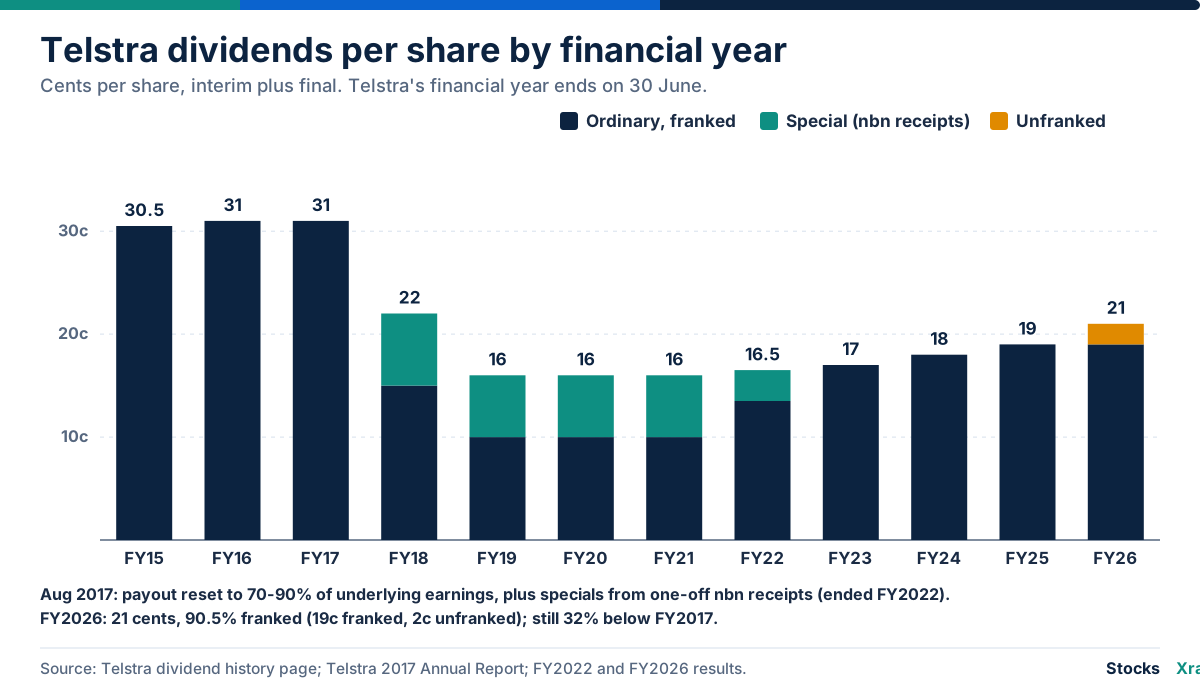
- Telstra paid 21 cents a share for FY2026, up from 19 cents in FY2025 and the fifth annual increase in a row, but still 32% below the 31 cents it paid in FY2016 and FY2017.
- Both FY2026 dividends were 90.5% franked (19 cents franked, 2 cents unfranked for the year) because Telstra's franking account was in deficit. The unfranked part was declared conduit foreign income, so non-resident holders pay no Australian withholding tax on it.
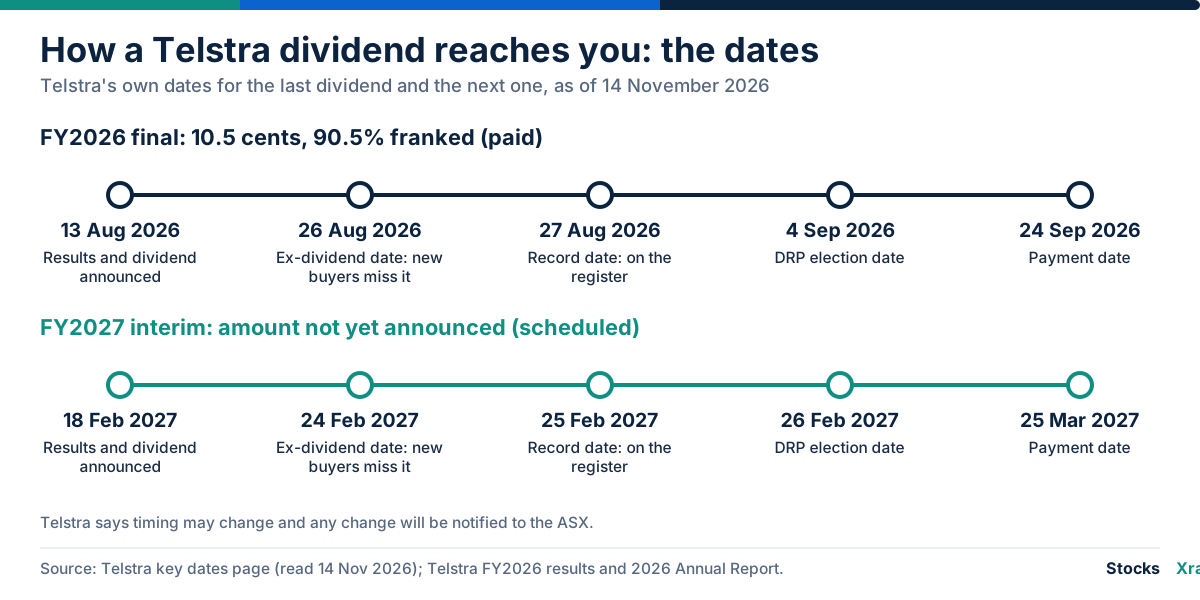
- As of 14 November 2026, Telstra's investor calendar schedules the FY2027 interim with half-year results on 18 February 2027, ex-dividend on 24 February, record date 25 February and payment on 25 March 2027. The amount is not yet known.
- Telstra's stated aim is a "sustainable and growing dividend", preferably fully franked. The FY2026 dividend was 106% of statutory earnings per share and 82% of cash earnings per share, the measure Telstra cites as support for the dividend.
- On the 13 November 2026 close of A$5.12, the 21 cents paid in the past 12 months gave a cash yield of 4.10%, or 5.69% including franking credits.
What Telstra does and how it makes money
Telstra describes itself as Australia's largest telecommunications provider and an operator of critical national infrastructure. It sells mobile, broadband and fixed-line services to households, businesses and government, rents network capacity to other carriers through its InfraCo unit, owns mobile towers through Amplitel, and runs international networks, including the Pacific mobile operator Digicel Pacific, which it bought in partnership with the Australian Government in 2022.
Telstra reports income and earnings by product. Mobile is the core of the business: it produced almost half of FY2026 income and about 60% of product earnings.
| Product | FY2026 income (A$m) | FY2026 EBITDA (A$m) |
|---|---|---|
| Mobile | 11,368 | 5,436 |
| Fixed, consumer and small business | 4,177 | 412 |
| Fixed, enterprise | 3,167 | 199 |
| Fixed, active wholesale | 329 | 65 |
| International | 2,294 | 654 |
| InfraCo fixed (network access for other carriers) | 2,779 | 1,865 |
| Amplitel (towers) | 487 | 391 |
| Group total income | 23,405 | 8,822 (group EBITDA) |
EBITDA is earnings before interest, tax, depreciation and amortization; our guide to EBIT and EBITDA explains the measure. Product figures include sales between Telstra units, so they do not add up to the group totals. Mobile income rose 3.2% in FY2026 and Telstra added more than 270,000 mobile users, while enterprise and international income fell as Telstra exited or reshaped weaker product lines. Our communication services sector guide covers how telecom companies earn money more generally.
Telstra results, FY2022 to FY2026
| Year to 30 June | Total income (A$m) | EBITDA (A$m) | Net profit after tax (A$m) | Basic EPS (cents) | Dividend (cents) |
|---|---|---|---|---|---|
| FY2022 | 22,045 | 7,256 | 1,814 | 14.4 | 16.5 |
| FY2023 | 23,245 | 7,862 | 2,051 | 16.7 | 17.0 |
| FY2024 | 23,482 | 7,528 | 1,788 | 14.1 | 18.0 |
| FY2025 | 23,610 | 8,607 | 2,343 | 18.9 | 19.0 |
| FY2026 | 23,405 | 8,822 | 2,406 | 19.9 | 21.0 |
EPS means earnings per share; net profit includes the share belonging to minority holders of some subsidiaries. What moved the numbers:
- FY2022: one-off payments from nbn co, the company that built the national broadband network, fell from A$1,050 million in FY2021 to A$378 million as the rollout finished, and to A$72 million in FY2023. Reported EPS fell 7.7%.
- FY2023: income rose 5.4%, helped by the first year of Digicel Pacific, and net profit rose 13.1%.
- FY2024: net profit fell 12.8% after A$715 million of one-off items before tax: A$311 million of impairments tied to resetting the enterprise business, A$247 million of restructuring costs from the cost cuts announced in May 2024, and other write-downs.
- FY2025 and FY2026: with fewer one-offs, net profit rose 31% to A$2.3 billion and then 2.7% to A$2.4 billion. FY2026 EPS rose 5.3% to 19.9 cents, helped by the smaller share count after buybacks.
Income has barely moved in five years, staying between A$22.0 billion and A$23.6 billion. The growth in earnings and dividends has come mainly from lower costs and fewer shares rather than from higher sales.
The latest four halves
| Half year | Total income (A$m) | EBITDA (A$m) | Net profit (A$m) | Dividend (cents) |
|---|---|---|---|---|
| Six months to Dec 2024 | 11,823 | 4,248 | 1,115 | 9.5 interim |
| Six months to Jun 2025 | 11,787 | 4,359 | 1,228 | 9.5 final |
| Six months to Dec 2025 | 11,845 | 4,449 | 1,205 | 10.5 interim |
| Six months to Jun 2026 | 11,560 | 4,373 | 1,201 | 10.5 final |
Two other items in the FY2026 report bear on the company. On 8 July 2026 a network outage disrupted some mobile calls and data, including some Triple Zero emergency calls; Telstra has received one regulatory notice, expects more, and says the regulatory and financial consequences cannot yet be reliably estimated. Telstra has also signed a binding agreement to sell its 100% interest in Reach Networks Hong Kong Limited. At the annual general meeting on 13 October 2026 the chair called the outage disappointing and said the board had reflected it in executive pay for FY2026.
Telstra dividend history
Telstra's dividend history page lists every payment back to 1998. The table shows each financial year since FY2015.
| Financial year | Interim (cents) | Final (cents) | Total (cents) | Of which special | Franking |
|---|---|---|---|---|---|
| FY2015 | 15.0 | 15.5 | 30.5 | none | full |
| FY2016 | 15.5 | 15.5 | 31.0 | none | full |
| FY2017 | 15.5 | 15.5 | 31.0 | none | full |
| FY2018 | 11.0 | 11.0 | 22.0 | 7.0 | full |
| FY2019 | 8.0 | 8.0 | 16.0 | 6.0 | full |
| FY2020 | 8.0 | 8.0 | 16.0 | 6.0 | full |
| FY2021 | 8.0 | 8.0 | 16.0 | 6.0 | full |
| FY2022 | 8.0 | 8.5 | 16.5 | 3.0 | full |
| FY2023 | 8.5 | 8.5 | 17.0 | none | full |
| FY2024 | 9.0 | 9.0 | 18.0 | none | full |
| FY2025 | 9.5 | 9.5 | 19.0 | none | full |
| FY2026 | 10.5 | 10.5 | 21.0 | none | 90.5% |
Because the financial year ends in June, each calendar year holds the final from one financial year and the interim from the next. The dividends paid in calendar 2025 were 9.5 cents in March and 9.5 cents in September, 19 cents in all. In calendar 2026 they were 10.5 cents each, 21 cents in all.
The reset of 2017
In August 2017 Telstra changed its dividend policy, moving away from paying out almost all of its profit. From FY2018 the ordinary dividend was set at 70% to 90% of underlying earnings, and Telstra said it would return about 75% of the net one-off payments it received from nbn co through fully franked special dividends. The total fell from 31 cents in FY2017 to 22 cents in FY2018, then to 16 cents, of which 10 cents was ordinary and 6 cents special, for FY2019 to FY2021.
In August 2022 Telstra said the special dividends had ended because the nbn rollout was complete and it had met its 75% commitment. The ordinary dividend rose from 10 cents to 13.5 cents in FY2022, which with 3 cents of specials made 16.5 cents, the first increase in the total since 2015.
Growth since then
Since FY2022 the dividend has risen every year: 16.5, 17, 18, 19 and 21 cents. From FY2023, the first year without specials, to FY2026 that is about 7.3% a year. Measured from FY2017, the FY2026 total is still 32% lower. Both views are correct, and the base year changes the story; our guide to dividend growth investing explains why.
Telstra dividend dates for 2025, 2026 and 2027
Telstra announces its interim dividend with half-year results in February and its final with full-year results in August, and publishes the dates a year ahead. On the ASX, the ex-dividend date is one business day before the record date: a buyer on or after the ex-dividend date does not get the coming dividend.
| Dividend | Announced | Ex-dividend | Record date | Paid | DRP price |
|---|---|---|---|---|---|
| FY2025 interim, 9.5c | 20 Feb 2025 | 26 Feb 2025 | 27 Feb 2025 | 28 Mar 2025 | $4.1930 |
| FY2025 final, 9.5c | 14 Aug 2025 | 27 Aug 2025 | 28 Aug 2025 | 25 Sep 2025 | $4.8777 |
| FY2026 interim, 10.5c | 19 Feb 2026 | 25 Feb 2026 | 26 Feb 2026 | 27 Mar 2026 | $5.1940 |
| FY2026 final, 10.5c | 13 Aug 2026 | 26 Aug 2026 | 27 Aug 2026 | 24 Sep 2026 | $4.7970 |
| FY2027 interim (amount not set) | 18 Feb 2027 | 24 Feb 2027 | 25 Feb 2027 | 25 Mar 2027 | |
| FY2027 final (amount not set) | 12 Aug 2027 | 25 Aug 2027 | 26 Aug 2027 | 23 Sep 2027 |
The 2027 dates are from Telstra's key dates page as of 14 November 2026. Telstra says timing may change and that any change will be announced to the ASX. Our explainer on ex-dividend and record dates covers the mechanics, and our dividend calendar lists ex-dates as they approach.
The dividend reinvestment plan
Telstra's dividend reinvestment plan (DRP) lets shareholders who live in Australia or New Zealand take shares instead of cash. To take part, a holder must elect by the DRP election date for that dividend: 27 February 2026 for the FY2026 interim, 4 September 2026 for the FY2026 final and, on the current calendar, 26 February 2027 for the next interim. The DRP price was $4.7970 a share for the FY2026 final.
Franking: why FY2026 was 90.5% franked
A franking credit passes on to shareholders the 30% company tax Telstra has already paid on the profits behind a dividend. From 2000 to FY2025 every Telstra dividend was fully franked; the only earlier unfranked payment in its published history was a 16 cent special dividend in 1999. Each FY2026 dividend was 90.48% franked: 9.5 cents franked and 1 cent unfranked.
The reason is the franking account, the running tally of tax paid that a company can attach to dividends. Telstra's account was A$306 million in deficit at 31 December 2025. It said it would use the current balance plus credits from the tax instalments it expected to pay to partly frank the dividends, and the result was 9.5 cents of franking on each 10.5 cent dividend. Telstra declared the unfranked 1 cent to be conduit foreign income, which matters for holders abroad: the Australian Taxation Office (ATO) does not require withholding tax on dividends that are fully franked or paid out of conduit foreign income, so non-residents receive the full cash amount from Australia.
Worked example: 1,000 shares and the 10.5 cent final
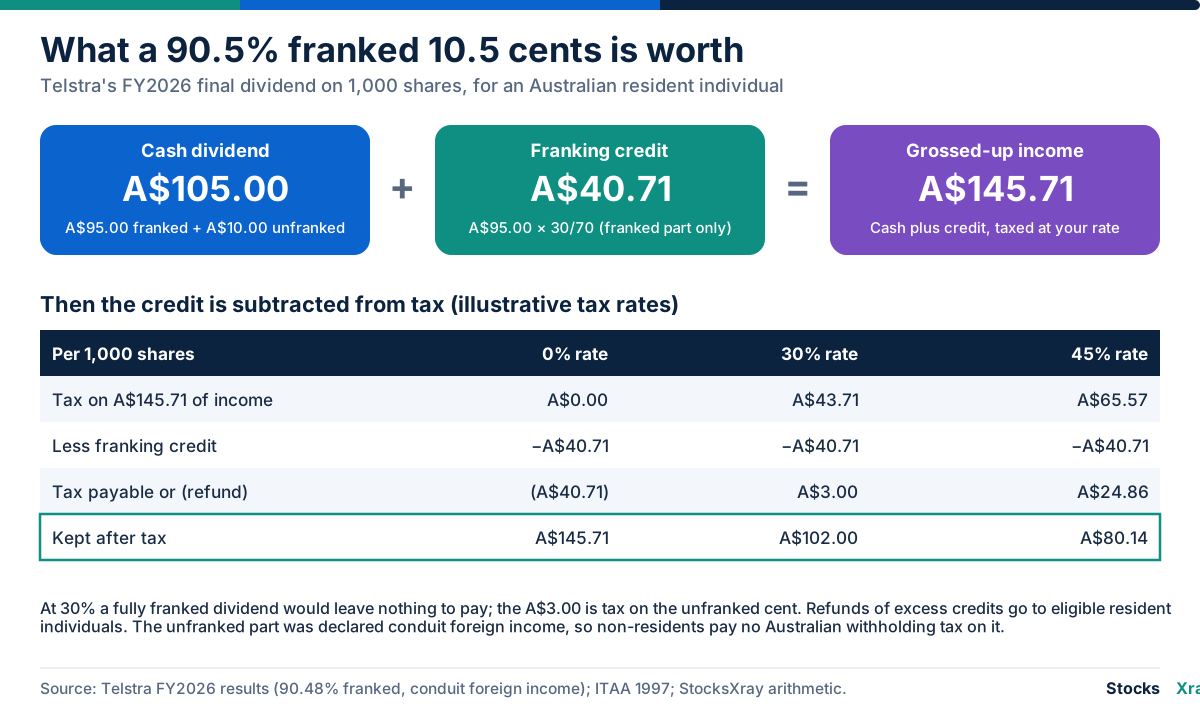
On 1,000 shares the FY2026 final paid A$105.00 in cash. Of that, A$95.00 was franked and A$10.00 was not. The franking credit is the franked amount multiplied by 30/70, so A$40.71, and grossed-up income is A$145.71. With illustrative tax rates, chosen to show the mechanics rather than any person's bracket:
- At 0%, no tax is due and the ATO refunds excess credits to eligible resident individuals, so the holder keeps A$145.71.
- At 30%, tax on A$145.71 is A$43.71; the credit covers A$40.71, leaving A$3.00 to pay, so the holder keeps A$102.00. On a fully franked dividend the bill at this rate would have been nil; the A$3.00 is the cost of the unfranked cent.
- At 45%, tax is A$65.57, leaving A$24.86 to pay, so the holder keeps A$80.14.
To use franking credits, the ATO generally requires shares to be held "at risk" for at least 45 days, not counting the days of purchase and sale, unless the small shareholder exemption applies (franking credits under A$5,000 in the year).
Dividend policy, payout ratio and the cash behind it
Telstra's capital management framework, updated for its Connected Future 30 strategy, lists five principles: balance sheet settings consistent with an A-band credit rating, disciplined business-as-usual capital spending, a "sustainable and growing dividend (prefer fully-franked)", disciplined portfolio management and strategic investment, and using spare balance sheet capacity for additional shareholder returns. It does not set a payout ratio or promise a dollar amount.
Telstra reports three payout ratios. Statutory EPS includes one-offs; underlying EPS removes them; cash EPS is underlying operating earnings after leases, minus routine capital spending, spectrum costs, interest, tax and minority interests, per share.
| Payout ratio | FY2024 | FY2025 | FY2026 |
|---|---|---|---|
| Dividend as % of statutory EPS | 128% | 101% | 106% |
| Dividend as % of underlying EPS | 97% | 99% | 103% |
| Dividend as % of cash EPS | 90% | 85% | 82% |
A payout above 100% of reported profit looks stretched. The gap between the measures comes largely from depreciation: in FY2026 Telstra's depreciation and amortization of network and other assets was A$4,262 million, while its business-as-usual capital spending was A$3,365 million. Cash EPS was 25.5 cents, up 14%. Our dividend payout ratio guide explains how to read both views.
The cash flow statement shows how the payouts were funded. In FY2026 operating cash flow was A$7,554 million and investing cash flow was minus A$3,473 million, leaving A$4,081 million. Telstra paid A$2,262 million of dividends and completed a A$1.25 billion on-market buyback, which retired 245.9 million shares at an average A$5.08 between September 2025 and June 2026. Net debt rose by A$856 million to A$17,301 million, 2.0 times EBITDA; our guide to net debt to EBITDA explains that ratio. On 13 August 2026 Telstra announced a further buyback of up to A$1 billion during FY2027, which it says shifts its funding toward more debt and less equity. Our post on share buybacks covers how buybacks lift per-share figures.
Telstra dividend yield
Dividend yield is the last 12 months of dividends divided by the share price. Telstra closed at A$5.12 on 13 November 2026, and the 21 cents paid in the 12 months to then gives a cash yield of 4.10%. Adding the franking credits on the 19 franked cents, about 8.1 cents, the grossed-up yield was 5.69%.
| Date | Close (A$) | Dividends in the calendar year (cents) | Cash yield |
|---|---|---|---|
| End of 2021 | 4.18 | 16.0 | 3.83% |
| End of 2022 | 3.99 | 16.5 | 4.14% |
| End of 2023 | 3.96 | 17.0 | 4.29% |
| End of 2024 | 4.01 | 18.0 | 4.49% |
| End of 2025 | 4.87 | 19.0 | 3.90% |
| 13 Nov 2026 | 5.12 | 21.0 (past 12 months) | 4.10% |
From the end of 2021 to 13 November 2026 the annual dividend rose 31% and the share price 22.5%, so the year-end yield has stayed between about 3.8% and 4.5%. Our dividend yield guide explains why a yield should be read alongside the payout ratio, and our best dividend stocks list ranks income stocks across markets. For the current price, see the Telstra stock page and its interactive chart; the ASX 200 page shows the wider Australian market.
How StocksXray scores Telstra
On 13 November 2026 Telstra had a Market X-Ray score of 81 out of 100, ranking 93rd of 1,820 stocks on the Australian Securities Exchange, with high confidence. The Market X-Ray is price-based: it ranks how the share has traded against other ASX stocks. The five lenses read trend 78, momentum 71, stability 96, liquidity 100 (about A$136 million traded a day) and income 50. The income lens uses the cash yield of 4.1% and the years with dividends, without franking, which puts Telstra in the middle of the ASX range.
The score says nothing about Telstra's network, debt or the safety of its dividend. Our fundamental X-Ray, built from financial statements, covers US stocks for now. The Telstra research report collects the latest figures, and how the X-Ray score works explains the method.
Risks Telstra itself lists
Telstra's 2026 Annual Report sets out its material risks. Those that bear most on the dividend:
- Network outages. Telstra says outages can cause customer harm, regulatory consequences and reputational damage, and that the July 2026 outage reaffirmed how much customers depend on its network.
- Strategy execution. Telstra lists the risk of not fully delivering Connected Future 30 because of delays or poorly managed links between major programs; the Aura fibre network, which Telstra says is more than halfway built, is one of them.
- Regulatory compliance. Failing to meet regulatory requirements can bring penalties; Telstra also lists growing complexity in policy and regulation, such as proposals for mandated mobile roaming, which the chair argued against at the 2026 AGM.
- Cyber and physical security. Attacks or incidents affecting networks, systems and physical assets could disrupt service and cause financial loss.
- Privacy and data. Inappropriate access to, or loss of, personal information could harm customers and lead to regulatory action.
- New technology. Telstra lists the risk of not responding strategically to technologies such as satellite and AI.
Common mistakes when reading Telstra's dividend
- Assuming every dividend is fully franked. The FY2026 dividends were 90.5% franked. Check the franked and unfranked amounts in each announcement.
- Counting old specials as recurring. From FY2018 to FY2022, between 3 and 7 cents a year came from nbn special dividends that have now ended.
- Buying on the ex-dividend date. Shares bought on or after the ex-dividend date do not carry the coming dividend.
- Judging the payout on statutory profit alone. At 106% of statutory EPS the dividend looks uncovered; at 82% of cash EPS it does not. Compare the same measure across years.
- Treating scheduled dates as declared dividends. The 2027 dates are a calendar, not a promise of an amount.
Frequently asked questions
When is the next Telstra dividend? As of 14 November 2026, Telstra's key dates page schedules the FY2027 interim dividend to be announced with half-year results on 18 February 2027. The shares are due to go ex-dividend on 24 February 2027, with a record date of 25 February and payment on 25 March 2027. The amount and franking will be set on 18 February.
What are the Telstra dividend dates for 2026? The FY2026 interim of 10.5 cents went ex-dividend on 25 February 2026, had a record date of 26 February and was paid on 27 March 2026. The FY2026 final of 10.5 cents went ex-dividend on 26 August 2026, had a record date of 27 August and was paid on 24 September 2026.
How much was the Telstra dividend in 2025? Telstra paid 19 cents a share in calendar 2025, both fully franked: a 9.5 cent interim on 28 March 2025 (ex-dividend 26 February) and a 9.5 cent final on 25 September 2025 (ex-dividend 27 August). Together they made up the FY2025 dividend.
What was the last dividend payment for Telstra? The most recent payment was the FY2026 final dividend of 10.5 cents a share, 9.5 cents franked and 1 cent unfranked, paid on 24 September 2026. The listed company has been Telstra Group Limited since a 2022 restructure replaced Telstra Corporation Limited as the head company, with one new share for each old share.
What is the Telstra dividend yield? Based on the 21 cents paid in the 12 months to 13 November 2026 and that day's close of A$5.12, the cash yield was 4.10%, or 5.69% including franking credits. The yield changes with the share price and with each new dividend.
Are Telstra dividends fully franked? Not fully at present. Every Telstra dividend from 2000 to FY2025 was fully franked, but both FY2026 dividends were 90.5% franked, with 9.5 cents franked and 1 cent unfranked, because Telstra's franking account was in deficit. Its capital management framework states a preference for fully franked dividends.
Does Telstra have a dividend reinvestment plan? Yes. Shareholders who live in Australia or New Zealand can reinvest dividends in Telstra shares by electing before the DRP election date set for each dividend. The DRP prices for the 2025 dividends were $4.1930 and $4.8777, and for the 2026 dividends $5.1940 and $4.7970.
Sources and data notes
- Telstra, dividend history and key dates, read on 14 November 2026.
- Telstra, FY2026 results market release, FY2026 financial results and annual report, analyst presentation materials and financial tables, 13 August 2026.
- Telstra, half-year results to 31 December 2025, 2026 Annual Report and 2024 Annual Report.
- Telstra, FY2022 and FY2023 results market releases, 2017 Annual Report (dividend policy change) and 2026 AGM presentations, 13 October 2026.
- Income Tax Assessment Act 1997 on legislation.gov.au; ATO guidance on withholding from dividends paid to foreign residents and franking tax offsets.
- Share price, yields and Market X-Ray scores: StocksXray, close of 13 November 2026.
This guide covers Telstra's dividends and results to 14 November 2026. It does not include dividend forecasts or company guidance, and it is not personal tax advice; tax outcomes depend on your residence and circumstances.
Educational information, not financial advice.
Related reading
Educational only, not financial advice. Examples use illustrative numbers.