









What Is an Index Fund? How It Works and How to Invest in the S&P 500
An index fund is a mutual fund or exchange-traded fund (ETF) that tries to match the return of a market index, such as the S&P 500, by holding all of the securities in that index, or a representative sample of them, instead of picking stocks. Because no one is paid to choose winners, costs are usually low. This guide explains how index funds copy an index, what they cost, how closely they track, what the evidence on active funds shows, and how to buy an S&P 500 index fund.
Key takeaways
- The SEC describes an index fund as a type of mutual fund or ETF that seeks to track the returns of a market index. You cannot invest in an index directly, so a fund is the usual way to own one.
- Index funds are cheap to own on average. In 2025 the asset-weighted average expense ratio was 0.05% for index equity mutual funds and 0.14% for index equity ETFs, against 0.64% for actively managed equity mutual funds, according to the Investment Company Institute (ICI).
- Index funds held 52% of US long-term mutual fund and ETF assets at year-end 2025, up from 19% at year-end 2010 (ICI).
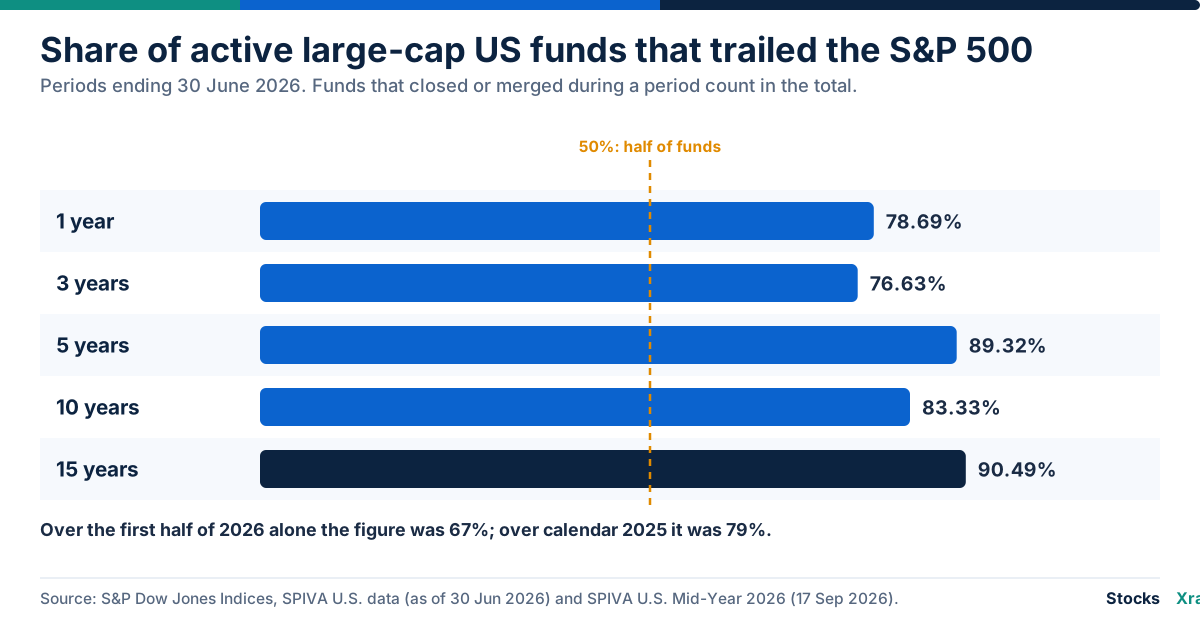
- Over the 15 years to 30 June 2026, 90.49% of active large-cap US stock funds trailed the S&P 500, according to S&P Dow Jones Indices. An index fund also trails its index, by roughly its costs.
- An S&P 500 fund is not "the whole market". As of 30 September 2026 the 10 largest constituents made up 37.3% of the index.
What an index fund is, and what it is not
An index is a rulebook plus a list: the provider decides which companies qualify, how much weight each gets and when the list changes. Our guide to what a stock market index is and how it is built covers weighting and rebalancing. This article picks up when you want to own the index rather than just watch it.
The SEC's Office of Investor Education describes an index fund as a type of mutual fund or ETF that seeks to track the returns of a market index, such as the S&P 500 or the Russell 2000. "Index fund" names the strategy; "mutual fund" and "ETF" name the wrapper. That is why "ETF vs index fund" has no single answer: many ETFs are index funds, and many index funds are mutual funds.
Index funds are passive: the fund buys what the index holds and trades mainly when the index changes or money flows in or out. An actively managed fund tries to beat a benchmark by choosing what to buy and sell.
A short history
Vanguard describes First Index Investment Trust, launched on 31 August 1976 to track the S&P 500, as the first index fund for individual investors. Its offering raised a little more than $11 million, and the fund was later renamed Vanguard 500 Index Fund. The SPDR S&P 500 ETF Trust, which its sponsor describes as the first ETF listed in the United States, started in January 1993 and also tracks the S&P 500.
ICI data show index mutual funds held $7.7 trillion at year-end 2025, 32% of long-term mutual fund assets. Including index ETFs, index funds held 52% of US long-term mutual fund and ETF assets, up from 19% at the end of 2010.
"S&P 500" in a fund's name is not enough
Our list of S&P 500 ETFs and index funds puts funds that track the S&P 500 itself next to equal-weight, growth, value, momentum and low-volatility versions, and even a product linked to volatility futures. Each follows a different index. The SEC suggests checking the investment strategy section of the prospectus, because you cannot always tell what a fund is from its name.
How an index fund copies its index
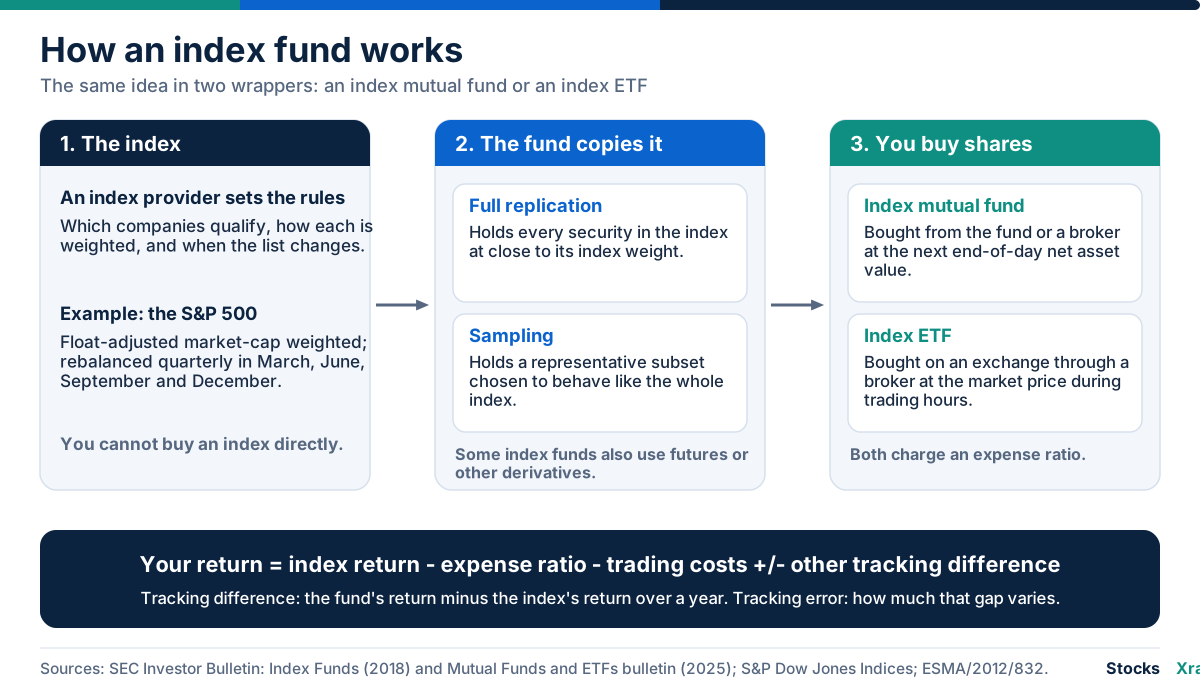
There are three main ways to deliver an index's return; the prospectus says which one a fund uses.
Full replication
The fund holds every security in the index at close to its index weight. This suits a large, liquid index such as the S&P 500, which S&P Dow Jones Indices weights by float-adjusted market capitalization and rebalances quarterly, in March, June, September and December. It had 503 constituents on 30 September 2026, more than 500 because a few companies, Alphabet among them, are included through two share classes.
Sampling
Some indexes contain thousands of securities, or small ones that are costly to trade. A sampling fund holds a representative subset chosen to behave like the whole index. That saves trading costs, but the SEC notes that a fund holding only a sample is less likely to match the index.
Derivatives and synthetic replication
The SEC notes that some index funds also use derivatives such as futures or options. In Europe, index-tracking UCITS funds (funds authorized under the EU's UCITS directive) may use synthetic replication, receiving the index return through a derivative contract with a counterparty. Guidelines from the European Securities and Markets Authority (ESMA) require the prospectus to state whether replication is full, sample-based or synthetic, and what that means for counterparty risk.
| Method | What the fund holds | Where it fits | Trade-off |
|---|---|---|---|
| Full replication | Every index security at about its index weight | Large, liquid indexes such as the S&P 500 | Closest match; trades whenever the index changes |
| Sampling | A representative subset of the index | Indexes with thousands of securities or illiquid ones | Lower trading costs; more tracking error |
| Synthetic (some UCITS funds) | Other assets plus a derivative that pays the index return | Some European-domiciled funds | Adds counterparty risk |
What index funds cost
The expense ratio
A fund's expense ratio is its total annual operating expenses (management fee, any 12b-1 distribution fee and other costs) as a percentage of average net assets. You never receive a bill: the costs come out of the fund's assets and reduce the value of every share. The SEC notes that 12b-1 fees typically apply to mutual funds, not ETFs.
ICI's 2026 Fact Book puts the asset-weighted average expense ratio, the average investors actually paid, for all equity mutual funds at 0.99% in 2000 and 0.40% in 2025. For index equity mutual funds it fell from 0.27% to 0.05%, and for actively managed equity mutual funds from 1.06% to 0.64%. Index equity ETFs averaged 0.21% in 2017 and 0.14% in 2025.
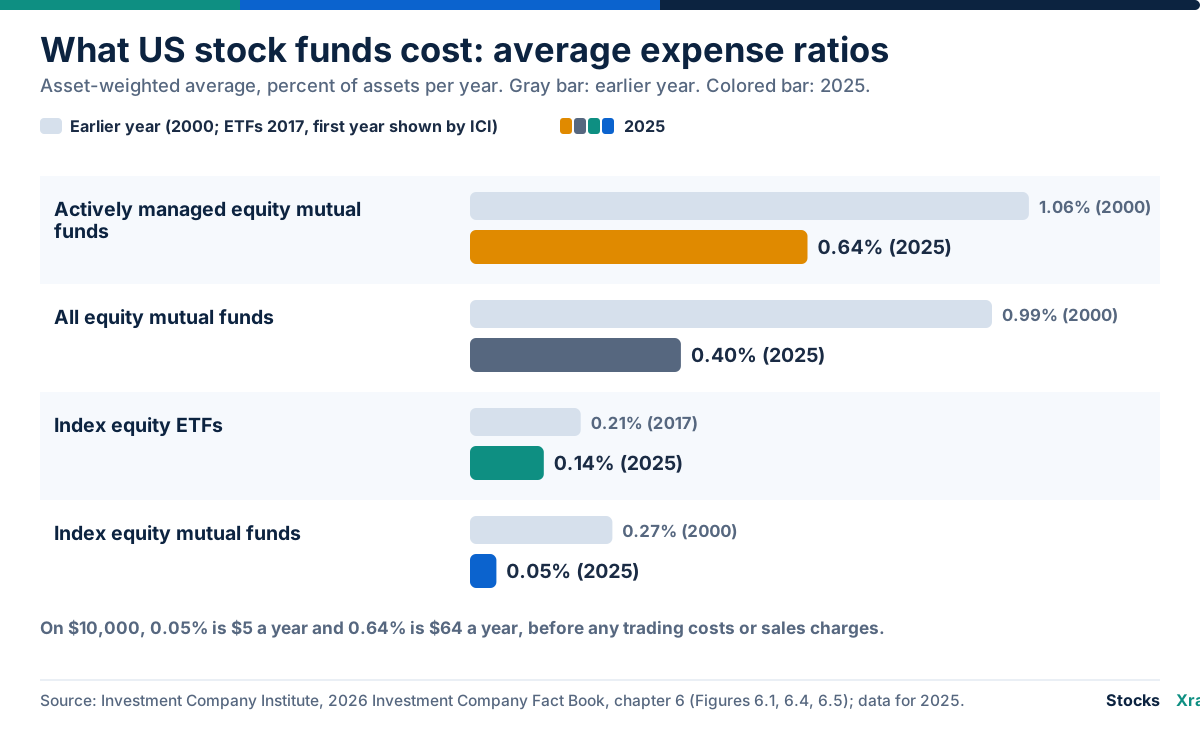
The word "asset-weighted" matters. The simple average expense ratio of all index equity ETFs on offer was 0.45% in 2025, more than three times the 0.14% the average invested dollar paid, because money gathers in the cheapest funds. So "index fund" does not guarantee a low fee, and the SEC warns that not all index funds cost less than actively managed funds.
Costs outside the expense ratio
The prospectus fee table does not show brokerage commissions or fees paid to other intermediaries. ETF buyers also pay the bid-ask spread, explained in bid, ask, spread and liquidity. Some mutual funds charge shareholder fees such as a sales load (a commission to the selling broker), a redemption fee or an account fee, which the SEC says is uncommon for ETFs. An adviser may add a separate fee.
Worked example: fee drag over 30 years (illustrative)
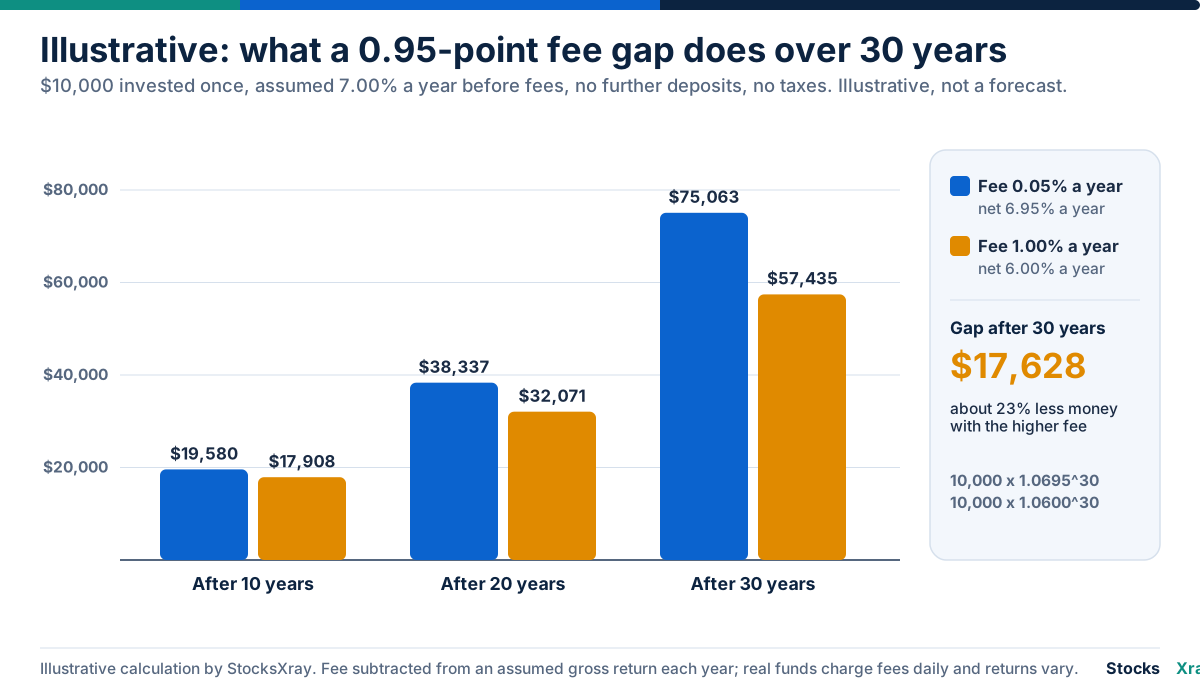
Take an illustrative one-time investment of $10,000 held for 30 years, and assume the underlying stocks return 7.00% a year before fees. Compare a 0.05% fee with a 1.00% fee, ignoring taxes and further deposits, and subtract the fee from the return each year.
- Fee 0.05%: net return 6.95% a year. $10,000 x 1.0695^30 = about $75,063.
- Fee 1.00%: net return 6.00% a year. $10,000 x 1.0600^30 = about $57,435.
- Gap: $75,063 - $57,435 = $17,628, or about 23% less money for the higher-fee investor.
| After | Fee 0.05% a year | Fee 1.00% a year | Gap |
|---|---|---|---|
| 10 years | $19,580 | $17,908 | $1,672 |
| 20 years | $38,337 | $32,071 | $6,266 |
| 30 years | $75,063 | $57,435 | $17,628 |
The gap widens because each year's fee also removes the growth that money would have earned later. Real funds deduct fees daily and real returns vary, including losing years, so treat this as a picture of the mechanism, not a forecast. It also shows an active fund's hurdle: to justify a fee 0.95 percentage points higher, it must beat the index by more than that on average.
Tracking difference and tracking error
No index fund matches its index exactly. ESMA's guidelines define the two measures of the gap:
- Tracking difference is the fund's annual return minus the annual return of the index it tracks. It is usually negative, because the fund pays costs that the index does not.
- Tracking error is the volatility of the difference between the fund's return and the index's return. It measures how consistent the gap is, not how big it is.
An illustrative example: in a year when an index returns 10.00% including dividends, a fund with a 0.03% expense ratio returns 9.95%. Its tracking difference is -0.05 percentage points: 0.03 from the fee and 0.02 from everything else. A fund whose gap swings between +0.30 and -0.40 points from year to year has a higher tracking error than one that trails by a steady 0.05, even if their averages look similar.
ESMA lists transaction costs, small and illiquid index components and dividend reinvestment among the factors that affect tracking; add the expense ratio and, for sampling funds, the sample itself.
Two checks help. Compare a fund with the total return version of its index, since a price index leaves out dividends. And read the annual shareholder report: under SEC rules it must show the fund's average annual total returns for the past 1, 5 and 10 years beside a broad-based market index. For ETFs, the market price can also sit above or below net asset value (NAV, the per-share value of the holdings); the SEC says the two generally stay close but can diverge significantly.
Active vs passive: what the SPIVA scorecard shows
A widely cited test of active funds is the SPIVA (S&P Indices Versus Active) U.S. Scorecard from S&P Dow Jones Indices. It compares each category of active funds with a suitable benchmark and counts funds that were merged or closed during the period, so the survivors are not flattered.
The latest data, for periods ending 30 June 2026:
| Active fund category | Benchmark | 1 year | 3 years | 5 years | 10 years | 15 years |
|---|---|---|---|---|---|---|
| All large-cap | S&P 500 | 78.69% | 76.63% | 89.32% | 83.33% | 90.49% |
| All mid-cap | S&P MidCap 400 | 76.21% | 72.26% | 76.95% | 78.38% | 87.72% |
| All small-cap | S&P SmallCap 600 | 68.50% | 54.76% | 55.58% | 71.08% | 91.12% |
| All domestic | S&P Composite 1500 | 60.82% | 79.31% | 91.40% | 88.19% | 93.25% |
Each figure is the share of funds that underperformed. Over the first half of 2026 alone, 67% of active large-cap funds trailed the S&P 500, against 79% over calendar 2025; S&P Dow Jones Indices described a more supportive backdrop, with mid-cap and small-cap stocks beating large caps.
Spotting the winners in advance is harder still. S&P Dow Jones Indices tracks 1,021 US domestic funds that were in the top half of their peers starting December 2015: 336 were still there a year later, and 43 after four years.
Read the scorecard with three caveats:
- It compares active funds with the index, which has no costs. Real index funds trail the index too, by roughly their expense ratio, so the true gap is a little smaller.
- Some active funds do win. In the first half of 2026 only 49% of US-domiciled international funds and 38% of emerging-market funds underperformed, so short periods and some categories can favor active managers.
- The figures describe the past and say nothing about any single fund.
Index mutual fund vs index ETF
General differences between the wrappers are covered in our comparison of ETFs, mutual funds and individual stocks, and what an ETF is and how it works explains creation and redemption. Here is what matters when both track the same index.
| Feature | Index mutual fund | Index ETF |
|---|---|---|
| Where you buy | From the fund company, or through a broker or adviser | Only on an exchange, through a brokerage account |
| Price you get | The next NAV, usually calculated at the end of the business day | The market price during trading hours, which can be slightly above or below NAV |
| Smallest purchase | Set by the fund; some have a minimum first investment | One share, or less where the broker offers fractional shares |
| Shareholder fees | Some charge sales loads, redemption or account fees | Uncommon, but you may pay a commission and the bid-ask spread |
| Average cost in 2025 (index equity, asset-weighted) | 0.05% | 0.14% |
| Capital gains distributions in a US taxable account | Paid out when the fund sells holdings at a gain | Often fewer, because many ETFs use in-kind exchanges |
| Inside an IRA or 401(k) | No tax difference | No tax difference |
Caveats on the table:
- Averages are not your fund. ICI notes that index equity mutual fund assets are concentrated in funds tracking US large-cap indexes such as the S&P 500, which cost less to run than funds investing in smaller companies, foreign markets or single sectors. Compare the specific funds, not wrapper averages.
- The tax edge depends on the account and the fund. The SEC says many ETFs distribute fewer capital gains because they exchange securities in kind, but there is no tax difference inside a tax-advantaged account, and rules differ by country; see capital gains and dividend tax basics.
- Intraday trading is optional. An index strategy does not need it. A mutual fund order is filled at the next NAV, usually calculated at the end of the business day, so you do not know the exact price when you place it.
- Fractional shares have limits. FINRA notes that fractional shares generally cannot be transferred to another brokerage firm, and some firms batch fractional orders, which can affect the price.
- Workplace plans decide for you. In a 401(k) the S&P 500 option may be a mutual fund or a collective investment trust (a pooled vehicle that is not a mutual fund), chosen from the plan's menu. See 401(k), IRA and Roth basics.
How to invest in the S&P 500 through an index fund
The S&P 500 explained covers what the index holds and how companies get in; S&P Dow Jones Indices says it covers approximately 80% of available US market capitalization. Follow the index on our S&P 500 page:
These steps describe a process, not a recommendation of any fund, account or provider.
- Choose the account type. A taxable brokerage account and a tax-advantaged retirement account (such as an IRA or 401(k) in the US) are taxed differently and may offer different funds.
- Open the account. An ETF needs a brokerage account; an index mutual fund can also be bought directly from the fund company. In the US, FINRA's BrokerCheck shows a broker's registration and disciplinary record.
- Shortlist funds that track the S&P 500 itself. Confirm the index name in the prospectus, since variants carry similar names. Our S&P 500 ETFs and index funds list shows expense ratio, yield and returns side by side.
- Compare the shortlist on a few criteria.
- Expense ratio, plus any loads, account fees or commissions.
- Tracking difference over 1, 5 and 10 years, from the annual shareholder report.
- For an ETF, trading volume and the typical bid-ask spread, since the spread is a cost each time you buy or sell.
- Structure: mutual fund or ETF, and for investors outside the US, where the fund is domiciled and how that is taxed.
- Minimum investment and whether dividends can be reinvested automatically.
- Place the order. For an ETF, choose a market or limit order; market, limit and stop orders explains the difference. A mutual fund order is filled at the next NAV. Settlement follows the cycle in trade settlement and T+1.
- Decide how you will add money. A lump sum and regular fixed amounts are compared in dollar-cost averaging vs lump sum. Also decide whether to reinvest dividends and how you will rebalance if you hold other assets.
Risks and limits
An index fund removes the risk of a manager's bad picks, not the risk of the market.
- Market risk. The SEC says an index fund carries the same general risks as the securities in its index and has less flexibility to react to falling prices. It also notes that mutual funds are not guaranteed or insured by the FDIC or any other government agency. Drawdown and other risk measures shows how to gauge past declines.
- Concentration. A market-cap-weighted index gives the most weight to the largest companies. On 30 September 2026 the 10 largest S&P 500 constituents made up 37.3% of the index and the single largest 7.7%, according to S&P Dow Jones Indices. The ten largest on 30 October 2026 were Apple, Nvidia, Microsoft, Amazon, Alphabet (both share classes), Broadcom, Meta Platforms, Eli Lilly and Tesla, and the information technology sector alone was 37.4% of the index.
- Coverage. The S&P 500 holds only US large-cap stocks. It has no small companies, no non-US companies and no bonds. Diversification explained covers what a broader mix does and does not protect against.
- Rules, not judgment. The fund holds what the index holds, including a stock that joins only after it has grown large, until the index drops it.
- Tracking and pricing. Costs and sampling can widen tracking difference, and an ETF's market price can at times differ significantly from its NAV.
- Non-traditional index funds. Funds tracking custom-built "smart beta" or quantitative indexes behave differently, and the SEC says its basic index fund guidance may not apply to them.
Investing in index funds from outside the US
What you can buy, how it is taxed and which disclosures you get depend on where you live. Local funds tracking local indexes keep everything under one country's rules, while US-listed funds bought through an international broker add US tax rules and currency risk.
- India. SEBI's rules on categorizing mutual fund schemes, revised by a circular dated 26 February 2026, group index funds and ETFs as passive schemes under the heading "Other Schemes", according to a summary by the law firm Economic Laws Practice. You can follow the Nifty 50 on our index pages.
- Pakistan. The Pakistan Stock Exchange lists ETFs run by asset management companies that aim to track a benchmark index. They trade through stockbrokers during market hours, and the SECP registers each fund and approves its offering document before listing. You can follow the KSE-100 index on our KSE-100 page.
- UK and EU. Index-tracking UCITS funds must explain their replication method in the prospectus and report tracking error and tracking difference under ESMA's guidelines. UK investors should check what their platform offers and what the FCA's rules allow.
- Gulf countries and elsewhere. Ask your broker which funds residents may buy and check with the local securities regulator; we do not list country-specific products.
If you buy US-listed funds from abroad, two US tax rules apply. The IRS says most types of US-source income paid to a foreign person are taxed at 30% unless a tax treaty lowers the rate, which matters for dividends. It also requires an estate tax return when a non-resident non-citizen dies holding US-situated assets worth more than $60,000, and it lists stock of US corporations as US-situated property. How they apply to a particular fund is a question for a tax adviser in your country. Returns also arrive in dollars, so your result in rupees or pounds includes the currency move; see our USD to PKR converter.
Common mistakes
- Trusting the name. A fund with "S&P 500" in its name may track a variant of the index. Read the prospectus.
- Choosing on last year's return. Funds that track the same index have almost the same returns before costs, so differences mostly come from fees and tracking.
- Assuming one index fund is fully diversified. An S&P 500 fund is concentrated in its largest holdings and in US large caps.
- Ignoring costs outside the expense ratio. Sales loads, account fees, commissions, spreads and adviser fees can cost more than the fund itself.
- Forgetting taxes and domicile. Capital gains distributions in a taxable account, and US withholding and estate rules for non-US investors, can change the result.
- Expecting protection in a fall. An index fund holds the market through declines by design.
Frequently asked questions
What is an index fund? An index fund is a mutual fund or ETF that tries to match the return of a market index, such as the S&P 500, rather than beat it. It holds all the securities in the index, or a representative sample, and trades mainly when the index changes. Because there is no stock picking, its costs are usually lower than those of actively managed funds.
Is an index fund the same as an ETF? Not exactly. "Index fund" describes the strategy of tracking an index, while "ETF" describes a fund whose shares trade on an exchange. Many ETFs are index funds and many index funds are mutual funds, but some ETFs are actively managed and some index funds are not ETFs.
How do I invest in the S&P 500? You cannot buy the index itself, so the usual route is a fund that tracks it. Open a brokerage or retirement account, shortlist funds whose prospectus names the S&P 500 as the index, compare their expense ratios, other fees and tracking difference, then buy an ETF on the exchange or a mutual fund at its next end-of-day NAV.
Which is cheaper, an index ETF or an index mutual fund? It depends on the specific funds. In 2025 ICI put the asset-weighted average expense ratio at 0.05% for index equity mutual funds and 0.14% for index equity ETFs, but those averages mix very different funds. Compare the expense ratios, sales charges, commissions and spreads of the particular funds you are considering.
Can you lose money in an index fund? Yes. An index fund carries the same market risk as the securities in its index, so it falls when the index falls, and the SEC notes that mutual funds are not guaranteed or insured by the FDIC or any other government agency. It removes only the risk that a manager's picks do worse than the index.
How much money do I need to start investing in an index fund? It varies by fund and broker. Some index mutual funds set a minimum first investment, shown in the prospectus, while an ETF can be bought for the price of one share, or less at brokers that offer fractional shares. Check fees as well, since a fixed charge weighs more heavily on a small purchase.
Do index funds pay dividends? Yes, stock index funds pass on the dividends paid by the companies they hold, after deducting expenses. Mutual funds usually let you take these payments in cash or reinvest them in more shares. How the payments are taxed depends on the account and the country you live in.
Do index funds beat actively managed funds? Over long periods most active funds have trailed their benchmarks. S&P Dow Jones Indices found that 90.49% of active large-cap US funds underperformed the S&P 500 over the 15 years to 30 June 2026. Results vary by category and period, and an index fund itself trails its index slightly because of costs.
Sources and data notes
- SEC Office of Investor Education: Investor Bulletin: Index Funds (2018), Characteristics of Mutual Funds and ETFs (2025), Mutual Fund and ETF Fees and Expenses (2025), How to Read a Mutual Fund or ETF Shareholder Report (2024) and Mutual Funds.
- Investment Company Institute: 2026 Investment Company Fact Book, chapter 6 and fee release of 25 March 2026.
- S&P Dow Jones Indices: SPIVA U.S. data (as of 30 June 2026), SPIVA U.S. Mid-Year 2026, About SPIVA and the S&P 500 index page.
- ESMA, Guidelines on ETFs and other UCITS issues, ESMA/2012/832.
- FINRA, Investing in fractional shares; BrokerCheck.
- IRS, NRA withholding and estate tax for nonresidents.
- Vanguard, 50 years of indexing; State Street, SPY fund page; Pakistan Stock Exchange, ETFs and Listing Guide; Economic Laws Practice, summary of SEBI's February 2026 categorization circular.
This guide covers how index funds work, their costs and the evidence on active management as of 14 November 2026. It does not recommend or rank any fund, and the worked examples are illustrative. Concentration and SPIVA figures are dated snapshots and will change.
Educational information, not financial advice.
Related reading
Educational only, not financial advice. Examples use illustrative numbers.